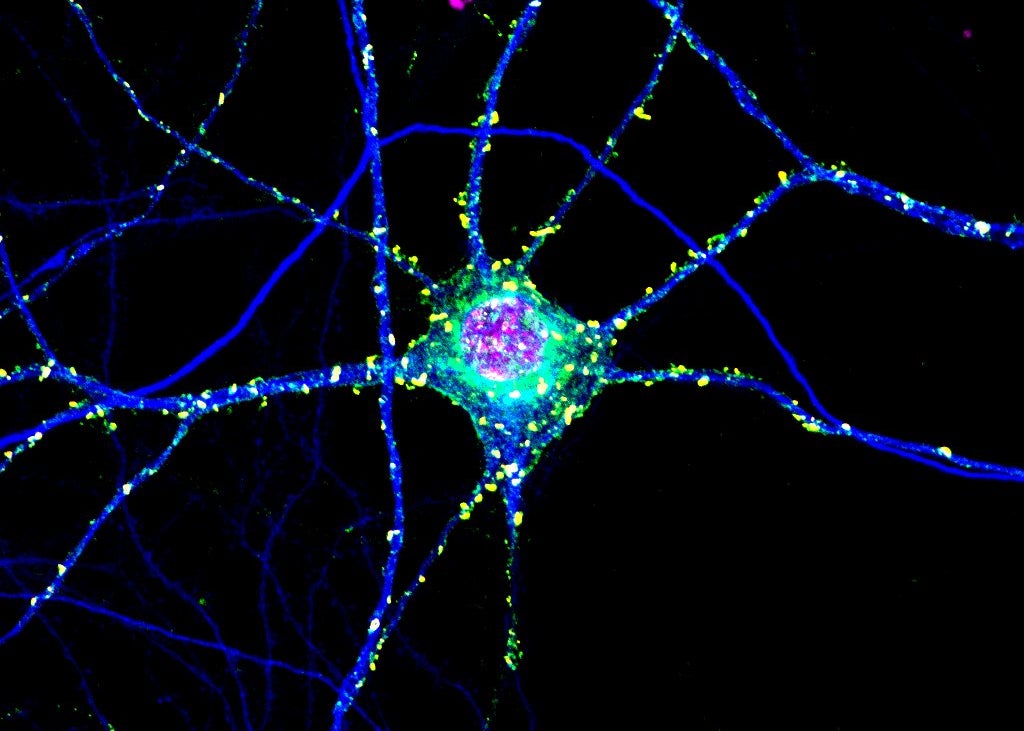
At Hebrew University of Jerusalem, researchers have upended a three-decade assumption about Huntington's disease: the toxic protein clumps long blamed for destroying neurons may actually be protecting them.
For nearly 30 years, neuroscience has operated on a simple, tragic logic. A genetic mutation causes neurons to produce misfolded huntingtin proteins. These proteins clump together into structures called inclusion bodies. The clumps overwhelm brain cells, eroding the ability to learn, remember, and make decisions. It's been doctrine. Yet decades of drugs designed to dissolve these clumps have largely failed. Scientists are now asking: What if the story is incomplete?
The new work suggests inclusion bodies function as a neuron's first line of defense against damage. The proteins are sequestered—quarantined—inside these bubble-like hubs, separating them from the rest of the cell. When researchers disrupted the formation of inclusion bodies using CRISPR-Cas9 gene editing in cultured cells from patients with severe Huntington's disease, something counterintuitive happened. The cells became more vulnerable to stress commonly seen in neurodegenerative diseases.
The protection works through a dual mechanism. Physical separation of toxic proteins is only part of the story. Inclusion bodies also rewrite the activity of genes involved in neuroinflammation, even without immune cells present. The researchers identified a "master regulator" gene called ATF3 that orchestrates immune responses. When they removed ATF3, the protective effects of inclusion bodies disappeared in cultured cells.
The patients whose cells were studied carried over 180 CAG repeats—the toxic DNA sequences that drive Huntington's disease. Normally, everyone carries this triplet sequence in their huntingtin gene. But more than 39 repeats produces longer, malformed proteins that cluster and become sticky. Severe cases feature over 100 repeats, transforming what should be freely moving protein workers into dysfunctional sludge.
Eran Meshorer, a study author, captured the significance plainly: "Our results reveal that these structures are not merely byproducts of disease, but a central factor in the cell's ability to mount a protective response against stress."
This finding doesn't mean inclusion bodies are good. They may be a double-edged sword—protective early in disease progression but harmful later. The study remains limited to cells in a petri dish, not living brains. Yet the implications ripple outward. Huntington's is purely genetic, caused by a single inherited mutation. But the revelation that protein clumps may have a defensive function could reshape thinking about other neurodegenerative diseases where inclusion bodies appear: Parkinson's disease, ALS, and Alzheimer's disease, where amyloid and tau clumps accumulate despite decades of drug development efforts.
Understanding inclusion bodies as complex rather than simple villains opens new strategic possibilities. Instead of immediately targeting clump formation, treatments might enhance the protective mechanisms while minimizing later damage. The path forward likely requires moving beyond the binary thinking that has defined this field—not seeking to eliminate protein aggregates entirely, but to understand and work with the brain's own protective responses before damage spirals beyond repair.