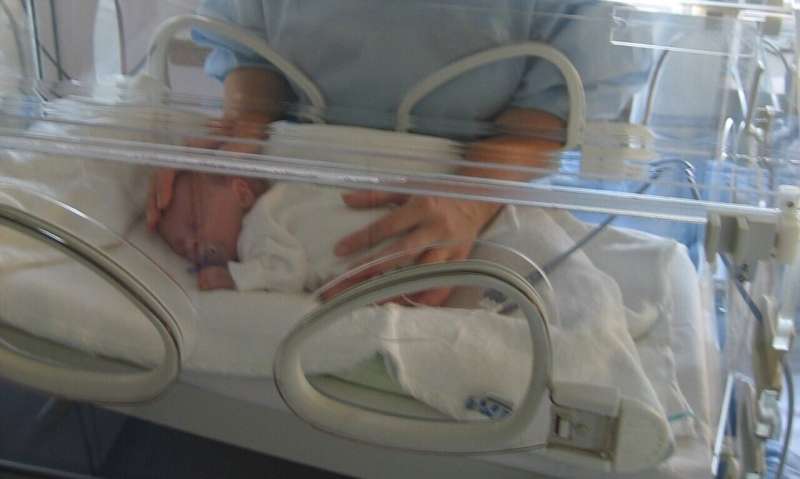
A bacterium so shielded by its own armor that conventional defenses can't touch it is now facing a three-part counterattack from Swiss researchers who found an elegant way to turn the pathogen's survival instincts against itself. Researchers at ETH Zurich and the University of Basel have developed a triple-therapy approach to prevent newborn meningitis caused by E. coli K1—combining oral vaccination, competing microbes, and bacteriophages in a strategy that circumvents the need for antibiotics and could protect vulnerable infants before infection even begins.
Newborn meningitis remains one of the most devastating childhood infections, often life-threatening and capable of leaving survivors with serious, lasting damage including developmental problems. Though rare overall in newborns, the disease strikes with brutal frequency in premature infants, affecting one in every 500 such babies in industrialized economies. In developing countries, the burden is likely far greater. One of the primary culprits is the K1 form of E. coli bacterium, which dwells harmlessly in the intestinal flora of one in three healthy adults—a silent cohabitant kept in check by competing bacteria and a functioning immune system.
The danger emerges during birth. If an expectant mother carries pathogenic E. coli K1, she can transmit it to her child during delivery. In premature babies whose immune systems are still underdeveloped, the bacterium can breach the intestinal barrier, slip into the bloodstream, cross into the brain, and trigger the severe inflammation that defines meningitis. Rather than treating infection after it occurs, researchers led by Emma Slack, Professor of Mucosal Immunology at ETH Zurich, and Médéric Diard, Professor of Infection Biology at the University of Basel's Biozentrum, set out to eliminate the pathogen in pregnant women before transmission could happen.
The K1 strain proved a formidable opponent. A year earlier, Slack and Diard had successfully developed a two-component therapy against other pathogens: oral vaccination to weaken the bacterium, followed by harmless competing microbes that starve it out and supersede it. This approach worked in mice against certain salmonellas and E. coli strains. But K1 E. coli wears a slippery protective coating that repels the antibodies generated by oral vaccination, rendering the two-pronged approach ineffective.
So the researchers added a third weapon: bacteriophages, viruses that specifically infect and kill bacteria. Here's where their ingenuity shines. When phages attack by docking to the bacterial protective layer, the bacteria respond with rapid evolutionary adaptation—shedding that very coating in fewer than 24 hours to evade the viral threat. "This is essentially a resistance mechanism that the bacteria deploy against the phages," Slack explains. "We use this mechanism to our advantage: the antibodies formed by the oral vaccination are effective against K1 bacteria that no longer have their protective coating."
The researchers sourced their most effective phage strains from an unlikely place: waste water samples from the treatment plant serving the Lucerne conurbation in Switzerland. From these samples, they successfully isolated several phages particularly effective at attacking E. coli K1. In experiments with pregnant mice previously infected with the pathogenic strain, the triple therapy proved remarkably successful, protecting most young animals from infection.
The work, published in Nature Communications, offers a potential pathway to preventing one of the cruelest infections of early life—not through antibiotics that fuel resistance, but through a strategy that exploits the bacteria's own survival mechanisms to leave it defenseless.