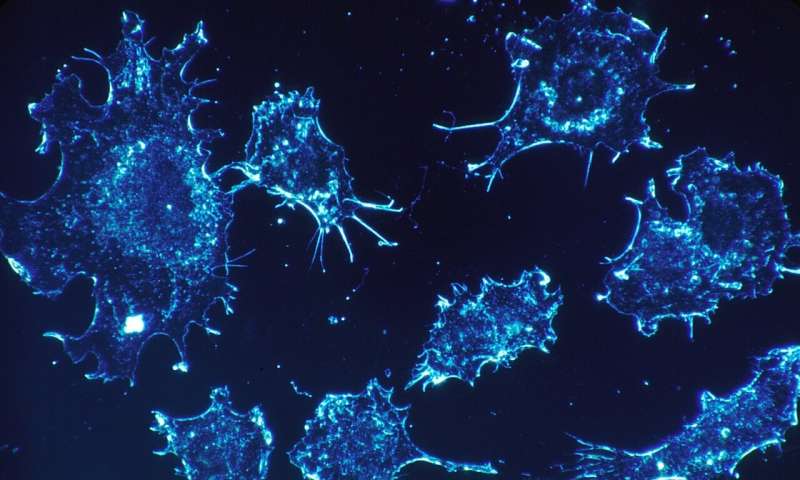
When René Jackstadt and his team at the German Cancer Research Center in Heidelberg started looking at colorectal cancer cells under the microscope, they noticed something unexpected: a protein called TROP2 seemed to light up the most dangerous cells — the ones that spread to other organs and come back after treatment.
Colorectal cancer is one of the most common and deadly cancers worldwide. When the disease spreads beyond the colon, survival rates drop sharply. Part of the problem is that cancer cells are remarkably adaptable. They can change their behavior during treatment, making them harder to kill — a trick scientists call cellular plasticity.
But Jackstadt's team, working with researchers from the HI-STEM Stem Cell Institute, may have found a way to identify and target these sneaky cells. Their study, published in the journal Nature, shows that TROP2 acts like a flag marking the most aggressive colorectal cancer cells — the ones most likely to spread and cause the cancer to return.
"TROP2 specifically marks the colorectal cancer cells that contribute most strongly to metastasis, disease recurrence, and poor prognosis," Jackstadt said.
The researchers analyzed genetic data from thousands of patients and found that tumors with high TROP2 levels were far more likely to spread. In lab experiments, these TROP2-positive cells acted like cancer stem cells, capable of starting new tumors elsewhere in the body.
Here is the hopeful part: drugs that target TROP2 already exist. They have been approved for treating breast cancer. These medications are antibody-drug conjugates — essentially guided missiles that deliver cancer-killing chemicals directly to cells wearing the TROP2 flag.
Jackstadt's team tested these existing drugs on miniature tumors grown in the lab from actual patient cells. The results were striking. Tumors with high TROP2 responded strongly to the treatment. In mice with human tumors, the therapy specifically eliminated the dangerous TROP2-positive cells and significantly extended survival.
The researchers went further. They discovered that standard chemotherapy actually increases the number of TROP2-positive cells — which seemed like bad news at first. But they turned this into an opportunity: if chemotherapy creates more targets, why not combine it with the TROP2-targeting drug?
The combination approach worked even better than either treatment alone. In both lab-grown organoids and mouse models, the two-pronged attack reduced tumor growth and metastasis far more effectively than either therapy by itself.
The team sees TROP2 as both a warning signal and a weakness that can be exploited. Doctors could use it to identify the most aggressive tumors early, and patients could potentially benefit from treatments already sitting on pharmacy shelves.