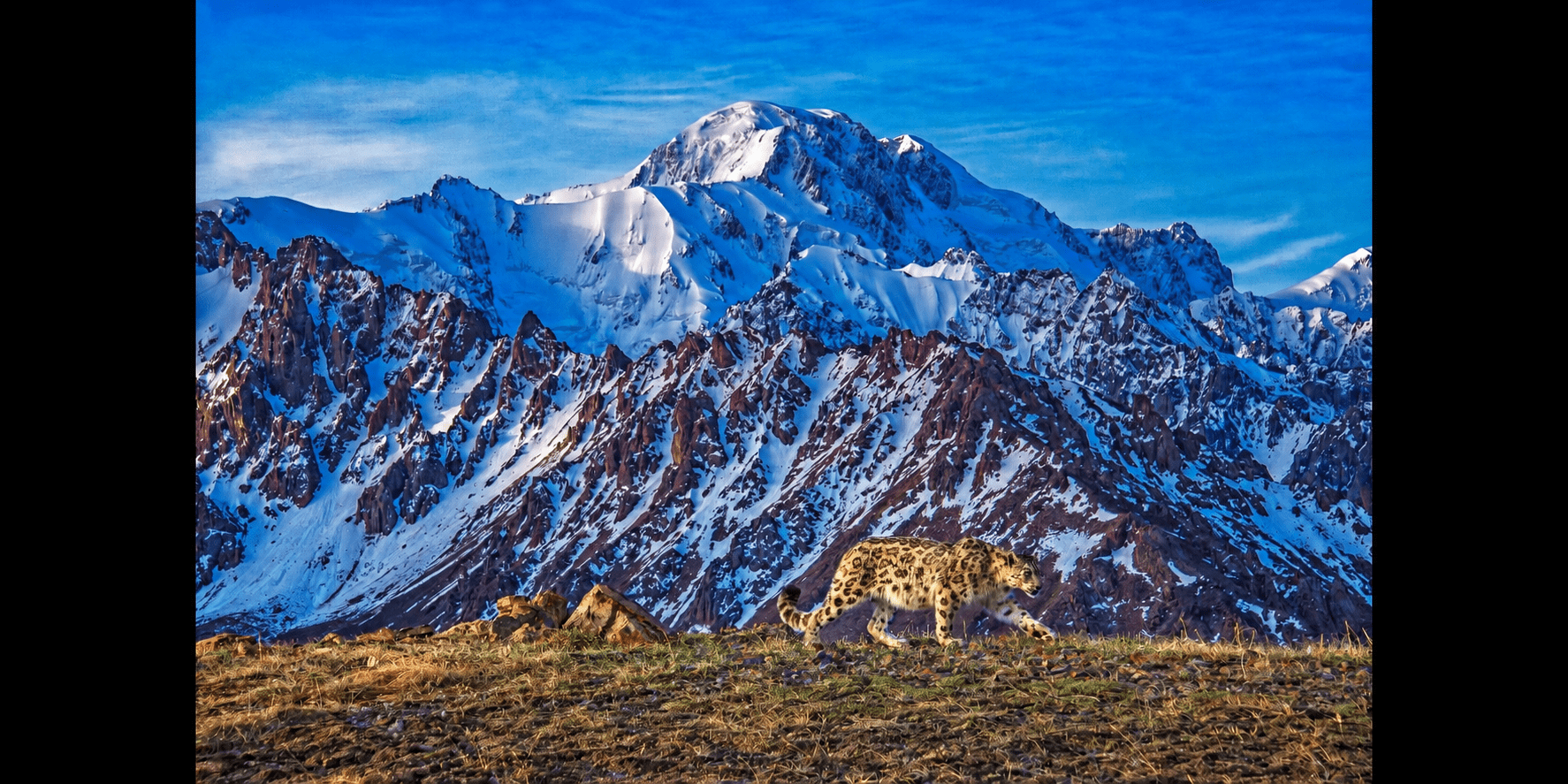
As the Global Environment Facility Assembly convenes in Samarkand, Central Asia is demonstrating a quiet revolution: glaciers, deserts, and river basins know no borders, and neither do the solutions to protect them. From the Tien Shan to the Pamir mountains, from the Ustyurt Plateau to temperate deserts below, the region's ecosystems are deeply woven together across Kazakhstan, Uzbekistan, Turkmenistan, and beyond — and the nations sharing these landscapes are learning to protect them together.
The snow leopard, that silent guardian of Central Asia's heights, tells the story of what is possible. In Kazakhstan alone, the species nearly vanished: by the mid-1990s, fewer than 100 snow leopards remained, their mountain habitats fragmented by land degradation, unsustainable grazing, and climate pressure. Today, after a decade of coordinated conservation — digital monitoring systems, genetic banks, behavioral studies, and the creation of the Merke Regional Nature Park in 2026 — the population has climbed to an estimated 152–189 animals. Around 70 percent of the snow leopard's range in Kazakhstan now sits within protected areas, a remarkable shift driven by governments, UNDP, the Global Environment Facility, and scientists working across borders.
But the snow leopard represents something far larger than one species. Its recovery reflects the health of entire mountain ecosystems that supply freshwater, regulate water systems for agriculture and energy, sustain pastures, and build resilience against climate change for millions of people downstream. Rivers flow between countries. Wildlife migrates through shared landscapes. A healthy Tien Shan benefits communities in Kazakhstan, China, Kyrgyzstan, Russia, and Uzbekistan alike.
The pressures, however, are relentless. Climate change is accelerating glacier melt and intensifying water stress across the region. Land degradation, habitat fragmentation, and biodiversity loss are mounting. Rural communities living closest to these ecosystems — often the first to feel the consequences — face declining water availability, degraded pastures, and increasing climate-related risks. These challenges do not pause at borders, and neither do their solutions.
Perhaps the most compelling example of what coordinated regional action looks like is the transboundary nature conservation agreement protecting the Ustyurt Plateau and Turan Temperate Deserts across Kazakhstan, Uzbekistan, and Turkmenistan. This initiative has successfully safeguarded vulnerable ecosystems and migratory species, including the saiga antelope alongside the snow leopard. It proves that when governments commit to protecting ecological corridors and strengthening transboundary protected areas, when they improve water and land governance and invest in climate-resilient livelihoods for communities tied to nature, conservation and development can advance together.
The lesson emerging from Central Asia is stark and hopeful in equal measure: nature and people both thrive when communities benefit from healthy ecosystems. As the region gathers in Samarkand, the snow leopard's return from near extinction stands as evidence that long-term regional cooperation, scientific collaboration, and shared responsibility for interconnected landscapes work. The question now is whether this moment becomes a turning point — whether Central Asia's coordinated approach to saving snow leopards and saiga antelopes, to protecting glaciers and river systems, becomes the model for how nations everywhere protect the ecosystems that sustain us all.