On November 17, 1991, in the city of Panyu, China, Carin Jennings stepped onto the field for the United States women's soccer team and scored the first two goals of her nation's World Cup history—a debut so luminous it set the tone for three decades of dominance that would reshape women's sports globally.
The United States women's national soccer team is the most successful team in FIFA Women's World Cup history, a distinction earned through a combination of tactical brilliance, institutional investment, and a culture that has consistently produced world-class players. Since that inaugural tournament in China, the team has won four World Cup titles, finished as runners-up once, and claimed third place three times—a record unmatched by any other nation competing in the event.
That opening victory against Sweden, 3–2, launched a tournament where the Americans moved with near-perfect efficiency. Michelle Akers, who would finish as the tournament's top scorer with 10 goals, delivered the championship-clinching performance in the final against Norway, scoring the decisive goals in a 2–1 victory. Akers's performance crystallized what would become a hallmark of U.S. excellence: the ability to produce clinical finishing when stakes are highest. Carin Jennings was awarded the Golden Ball as the tournament's best player, recognition of a team that seemed to operate on a different plane from its competitors.
The scope of that early dominance cannot be overstated. In qualification matches leading to the 1991 tournament, held in Port-au-Prince, Haiti, the Americans scored 34 goals while conceding none—a statistical expression of overwhelming superiority. They went on to score 34 additional goals across the World Cup itself, averaging more than five goals per match. The team's trajectory was not linear perfection; they suffered their first World Cup loss in 1995 to Norway in the semifinals, finishing third that year. But losses only seemed to sharpen their focus.
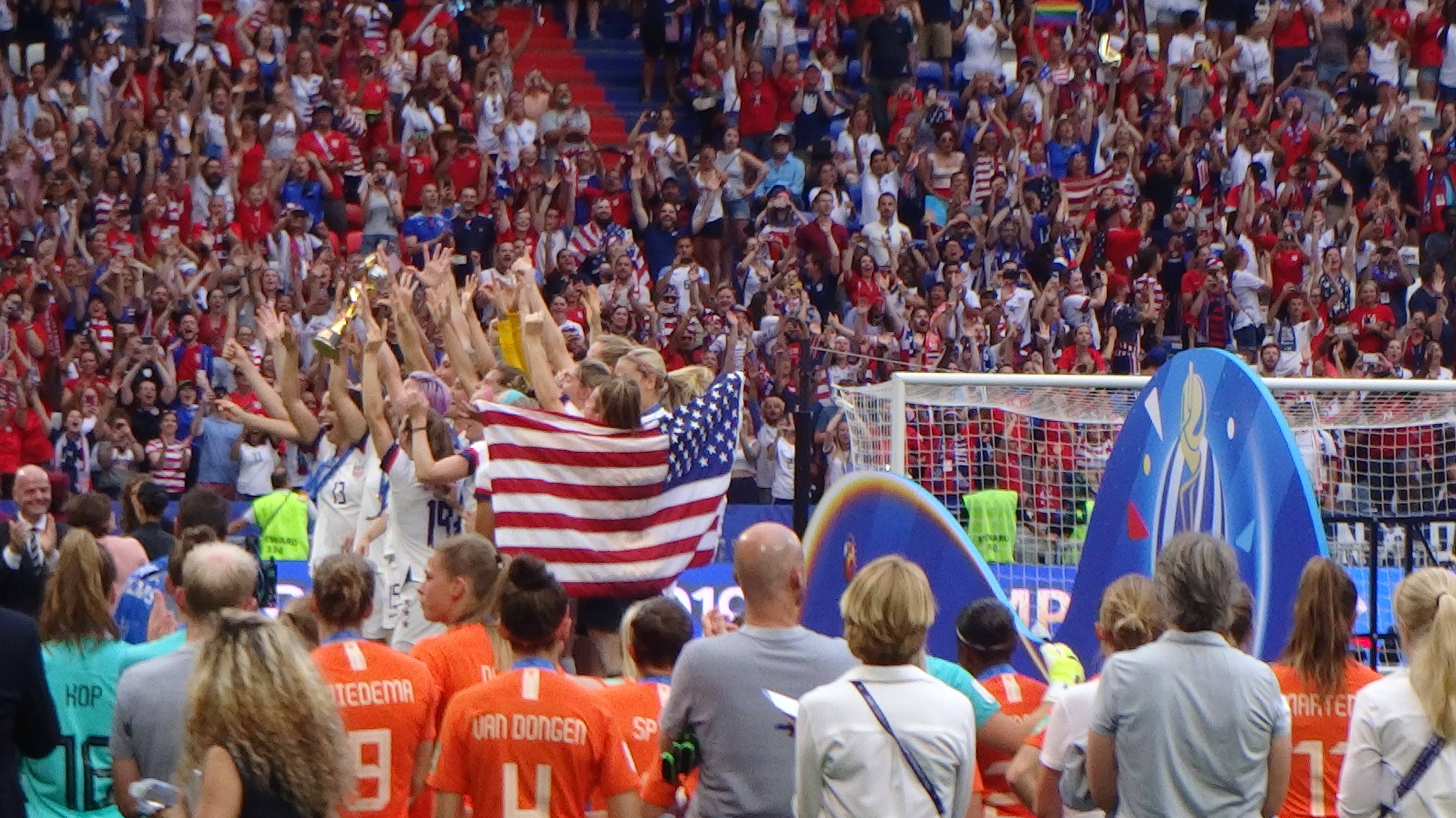
The United States lifted their fourth championship trophy in 2019 in France, joining only Germany, Japan, Norway, and Spain as the five nations ever to win a FIFA Women's World Cup. The team won in China in 1991, in the United States in 1999, in Canada in 2015, and in France in 2019—each victory a different landscape, each one a demonstration of sustained excellence across generations of players. Remarkably, until their elimination by Sweden in the 2023 round of 16, the United States was the only team that had played the maximum number of matches possible in every single World Cup tournament in which they competed—a feat of consistency that speaks to both their competitive strength and their institutional staying power.
What makes the American achievement particularly significant is its context within women's sports history. These victories were not won in a sport that had long occupied the cultural mainstream or received the financial backing that men's soccer enjoyed. The team's dominance was built on a foundation of determination and vision, creating a template that inspired investment in women's athletics across countless disciplines. The 2019 victory, secured in France more than a quarter-century after that first triumph in China, represents not merely sporting success but proof that excellence in women's sport, when properly supported, can be sustained and deepened across generations.