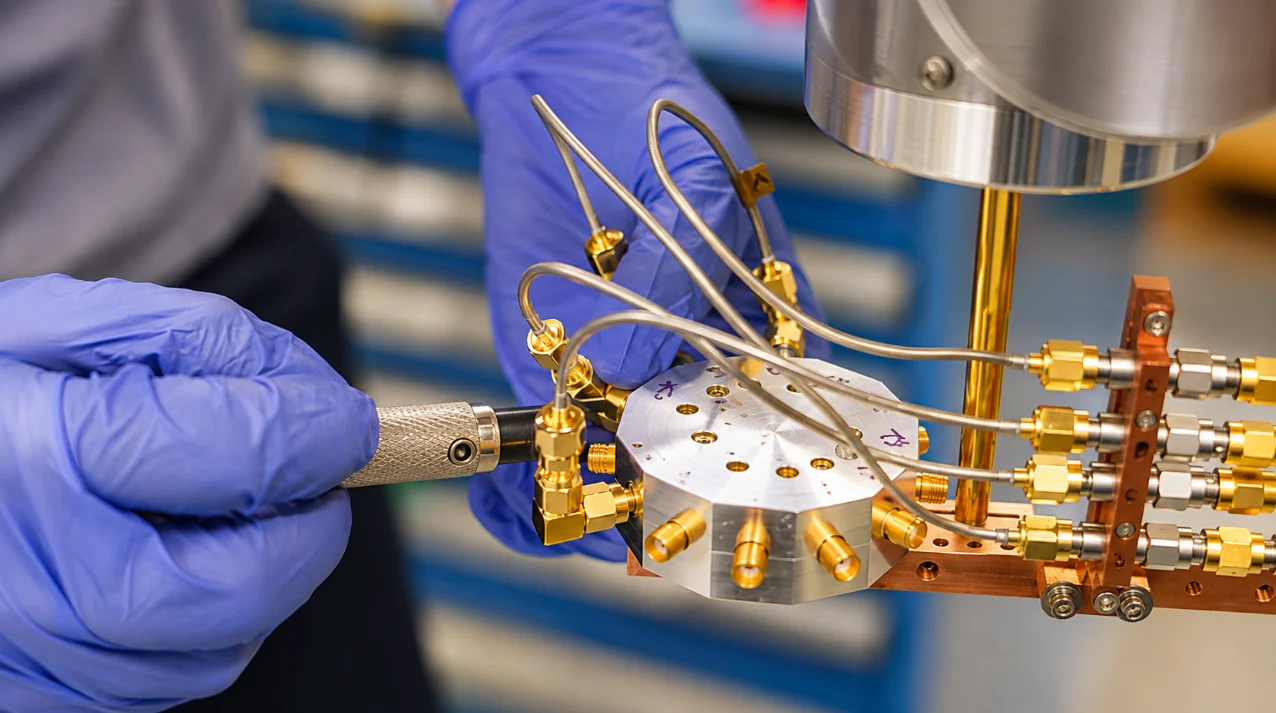
Two new research labs at Tohoku University in Sendai will give Japanese and American scientists a shared place to move quantum ideas from materials research toward working devices. The University of Chicago and Tohoku have launched a five-year partnership to deepen research, train students and build links between their quantum communities.
Quantum technology could lead to new kinds of computers and other devices, but progress depends on many fields working together. The agreement joins the University of Chicago’s strengths in fundamental quantum science and engineering with Tohoku’s experience in materials science and device engineering. The institutions say researchers will work across the development process, from finding promising materials to making and testing quantum devices.
The partnership is between Tohoku’s Research Institute of Electrical Communication and the University of Chicago’s Pritzker School of Molecular Engineering. It will open two dedicated laboratory spaces at Tohoku for joint research. Tohoku will also provide annual funding for collaborative projects, while faculty and students are expected to have opportunities to study and conduct research at the partner institution.
Researchers will be able to use Tohoku facilities including NanoTerasu, an accelerator that produces very bright X-rays. These X-rays can help scientists examine the structure and electronic behavior of materials. That work may help teams decide which materials are useful for future quantum devices.
The partnership also puts people at its center. David Awschalom, a University of Chicago professor of molecular engineering and physics and founding director of the Chicago Quantum Exchange, and Giulia Galli, a professor of electronic structure and simulations, have been named distinguished visiting professors at Tohoku’s International Research Excellence unit. They will mentor graduate students and postdoctoral researchers affiliated with Tohoku, hold joint workshops and look for further research opportunities. The program is designed to prepare students in both the United States and Japan for careers in a fast-growing field.
“Quantum is a global field, and the talent pipeline has to be global too,” Awschalom said. He described the partnership as a way to connect Tohoku’s work in materials and device engineering with Chicago’s quantum science expertise. Galli said bringing together researchers from different disciplines could open paths that might not emerge within one field alone.
The universities also plan to support quantum entrepreneurship through startup incubation and public-private partnerships. One proposal is an incubator modeled on UChicago’s Duality accelerator. The source describes this as a plan, rather than a launched program.
The agreement builds on a relationship between the institutions that has lasted more than three decades. In 2023, they formed the Chicago-Tohoku Quantum Alliance. The new five-year effort is part of Tohoku’s University for International Research Excellence designation, which receives funding from Japan’s government. With laboratories, exchanges and training planned under one partnership, the universities aim to connect fundamental research with the people and tools needed to develop the next generation of quantum technology.