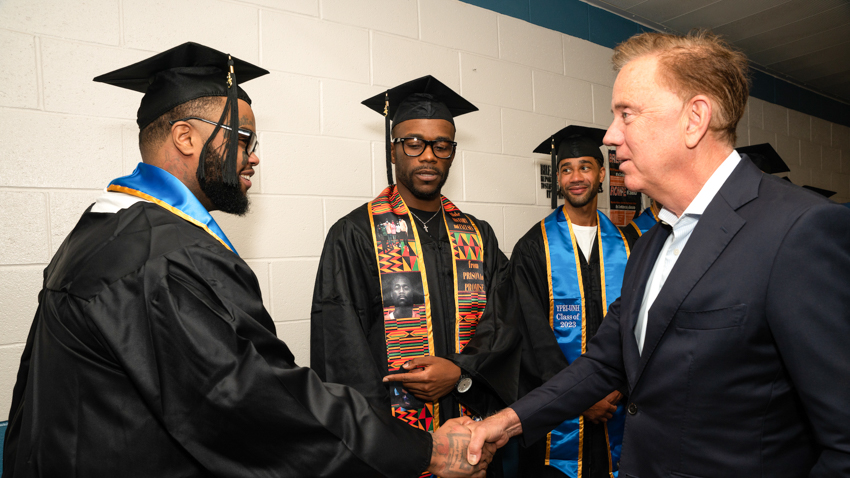
On a crisp spring morning in 2023, graduates in bright blue caps and gowns shook hands with Connecticut Governor Ned Lamont inside the walls of MacDougall-Walker Correctional Institution — a moment that marked the first time an Associate of Arts degree was awarded within a state prison. These graduates were part of a growing movement led by the University of New Haven and the Yale Prison Education Initiative (YPEI), a partnership transforming lives through college education behind bars.
Founded in 2021 by Dr. Zelda Roland, the program began with four college courses a year. Today, it offers more than 40, thanks to a new $1.2 million, three-year grant from the Mellon Foundation. This funding renews and expands a collaboration that has already delivered over 500 course enrollments to 70 incarcerated students across two facilities — including the Federal Correctional Institution in Danbury, where the program reached incarcerated women for the first time in 2022.
The classroom offerings have grown as fast as the student body. What started with basic liberal arts now includes full-year chemistry sequences, poetry workshops, and graphic design courses — subjects chosen not just for their academic value, but for their power to awaken curiosity and identity. "We knew the incredible need for liberal arts college programs," Dr. Roland said, "because the students were so successful in these classes, we saw right away that their potential was unmet."
That success became undeniable in 2024, when the program awarded its first Bachelor of Arts degrees — another first in Connecticut correctional history. But the support doesn’t end at release. YPEI runs a fellowship program for alumni, offering full-time salaries and professional development at either Yale or the University of New Haven, helping formerly incarcerated graduates rebuild their lives with dignity and purpose.
"Both of our recent graduations were transformative and special moments for all of us," Dr. Roland reflected. The numbers tell part of the story: 70 students served, over 500 enrollments, two prisons, one bold vision. But the real measure is in the changed trajectories — in the chemist studying behind bars, the poet finding her voice, the designer building a future.
As the program looks ahead, its leaders hope to reach even more students, especially those preparing to return to their communities. Education, they believe, isn’t just about degrees — it’s about opening doors that society once sealed shut.