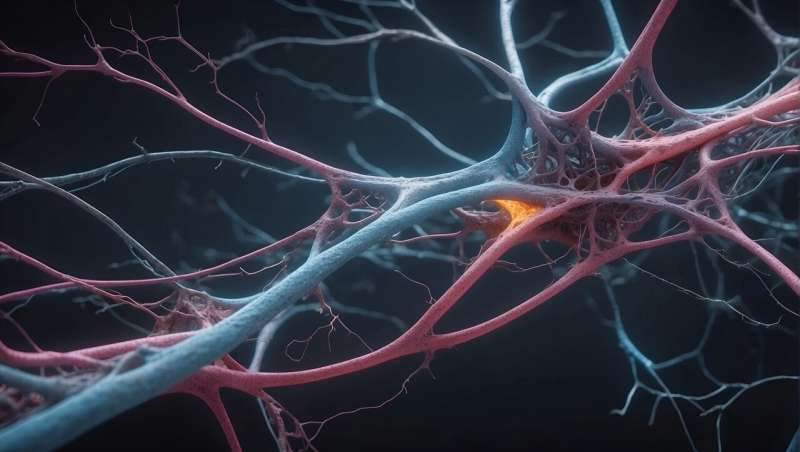
Which scientific paper attracted so much early interest that more than 11,000 researchers downloaded preliminary copies before it was even officially published? The answer is a study from Columbia University's Zuckerman Institute that answers one of neuroscience's oldest questions: are individual brain cells specialists, each doing one exact job, or are they generalists, capable of handling many tasks at once?
For decades, scientists have debated whether each neuron works like a dedicated tool — a hammer for one purpose, a saw for another — or more like a Swiss Army knife, ready for whatever the brain needs. Researchers Stefano Fusi and Lorenzo Posani led a team that finally gathered enough evidence to settle the argument.
To do this, they analyzed recordings from an enormous dataset: brain activity from 43 different regions across the cortex of mice, collected by the International Brain Laboratory consortium. The key was studying all these regions at once while the mice performed the same task. Earlier studies had looked at different animals, different brain areas, or different activities — which is why researchers kept getting mixed results.
What they found surprised them. While neurons in primary sensory areas — including the region that handles vision — did behave in specialized ways, most neurons elsewhere showed a much wider range of responses. In other words, the brain's cells are mostly generalists, not specialists.
"We're not saying that there are no specialized neurons," Fusi said. "We're saying they are the exceptions. They're not the rule."
Co-lead author Lorenzo Posani, who is now at the Paris Brain Institute in France, offered an analogy from an unexpected place: elections. "There are clear clusters where people generally vote the same way," he said. "But when you zoom in, you see mixes of opinions." The brain works similarly — modules exist, but individual neurons within them are far more flexible than previously thought.
Even more remarkable, each generalist neuron seems to be versatile in its own unique way, rarely duplicating another cell's behavior. Co-lead author Shuqi Wang, a doctoral student at EPFL in Switzerland, explained that this diversity helps give the brain its remarkable flexibility and computing power.
Why does this matter? Understanding how neurons truly work could help scientists figure out what goes wrong in brain disorders and how to fix them. If most cells are adaptable generalists, perhaps there are more ways to help the brain recover from injury or disease than researchers once assumed.
The findings appeared in the journal Nature, where they quickly became one of the most-downloaded preprints in the journal's history — suggesting the scientific community was eager for an answer to this long-running debate.