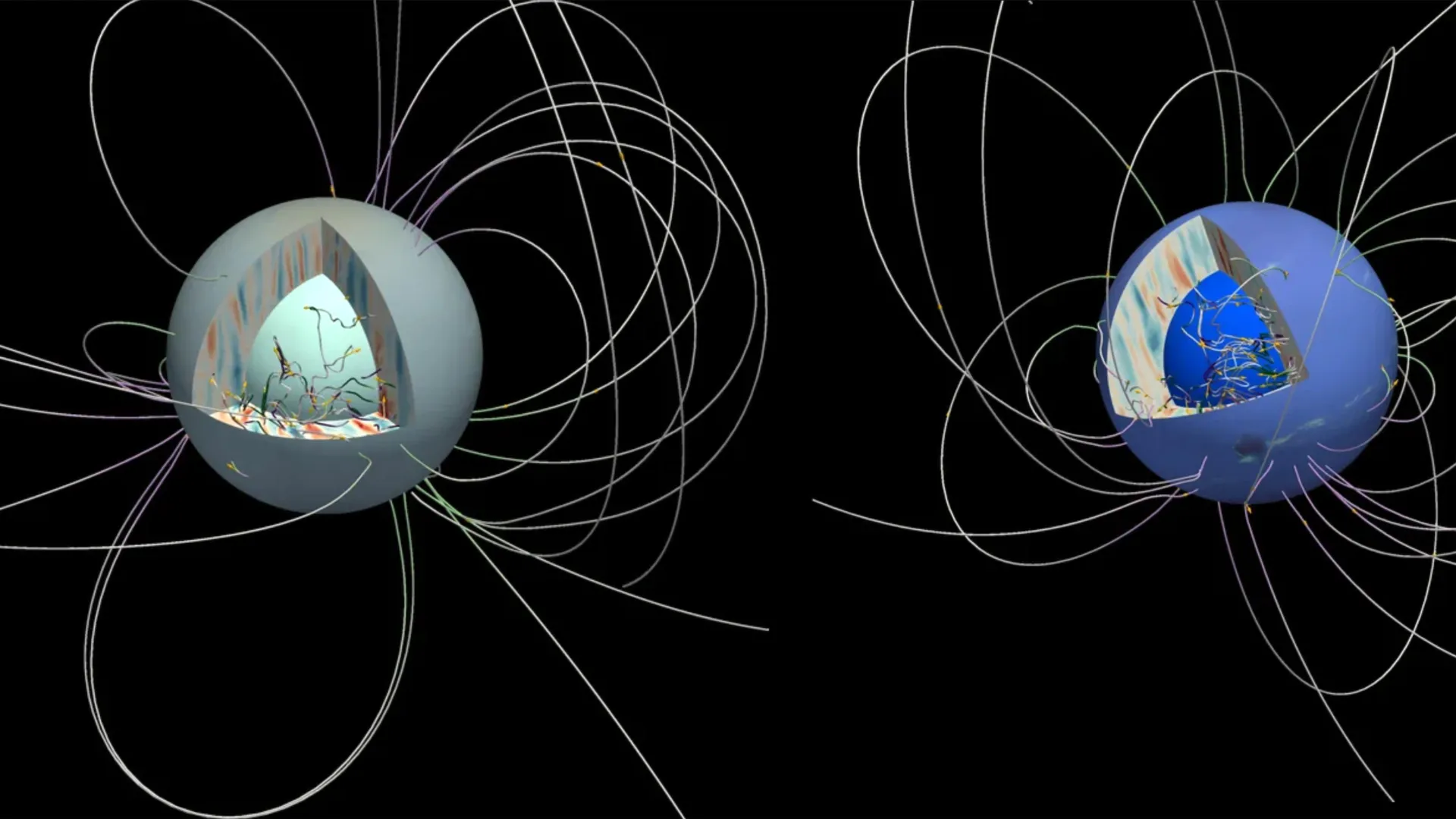
When Voyager 2 swept past Uranus and Neptune in the 1980s, it found magnetic fields that looked nothing like Earth’s neat, bar-magnet pattern. Uranus’s magnetic axis was tilted 59 degrees, and Neptune’s was tilted 47 degrees. A new study suggests that changing electrical properties deep inside the planets could help explain the puzzle—and that their magnetic fields may shift far faster than Earth’s.
Magnetic fields are made by moving material that conducts electricity. On Earth, circulating liquid iron in the outer core creates a field whose main axis leans just 11 degrees from the planet’s rotation axis. Uranus and Neptune are each about four times wider than Earth, but their insides are very different and still not fully understood. These “ice giants” are thought to contain hydrogen, helium, water, ammonia, methane and rocky material; the name describes their likely ingredients, not worlds covered in ordinary ice.
The study, published in Communications Physics, was led by Chi Yan, a research associate at the University of Texas at Austin’s Jackson School of Geosciences. Researchers from the University of California, Los Angeles, Imperial College London and Northumbria University also took part. Yan and colleagues explored whether conditions inside the planets could make their materials better at carrying electricity deeper down.
At great depths, pressure and heat may break water molecules into charged particles called ions. Those particles can carry electric current. If electrical conductivity rises with depth, the change could affect how moving fluids generate magnetic forces. The team built computer simulations using this idea, testing different possible interior structures and how fluid motion, temperature and magnetism might interact. Their models produced magnetic fields resembling the unusual ones Voyager 2 measured.
The simulations also point to a striking difference from Earth: the ice giants’ magnetic fields may not stay put. In some model runs, a planet’s magnetic tilt changed by tens of degrees over a few decades. In other periods, the change was small. Yan noted that Earth’s magnetic tilt moves only about a degree over 50 years. If the models are right, Uranus and Neptune’s fields today could differ greatly from those recorded during Voyager 2’s flybys.
That possibility is not yet a confirmed observation. It is a prediction from computer models, and scientists need evidence from the planets themselves. Researchers are examining detailed infrared images of Uranus and Neptune taken by the James Webb Space Telescope, focusing on their auroras. These glowing displays form when charged particles from the Sun interact with gases in a planet’s atmosphere, and their patterns may offer clues about magnetic activity.
The work gives scientists a new way to connect the chemistry of distant planets with the magnetic fields measured around them. Webb’s images may help test whether those fields have changed since Voyager’s brief visits, while future observations can sharpen the picture of what lies beneath the clouds. For now, the models suggest that the strange fields of Uranus and Neptune may be not only tilted, but also in motion.