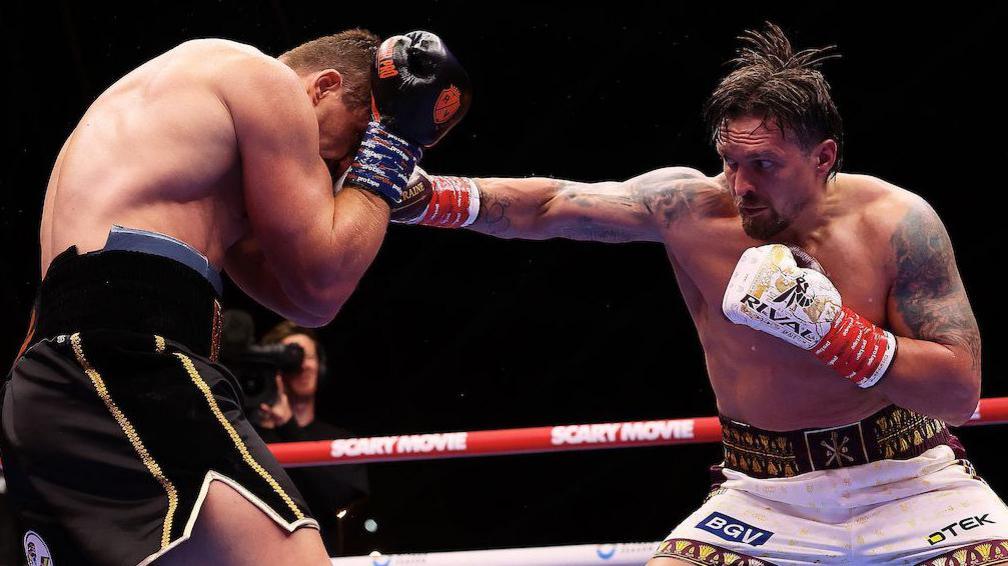
Under the ancient shadow of Egypt's Pyramids of Giza, Oleksandr Usyk faced the unlikeliest heavyweight challenge of his career when kickboxing legend Rico Verhoeven stepped into a purpose-built open-air arena at 01:10 local time, flanked by pharaoh-costumed performers, to contest the Ukrainian's world titles. The scene was pure spectacle—Usyk emerged in a gladiator costume complete with golden helmet—but what unfolded inside the ropes proved that Verhoeven, who had dominated kickboxing for more than 4,000 days, was far more than an exhibition novelty.
Boxing's crossover moment felt both theatrical and genuine. Hollywood star Jason Statham, credited with helping broker the fight, watched alongside boxing royalty: Canelo Alvarez, Terence Crawford, Gennady Golovkin, and Anthony Joshua. Yet for all the celebrity ringside, this was a legitimate bout where Usyk, so often the sport's patient master tactician, found himself forced to dig deep in ways he rarely has before.
Verhoeven entered the sixth round for the first time in his fighting career—a watershed moment for any crossover athlete. Kickboxing fights cap at five rounds, and his sole previous professional boxing match had ended inside two. He moved with constant energy and unpredictability, landing a solid right hand to the body early and following up with flush right hands in the third round. When Usyk hurt Verhoeven with a straight right and stinging left in the fourth, the kickboxing champion's trainer Peter Fury urged caution: "Get back to your boxing, you're getting too greedy, trying to land and getting caught."
The bout itself embodied a familiar crossover narrative—one that seemed to border on absurd as a sanctioned world title contest before Verhoeven proved the skeptics wrong. Francis Ngannou had come close to an extraordinary upset against Tyson Fury in 2023 before being stopped early by Anthony Joshua in his second professional fight. Verhoeven's performance suggested he understood the boxing lessons faster than most crossover athletes, earning himself "huge credit" as an awkward, physical operator.
Yet questions linger about whether Verhoeven's best chance has already passed—whether the element of surprise, now stripped away, will diminish any future rematch. Usyk's stock, for the first time in his career, took a hit. The controversial nature of the stoppage and the debate around what comes next are only likely to intensify.
WBC mandatory challenger Agit Kabayel wasted no time making his case, entering the ring post-fight to call for a bout in a German stadium. Usyk, who has previously suggested he may have two more fights after Verhoeven, agreed without hesitation. Whatever the future holds, Usyk emerged from perhaps the most unusual night of his career having endured the toughest test from a man few in boxing had given a realistic chance. The Pyramids of Giza had witnessed not just spectacle, but genuine sporting drama.