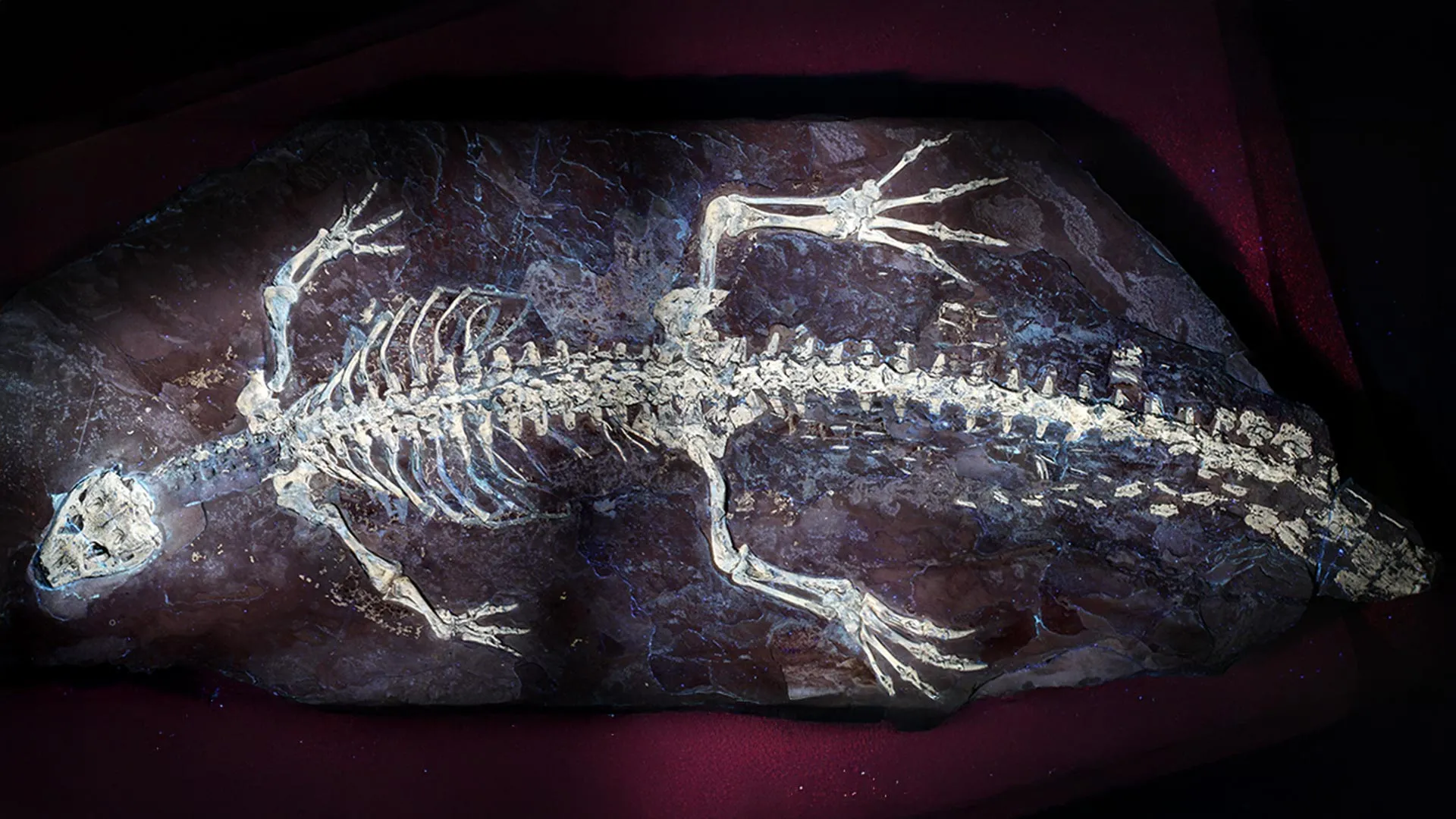
Shine a strong light on a 125-million-year-old rock in a dark room, and a tiny ancient crocodile suddenly shows you secrets it has kept hidden for eons. That is exactly what happened to paleontologists Oscar Castillo and Jesús Serrano in Spain, when they aimed ultraviolet light at a fossil called Montsecosuchus depereti and watched its long-buried soft tissues glow into view.
This small crocodile relative, only about 50 centimeters long, died roughly 125 million years ago in a karstic lake near the coast of what is now the Catalan Pre-Pyrenees. Its body sank into fine lake mud that later hardened into the famous lithographic limestones of Pedrera de Meià, in the province of Lleida. That site is now part of the UNESCO Orígens Global Geopark. The fossil, cataloged as MGB-512, has been kept at the Museum of Natural Sciences of Barcelona and was known to science for more than a century — but its soft tissues had stayed invisible since the day it was discovered.
The breakthrough came when Castillo and Serrano, who were building a database of Montsec fossils held in Catalan and European museums, examined the specimen under ultraviolet light. UV light makes fossilized tissues and the surrounding rock respond differently, causing hidden structures to stand out. "UV light allows us to see details that would otherwise remain completely hidden in the rock," explains Oscar Castillo-Visa, the study's first author, published in the Zoological Journal of the Linnean Society and led by the Institut Català de Paleontologia Miquel Crusafont.
The new images revealed the first detailed picture of the animal's skin, including epidermal scales that varied in shape and size across the body. The fossil may also preserve possible sensory organs in small scales near the neck, limbs, and the edges of the trunk and tail. Living crocodiles use similar organs to sense touch, water pressure, temperature, and chemicals — so this pattern hints that such sensors first evolved in localized spots before spreading over the skin in later relatives.
The ultraviolet scan also exposed cartilaginous structures in the chest, showing that Montsecosuchus already had a sophisticated breathing system resembling that of modern crocodiles. "These traits indicate that, despite being a primitive animal, it was already very well adapted to a semi-aquatic lifestyle," Castillo-Visa concludes.
But the most striking find is on the tail. Some scales there show alternating light and dark bands under UV light — possible evidence of the animal's original color pattern. That banding may have been disruptive camouflage, breaking up the crocodile's outline so it blended into its surroundings. If confirmed, Montsecosuchus would become the oldest known crocodylomorph with preserved evidence of coloration. Scientists can't yet say the exact colors, but co-author Albert G. Sellés notes they probably weren't far from what today's crocodiles show.
The work offers vivid new clues about how crocodylomorph skin, breathing, and body design evolved — all thanks to a clever trick of light.