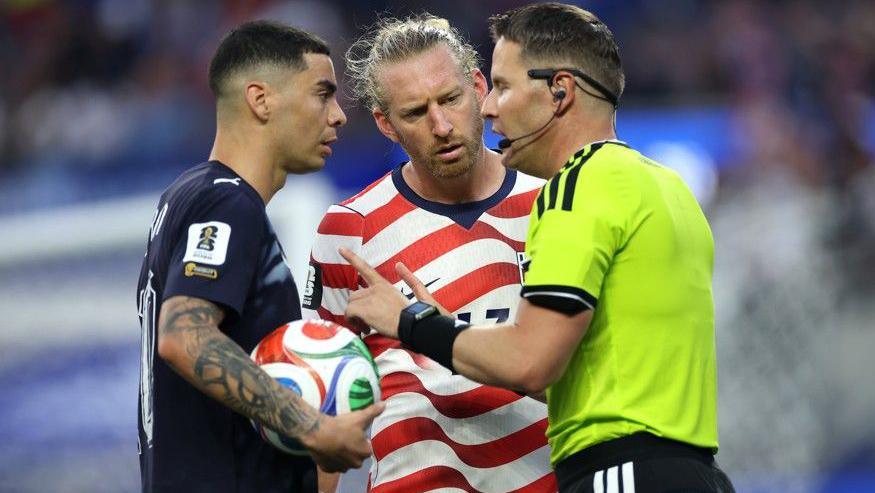
At SoFi Stadium in Inglewood, the United States opened their World Cup campaign with a commanding 4–1 victory over Paraguay — but the match will be remembered less for the scoreline than for an unprecedented moment that left fans and commentators bewildered in equal measure. In the 38th-year-old veteran defender Tim Ream, the Americans found themselves at the center of World Cup history, not for a mistake on the field, but for an intervention that corrected one.
The sequence unfolded with the US already leading comfortably 3–0 in Group D play. Ream conceded a free-kick and was immediately shown a yellow card for a challenge on Paraguay's Miguel Almiron. But then something extraordinary happened: Dutch referee Danny Makkelie was summoned to the VAR screen by video officials, who had spotted something amiss. The referee did not merely uphold his decision — he rescinded it entirely, a power that officials have never before been permitted to exercise at a World Cup.
What Makkelie saw was clear: Almiron, the former Newcastle United forward, had dived. The mistaken-identity rule, newly introduced by FIFA specifically for this tournament and championed by referee chief Pierluigi Collina, had been triggered. The caution was transferred from the innocent Ream to the player who had actually committed the offense. It was, improbably, the right decision — but the path to it left spectators bewildered. The officials allowed play to resume before pulling the game back to review the incident, a sequence that violated the usual protocol and added to the confusion in the stadium.
For those watching, the moment crystallized something larger about modern football: the tension between technology and tradition, between the desire to get things right and the human need for clarity and order. Former Everton and Wales defender Ashley Williams, speaking to BBC Sport, captured the sentiment: "They let them take the free-kick, which was bizarre but clearly the right decision. It's the first time we have seen it but fair play." Danny Murphy, the former England midfielder who was co-commentating for BBC Sport, offered a different take. "Any adaptation of the rules which means diving gets more punishment is good," he said — a reminder that beneath the procedural confusion lay a principle many in the sport welcomed.
The match itself was a showcase for American dominance under manager Mauricio Pochettino, the former Tottenham boss who has brought tactical precision to the squad. Paraguay's own goal by Damian Bobadilla gave the US an early advantage, and striker Folarin Balogun added two goals of his own before halftime, making him only the second US player ever to score twice in a World Cup match. Paraguay managed one response through Mauricio before substitute Giovanni Reyna sealed the victory in style with the final kick of the game — a curling 20-yard effort struck with the outside of his right foot that was, by any measure, the goal of the night.
What began as confusion became, in retrospect, a moment of clarity: proof that even at football's highest stage, the sport is still learning how to balance human judgment with technological oversight. For the United States, it was a winning start.