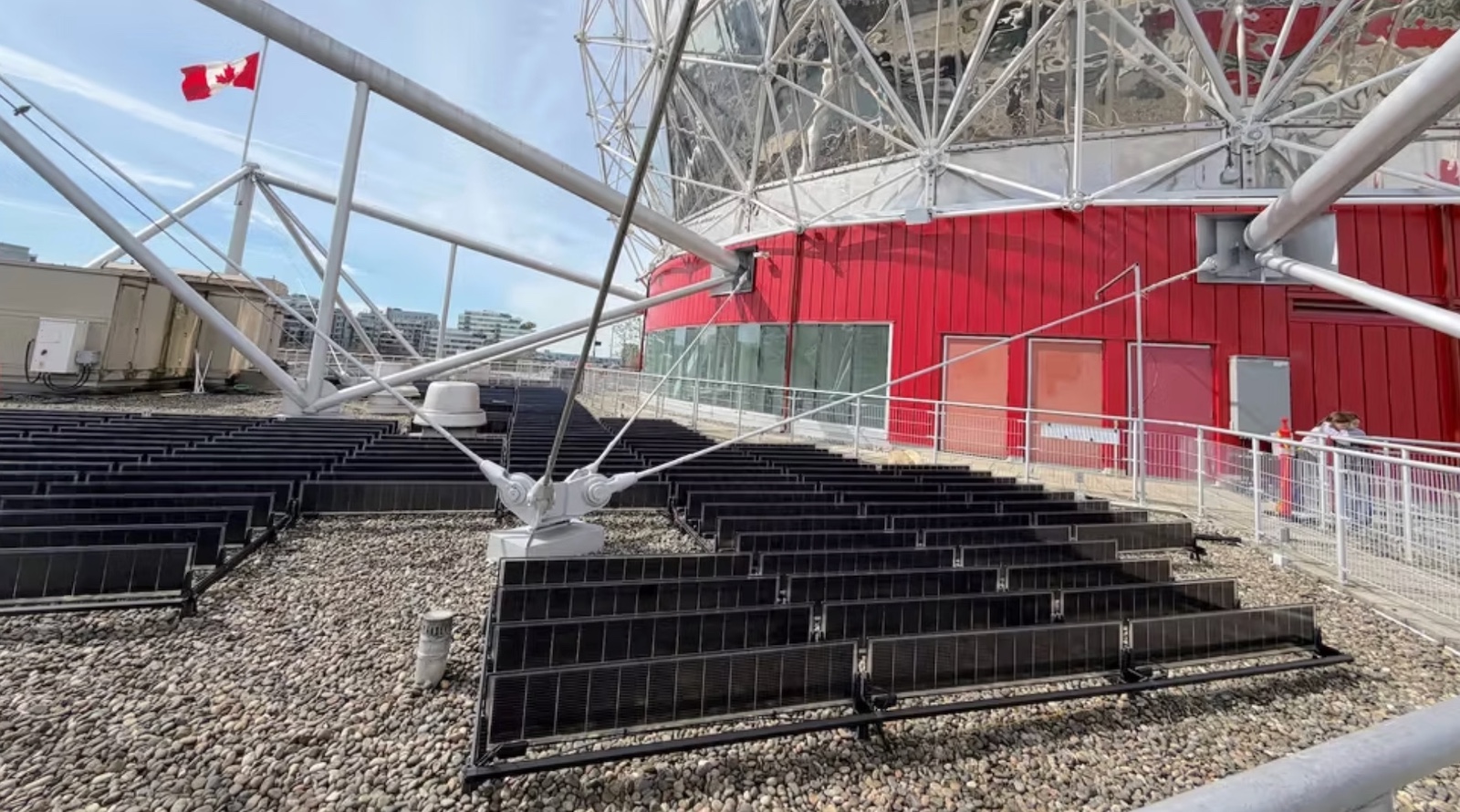
In Vancouver, a famous science museum is getting a surprising new feature: solar panels that stand straight up instead of lying flat.
This isn't a small experiment — it's Canada's first commercial vertical solar system, just installed on Science World, the round, shiny building by the water that draws kids and families from across the region. The 19.5 kW system uses 76 panels that stand up like tall windows, mounted in three separate groups across the roof.
The technology comes from Over Easy Solar, a company from Norway — a country that gets enormous snowfall and has been solving solar challenges for cold climates for years. In Norway, winter means heavy snow piling up, which can block traditional flat solar panels from working. Standing the panels vertically solves that problem: snow slides right off.
Science World sits in BC Hydro's utility district, and the utility company is watching the installation closely, considering whether to roll out similar systems across the region. The museum itself is in the middle of a massive CAD 39 million ($27.4 million) renovation that includes better insulation, heat pumps, and new cooling systems. Altogether, these upgrades are expected to cut the building's energy use by 42%.
Rob Baxter, co-founder of VREC Solar, the company that installed the system, explained why standing solar panels made sense here. "In the past there was not a good solution for flat roofs that could not support ballast or penetrations," he said. The dome-shaped Science World roof can't hold heavy weights, and puncturing it risks damaging the building. Vertical solar avoids both problems.
The benefits might extend beyond just solving technical headaches. A year-long study in the UK found that Over Easy Solar's vertical panels actually produced more electricity than traditionally tilted panels across every season. In April, the company also launched its first pilot project in New York, bringing the technology to the US market.
This technology isn't about to replace regular rooftop solar everywhere. But for snowy cities, flat roofs with weight limits, and places where the sun sits low on the horizon, vertical solar could be a game-changer — opening up clean energy possibilities in places where it never seemed practical before.