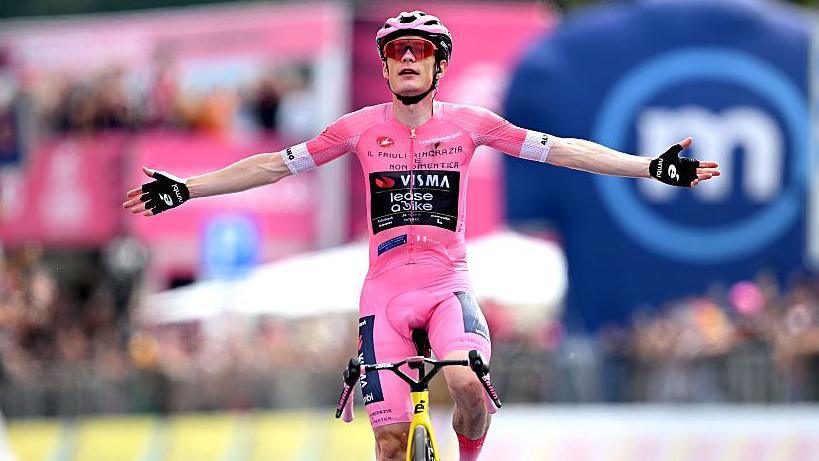
Jonas Vingegaard surged ahead of Felix Gall on the grueling final climb of stage 20, pulling away with four minutes left to race and sealing not just a stage victory, but something far larger—his coronation as the champion of the Giro d'Italia.
The 29-year-old Danish cyclist's attack during Saturday's penultimate stage transformed a three-week grand tour that had already seemed his to lose into something approaching inevitability. Vingegaard arrived at stage 20 holding a commanding four minutes three seconds over Austria's Gall, meaning that as long as he survived Sunday's final stage into Rome, he would join just seven other cyclists in history to win all three of cycling's greatest races—the Tour de France, the Vuelta a Espana, and the Giro d'Italia in a single career. He had already claimed the Tour twice and the Vuelta once, but the Giro represented his final piece.
The stage itself stretched 200 kilometers from Gemona del Friuli to Piancavallo, a serious test of endurance and tactical acumen. For the first two-thirds of the journey, Vingegaard made a studied choice to sit safely within the peloton, protected by two teammates from his Visma-Lease a Bike squad. He wasn't racing the stage—he was managing it, a distinction that separates the calculating champion from the aggressive attacker. But with 10 kilometers remaining on the Piancavallo climb, the moment shifted. Vingegaard launched his attack, a decisive move that cut through the thin mountain air.
Gall, who had battled impressively all week, attempted to follow Vingegaard's acceleration. The gap widened relentlessly. By the time five kilometers remained, Vingegaard had built a lead of more than a minute, and it was clear the Austrian could not match the Dane's power on the climb. When Vingegaard crossed the finish line, he had won by one minute 15 seconds, raising his arms in controlled triumph. Gall took second place, while Italy's Giulio Ciccone—racing in front of his home crowds—rounded out the podium.
The victory did more than secure another stage win for Vingegaard's palmares. It essentially ended the suspense of the entire race. In cycling's grand tours, a four-minute gap heading into the final stage is rarely overcome, especially when held by a rider of Vingegaard's caliber. His performance across three weeks in Italy demonstrated the same combination of tactical intelligence, climbing prowess, and mental resilience that had made him a dominant force in France and Spain.
What remains now is a formality: Sunday's final 130-kilometer stage to Rome, where Vingegaard need only avoid disaster to claim his place among cycling's immortals. Once he crosses that finish line in the Eternal City, he will have achieved something that only seven men before him have managed—the triple crown of cycling's three-week classics in a single career. For a rider who had never raced the Giro before this year, the achievement speaks to both his extraordinary talent and the depth of his ambition.