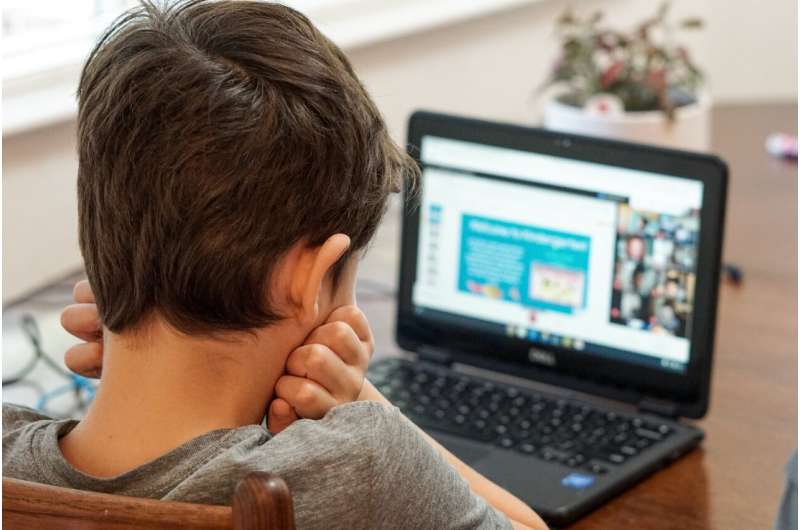
When Amanda Neitzel first tested a live virtual reading program called AirReading two years ago, she found modest results — about one extra month of learning for struggling readers after a single semester. But when she ran the same study across a full school year, something shifted. The literacy gains more than doubled.
"This tutoring should be in school budgets, just like textbooks," says Neitzel, an associate research professor at Johns Hopkins University. Her latest study, published with colleagues Nathan Storey and Xue Wang, suggests virtual reading tutoring has moved far beyond the pandemic era fix it once was.
The study followed roughly 400 students in grades one through four across two school districts: a rural, mostly Hispanic district in Texas and a larger suburban district in Louisiana. Students who had been flagged for reading help were randomly placed into either AirReading sessions or their usual literacy instruction. Those getting AirReading met in small groups of up to four students for 30-minute sessions four days a week with tutors who held bachelor's degrees, prior classroom experience, and state teaching certifications.
The results were striking. After a full school year, AirReading students learned the equivalent of 2.8 extra months compared to their peers — roughly an 11-percentile-point jump. Neitzel says those gains match what you'd typically see from well-run in-person tutoring, a finding that stands out because virtual tutoring had almost no research backing before the pandemic.
What's more, the benefits were remarkably even. English learners, students in special education, economically disadvantaged students, and children across racial and ethnic groups all made progress at the same rate. "We were doing badly before the pandemic," Neitzel notes. "Far too many kids are not reading proficiently at grade level."
But the study also came with a caveat: shortcuts don't work. Students needed at least 56 sessions to see meaningful gains. "Sustained exposure is likely necessary," the researchers wrote, "particularly in early grades where skill development is cumulative and foundational." Sessions longer than 30 minutes didn't necessarily help more, especially for first graders, whose attention spans are still developing.
The timing matters because many school districts are now cutting back on tutoring after federal pandemic relief funds ran out. Neitzel argues that approach misses the point. "In the beginning, it was like: We're back from the pandemic and we're just going to do this high-impact tutoring. All the kids will be caught up in three years," she says. "But that premise never worked."
Some states are betting on the model anyway. Louisiana recently won a five-year, $15 million federal grant to expand AirReading to roughly 4,500 first and second graders. A separate follow-up study Neitzel led found that 85 percent of students who finished a similar program, Ignite Reading, were still reading at grade level a year later — a sign the gains may stick.
For Neitzel, who taught first grade before becoming a researcher and now focuses on closing opportunity gaps, the potential is clear. "It was always a question in the field: Could this actually work?" she says. "Now we have the evidence."