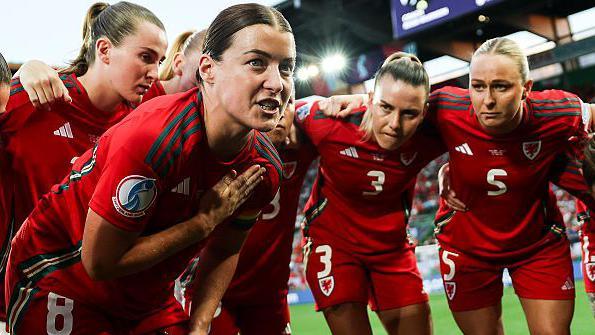
Wales' men's team made history in 2016 when the European Championship expanded to 24 teams, qualifying for their first major tournament since 1958 and ultimately reaching the semi-finals in France. Now the Welsh Football Association is making the case that women deserve the same opportunity—and they're lobbying UEFA to expand the Women's Euros from 16 to 24 teams by 2029.
The disparity stings particularly because of how much the 2016 expansion changed Wales' trajectory. Chris Coleman's side didn't just participate; they thrived, sparking a period that saw them qualify for subsequent European Championships and the 2022 World Cup. For women's football across Britain and Ireland, the current 16-team format has meant heartbreak for talented nations left on the outside. Scotland, Northern Ireland, the Republic of Ireland, and others have watched from home while Wales qualified for last year's Euros, where they were drawn in the same group as England.
The case for expansion extends beyond Wales' own ambitions. According to Irishman Mooney, a Uefa insider who previously worked for the governing body and recently held interim control of the Football Association of Ireland, the 2029 expansion could transform qualification prospects across neighbouring nations. "The Republic lost out to us going to Euro 2025, but if that was a 24-team tournament they'd have been there and that would have been a huge lift for their country," Mooney explained. The sentiment underscores a fundamental principle: if the men's format offers equal access, so should the women's.
Wales has practical reasons for prioritizing Euro 2029 over the 2027 World Cup. Having topped their World Cup qualifying group after beating the Czech Republic, the team faces a gruelling path to 2027—two European play-off ties followed by a potential inter-confederation play-off. Euro 2029, by contrast, would offer a more achievable milestone with an expanded field.
The Welsh Football Association isn't lobbying alone. They're coordinating with neighbouring nations and leveraging internal allies at UEFA. Laura McAllister, the former Wales captain now serving as vice president of UEFA, provides a direct channel to leadership. Mooney highlighted another crucial figure: Nadine Kessler, UEFA's chief of women and girls' football, whom he describes as "very progressive in how she thinks." The combination of insider access and a supportive structural climate suggests the push has momentum.
The argument itself is simple: consistency. "We're very lucky and we have great friends at Uefa," Mooney said, outlining the coalition's message. "Working with countries like our neighbours who are interested in this, we can bring those voices to Uefa and say, 'Look, we understand the costs impact by increasing the amount of teams, but if you're doing it for the men you should do it for the women too'."
This isn't nostalgia or sentimentality. The 2016 expansion proved that access to major tournaments reshapes national football cultures, attracting investment, media attention, and grassroots participation. A 24-team Women's Euros would mean more nations getting their own moment of history—the transformative experience Wales' men lived eight years ago, and that women's teams across Europe are still waiting for.