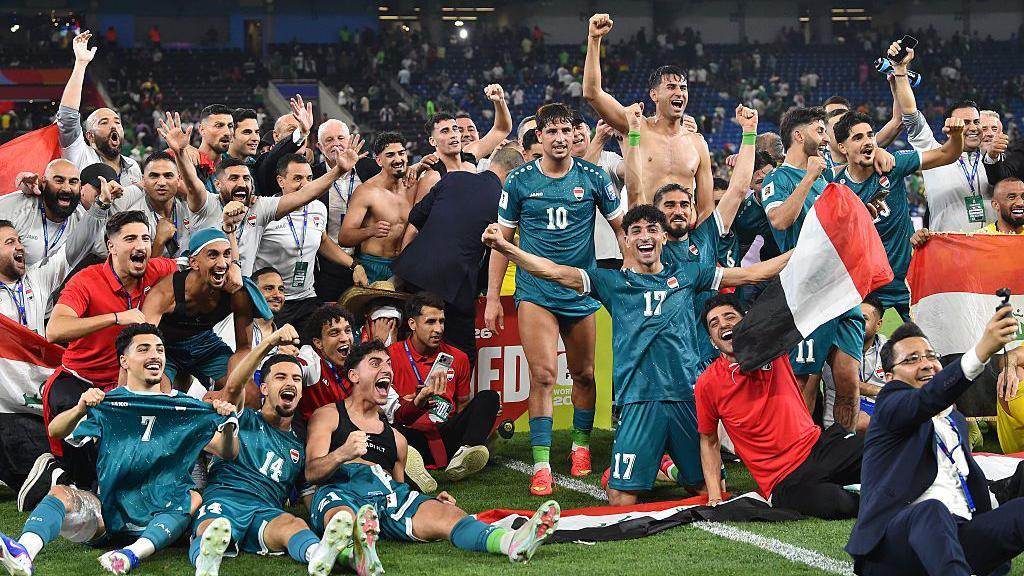
After four decades defined by war, dictatorship, international sanctions, and the reign of terror inflicted by Saddam Hussein's son over Iraq's football federation, the Lions of Mesopotamia are heading to the World Cup again. Iraq qualified for the 2026 tournament on March 26 with a victory over Bolivia in Mexico—the exact location where their first-ever World Cup appearance took place in 1986, a full generation before most of the current squad was born.
For a football-mad nation of 46 million people, this return represents far more than a sporting achievement. It is a testament to collective resilience and a reason to celebrate in a country that has endured unimaginable hardship. When the qualification was confirmed, crowds lined the streets of Baghdad on open-top buses, organizing festivals and public gatherings. "We were a good team," said Karim Allawi, who played in Iraq's first World Cup appearance 40 years ago and watched this qualification unfold as a 66-year-old fan.
The road to 2026 required 21 grueling matches, including a tight playoff victory against the United Arab Emirates before the decisive win against Bolivia. The journey was nearly derailed in March 2026 when regional conflict threatened to prevent the Bolivia playoff from taking place at all, with some players and coach Graham Arnold struggling to leave Iraq and reach Mexico. They persevered.
Allawi, who sat on the bench during Iraq's 1986 opener against Paraguay due to an injury suffered the day before the match, watched this new generation take shape with both hope and realism. Iraq's squad, now ranked 57th in the world, features players with genuine European pedigree. Ali Al-Hamadi plays for Ipswich Town in the English Premier League. Zidane Iqbal, a midfielder who once trained at Manchester United, now plays for Utrecht in the Dutch league. Kevin Yakob recently helped AGF capture the Danish championship.
Much of the credit belongs to Graham Arnold, the 62-year-old Australian coach hired in 2025 specifically to guide Iraq through the final phases of qualification. Arnold steered Australia to the second round of the 2022 World Cup, a credential that proved invaluable in steadying Iraq through elimination after elimination. "In 2022, Argentina found it very hard to win against Australia," noted TV sports reporter Nawar Faeq Al-Rikabi. "It will be the same with us. He is very experienced and I think we will do something really good."
Iraq's group opponents—France (multiple-time World Cup winners), Norway (a rising European power), and Senegal (Africa's defending champions)—form what Allawi calls "a truly tougher group than 1986." Yet the mood in Baghdad is one of qualified optimism. The targets are modest but meaningful: to score more than one goal would be a new achievement; to win a game would be great; to advance to the next stage would be terrific.
The historical weight is undeniable. Saddam Hussein placed his son Uday in charge of Iraq's football federation in 1984, initiating a brutal reign of terror involving torture, forced training with concrete balls, and imprisonment of players. That darkness has long since receded, but for decades it symbolized the country's isolation from the world stage. The U.S.-led invasion that toppled Saddam in 2003 created new instability. Iraq couldn't play World Cup qualifiers at home until 2020, when FIFA finally permitted Basra to host matches.
Now, at last, the wait is over. The Lions of Mesopotamia are ready.