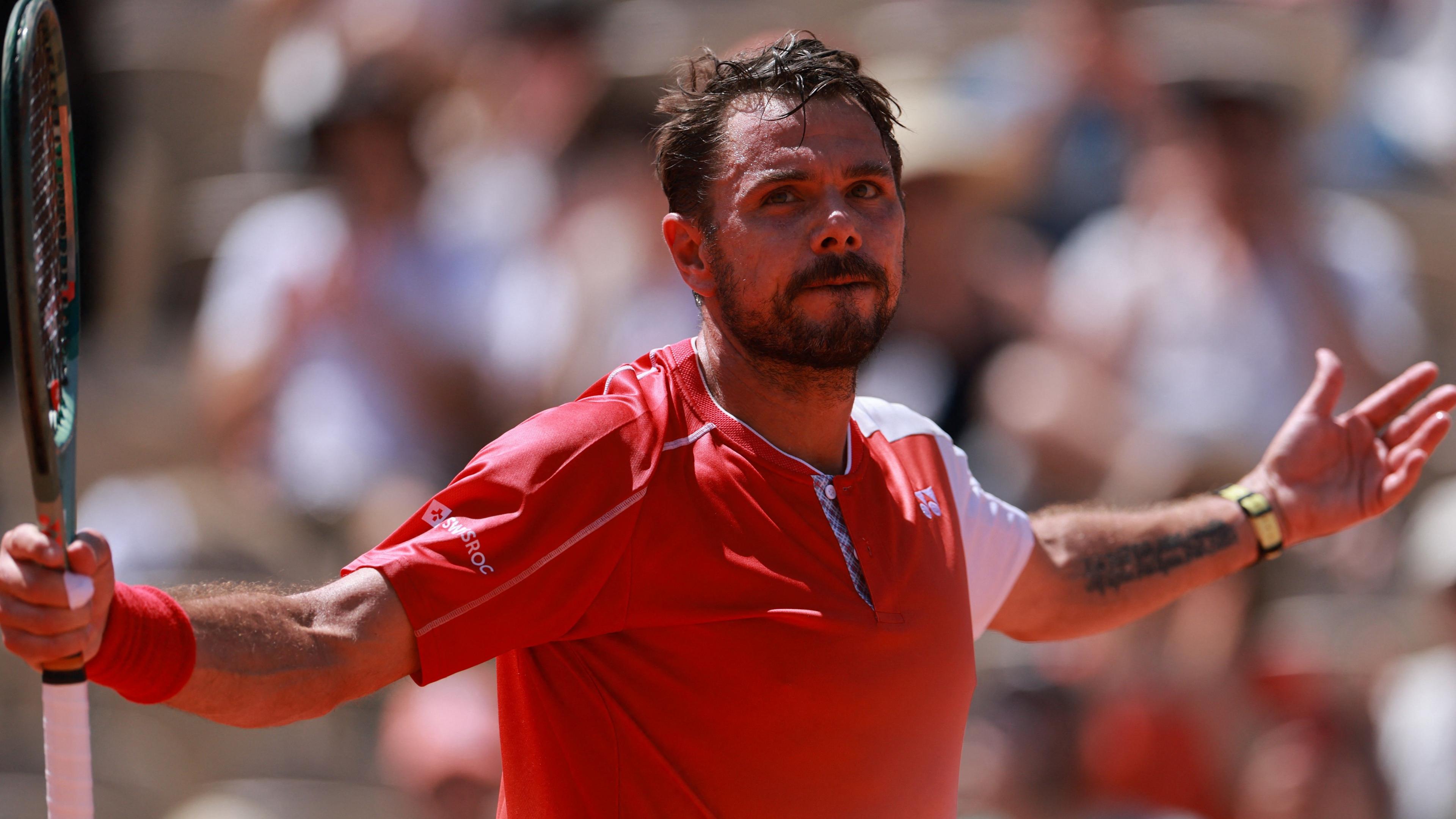
On a beautiful Parisian afternoon, 41-year-old Stan Wawrinka walked off the Roland Garros court one final time, carrying a small strip of plaid fabric sewn into his shirt—a tangible memory of the moment that defined his career.
The Swiss champion lost his first-round match to Jesper De Jong 6-3, 3-6, 6-3, 6-4 on Monday, but the score barely mattered. This farewell to the venue where he achieved his greatest triumph felt less like an ending and more like a homecoming. "It's always tough to choose, but yes, it's there, because it was Roland Garros and it was the final against Djokovic—number one at that time. I believe it was the best of my life," Wawrinka reflected to BBC Sport.
That "best match" came in 2015, when Wawrinka dismantled Novak Djokovic in the final with his signature single-handed backhand. He won from a set down, forcing Djokovic to wait another year to complete the career Grand Slam. The performance was legendary enough, but the red, white, and grey plaid shorts Wawrinka wore that day became equally iconic—one pair now lives in the Roland Garros museum, while others were framed as gifts for his team, including long-term coach Magnus Norman.
Wawrinka's three Grand Slam titles came at pivotal moments. His first arrived at the 2014 Australian Open, when at 28 he became only the player to interrupt Djokovic's run of 14 consecutive Grand Slam semi-finals. He beat a Nadal hampered by a back injury in the Melbourne final. Then came Paris. The trilogy completed two years later at the US Open in 2016, when Wawrinka again defeated Djokovic from a set down after an extraordinary fortnight that saw him play 27 sets and spend 21 hours and 49 minutes on court—including saving a match point against Britain's Dan Evans.
Between his three major wins and a single ATP 1,000 title in Monte Carlo in 2014, Wawrinka became something rare: the only other multiple Grand Slam champion besides the sport's dominant quartet of Djokovic, Nadal, Roger Federer, and Andy Murray across nearly two decades. Yet he never quite made it to their stratosphere. "I was really far from turning them into a 'Big Five,'" he acknowledged, noting his modest ATP Masters record compared to his peers.
What set Wawrinka apart wasn't just his tennis—it was his philosophy. Unlike Djokovic, who once denied himself chocolate for 18 months, Wawrinka embraced celebration. "When you sacrifice so much for your tennis, when you do so much hard work to get there, I think if you like to celebrate, you should celebrate," he said. "If you don't celebrate after winning a Slam then you will never celebrate, because tennis never stops."
Two knee operations and two foot operations since his last title in Geneva in 2017 would have ended most careers. Instead, at 41, Wawrinka kept returning to the court. Though he will not officially retire until October's Swiss Indoors tournament in Basel, this French Open send-off felt definitive—capped by a video tribute from Nadal, Federer, and Djokovic, and cheers of "Stan the Man" echoing through the stadium.
When asked about life after tennis, Wawrinka spoke of skydiving and adventure, but remained focused on finishing strong. "In the end, I gave my all to this sport," he said simply, carrying his plaid-striped shirt—and a career's worth of memories—into what comes next.