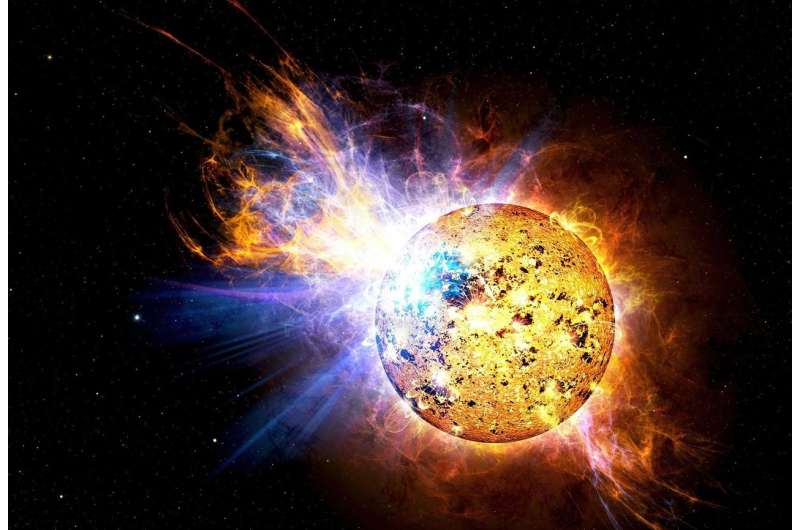
In May 2024, a solar storm knocked GPS systems offline just as American farmers were planting and harvesting crops, costing the agriculture industry $500 million in a single blow. It was a stark reminder that space weather—those violent eruptions on the sun that send torrents of charged particles hurtling toward Earth—doesn't just dim our satellites or disrupt our phone calls. It ripples through every layer of modern life, from the financial transactions that depend on satellite time stamps to the tractors guided by satellite signals in our fields.
For decades, scientists have gotten better at predicting these cosmic storms. But prediction alone leaves humanity in a purely defensive position. Now, Boston University researcher Brian Walsh is proposing something far more ambitious: what if we could actually stop them?
Walsh and colleagues from the University of Michigan have developed a theoretical system called StormWall, which could transform our relationship with space weather from passive preparation to active intervention. The concept is elegantly simple in principle. Six spacecraft, positioned in geosynchronous orbit to match Earth's rotation, would each carry canisters filled with charged chemical particles—alkaline elements like barium or lithium. When released, these materials would photoionize, seeding Earth's protective magnetic bubble, the magnetosphere, with plasma that disrupts the flow of energy between solar storms and our planet.
In computer simulations, the StormWall system achieved something remarkable: it cut the intensity of a major geomagnetic storm in half. Walsh, an associate professor of mechanical engineering at Boston University's College of Engineering, describes it as flipping the script entirely. "It's like people in a village who see a river flooding—maybe they can predict when that will happen," he says, "but probably what's even better is if they could build a storm wall."
The inspiration came from nature itself. Walsh observed how material naturally peels off Earth's atmosphere and drifts to the edge of the magnetosphere, naturally strengthening it. His team's innovation was recognizing that this process could be amplified intentionally, deliberately.
The engineering is within reach. Walsh emphasizes that the system relies on physics that works and launch capacities that already exist. The six spacecraft would carry roughly the equivalent of a dozen oil trucks' worth of material—substantial, but not beyond current capabilities. The challenge is not feasibility but economics. A single deployment would be one-shot; once the chemical payload was fired and expended, the system couldn't be replenished without launching again.
Yet the financial calculus may be shifting. Private companies are already pouring billions into space infrastructure and even contemplating orbital data centers. Against this backdrop, Walsh and his team have made a sobering comparison: a massive geomagnetic storm—the kind that occurs roughly once a century, with the last one striking in 1859—would cause catastrophic damage. The cost to Earth's power grids alone would exceed $2.4 trillion.
Walsh is already planning the next phase of research, looking for ways to halve the material required and further reduce costs. In a world where the stakes of inaction grow ever larger, the prospect of building a wall against space weather no longer sounds like science fiction. It sounds like necessary preparation.