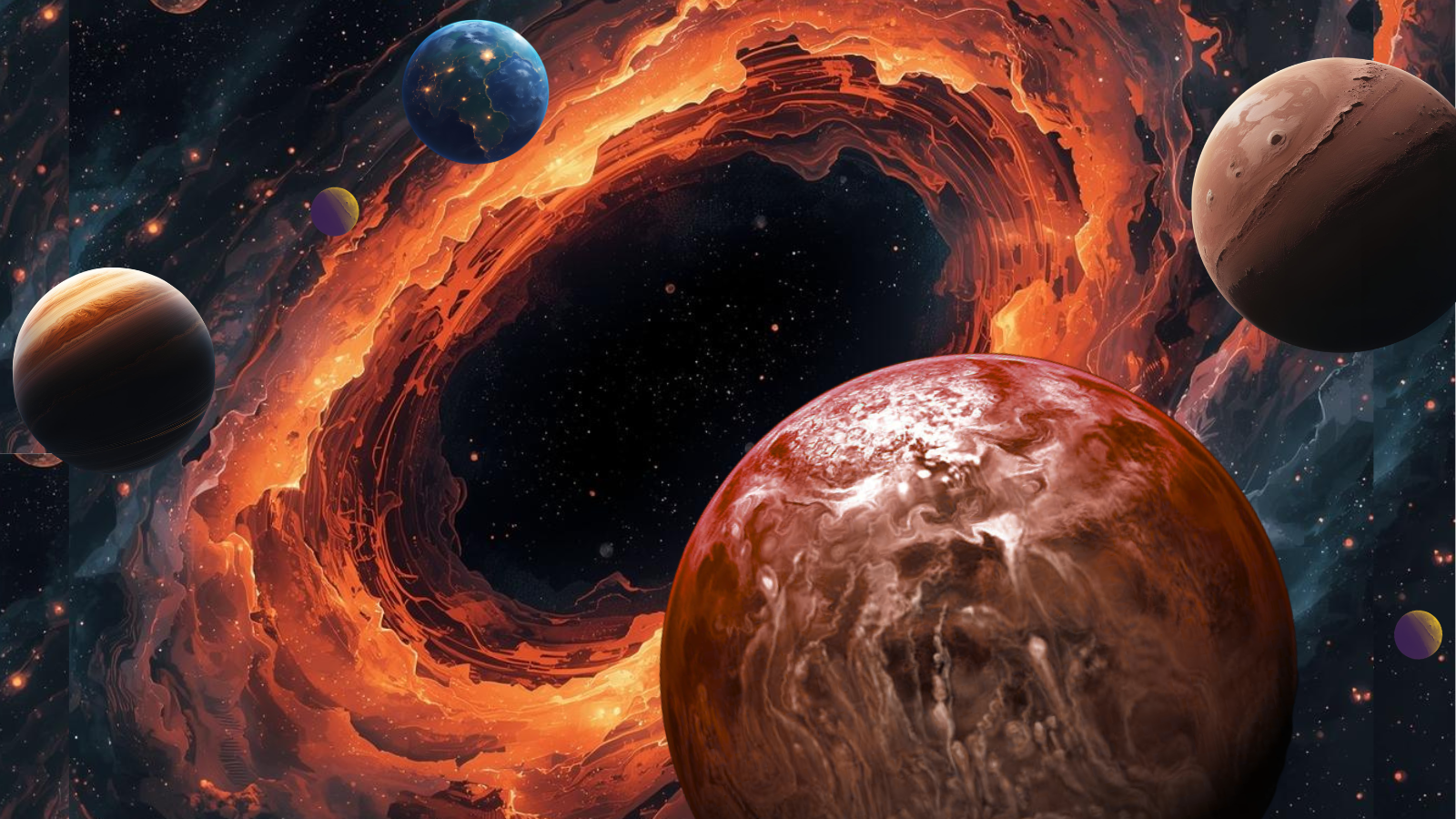
Bhupendra Mishra was staring at a simulation of a supermassive black hole’s swirling accretion disk when the numbers stopped making sense — in the best possible way. At tens of parsecs from the ravenous core of an active galactic nucleus (AGN), where chaos reigns and radiation blazes brighter than entire galaxies, his model revealed something almost impossible: millions of Jupiter-mass planets could be forming in the disk’s outer edges. "We were astonished!" Mishra, a researcher at the University of Colorado Boulder, told Space.com. "This has not been found in AGN disk context before using a streaming instability model."
For decades, astronomers assumed planet formation was reserved for the calm, dusty disks around young stars. But AGNs — powered by supermassive black holes feeding on vast clouds of gas and dust — are anything but calm. Their accretion disks glow across the electromagnetic spectrum, fueled by friction from immense gravitational forces, and launch plasma jets at near-light speed. Yet, at the disk’s outskirts, conditions may cool just enough for dust to clump together, not into pebbles or asteroids, but into planet-sized behemoths. Using a sophisticated computer model, Mishra and his colleague Wladimir Lyra, a planet formation expert at New Mexico State University, simulated how dust behaves in these extreme environments. They found that streaming instability — a process that creates dense filaments of dust — could trigger the birth of vast numbers of planets far from the black hole’s maw.
The implications are staggering. These aren’t Earth-like worlds but "dust giants" exceeding Jupiter’s mass, glowing like lava balls in the harsh radiation of their surroundings. And they’re not rare: the model suggests millions could form around a single supermassive black hole. Because AGN disks are more gas-rich than protoplanetary disks around young stars, they may spawn not just a handful of planets, but entire planetary populations on an unprecedented scale. While these planets may eventually drift outward, escaping the disk’s edge, they remain stable long enough to reshape how we think about planet formation.
The discovery also opens a new window into understanding the poorly mapped outskirts of AGN disks — regions that could hold clues to galaxy evolution. Confirming the theory won’t be easy. Detecting planets light-years from a black hole, buried in glare and distance, demands extraordinary tools. Gravitational lensing — where massive foreground objects bend and amplify light from behind them — might reveal clusters of these hidden worlds. But for now, astronomers must wait for a lucky alignment or more advanced models. "I believe we could detect these planets," Mishra said, "but we have to study this model further." The universe, it seems, is still full of places where the impossible quietly takes shape.