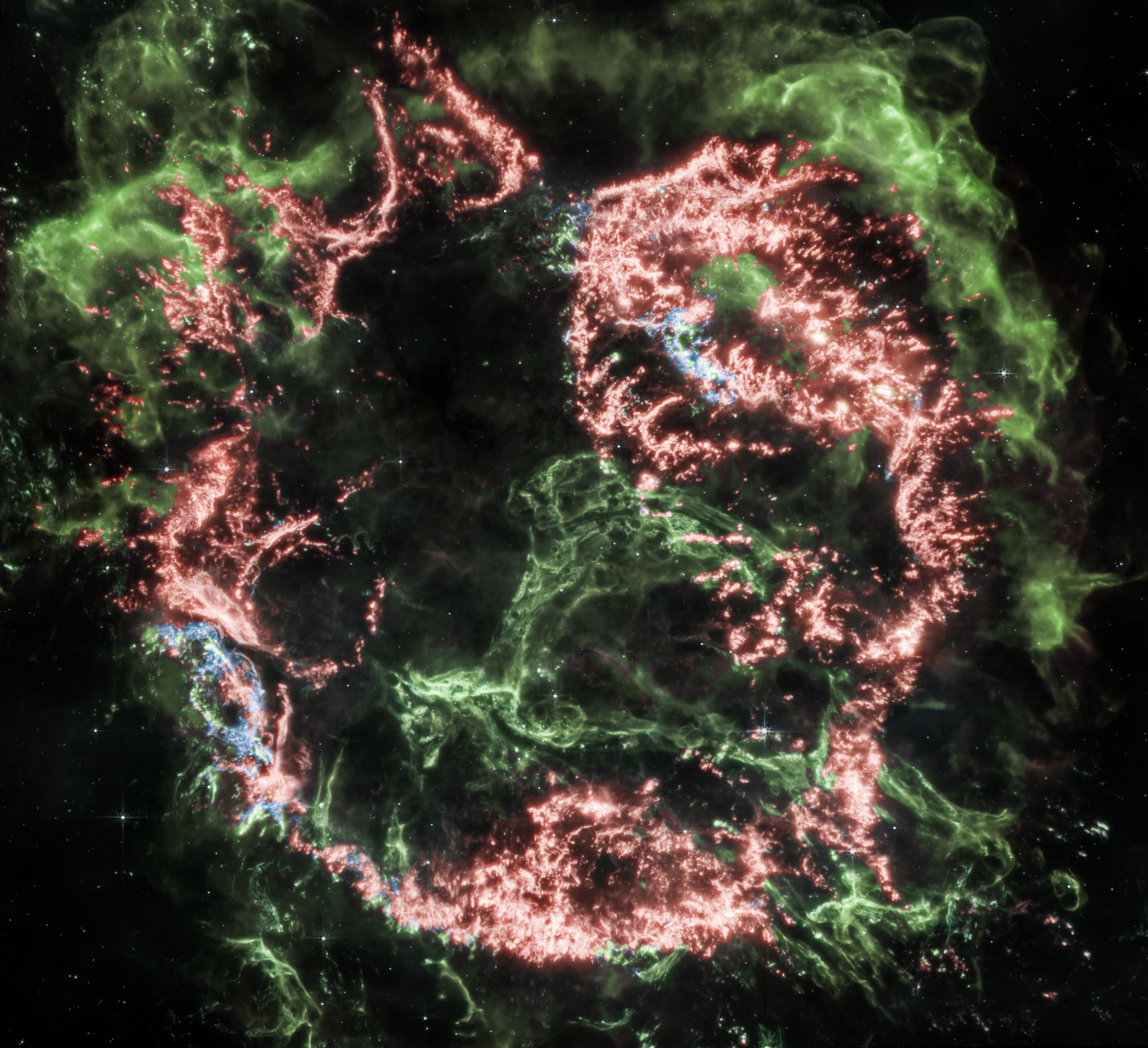
A dying star may have reshaped its inner core only hours before it burst apart, and NASA’s James Webb Space Telescope is giving scientists a closer look at what it left behind. A high-resolution, mid-infrared image released on Nov. 23, 2026, shows hot dust in Cassiopeia A, a famous cloud of debris from a stellar explosion.
Cassiopeia A, often shortened to Cas A, is a supernova remnant: the gas and dust left after a massive star explodes. These clouds are not simply cosmic wreckage. Over time, their material can help form a new generation of stars and planets. Studying a remnant can also offer clues about the final stages of a star’s life and how an explosion changes the matter around it.
Webb’s latest view focuses on the hot dust in Cas A, captured in mid-infrared light. The image’s fine detail helps researchers examine the structure of the remains. NASA says the telescope’s data supports a scenario in which the star’s interior underwent a dramatic change, possibly just hours before its demise. That timing is striking, but the finding is presented as a supported possibility, not a settled account of exactly what happened inside the star.
The observation links a brief moment at the end of one star’s life with material that may endure far longer. The star is gone, but its remnant remains a changing cloud of gas and dust. In the long run, material from remnants like Cas A can become part of stars and planets, connecting stellar death to the ingredients of future worlds.
The image was released by NASA on Nov. 23, 2026. Its credits list the European Space Agency and the Canadian Space Agency, along with the Space Telescope Science Institute. The named contributors include Tea Temim of Columbia University, Rick Arendt of the University of Maryland, Baltimore County, and Dan Milisavljevic of Purdue University. Joseph DePasquale of the Space Telescope Science Institute handled image processing.
Webb’s observations do not close the story of Cas A; they give scientists a sharper way to investigate it. Further study of the remnant may help test ideas about how a massive star’s inner workings change near the end of its life. For now, the image offers both a detailed look at a stellar aftermath and a reminder that the material from an explosion can become part of what comes next.