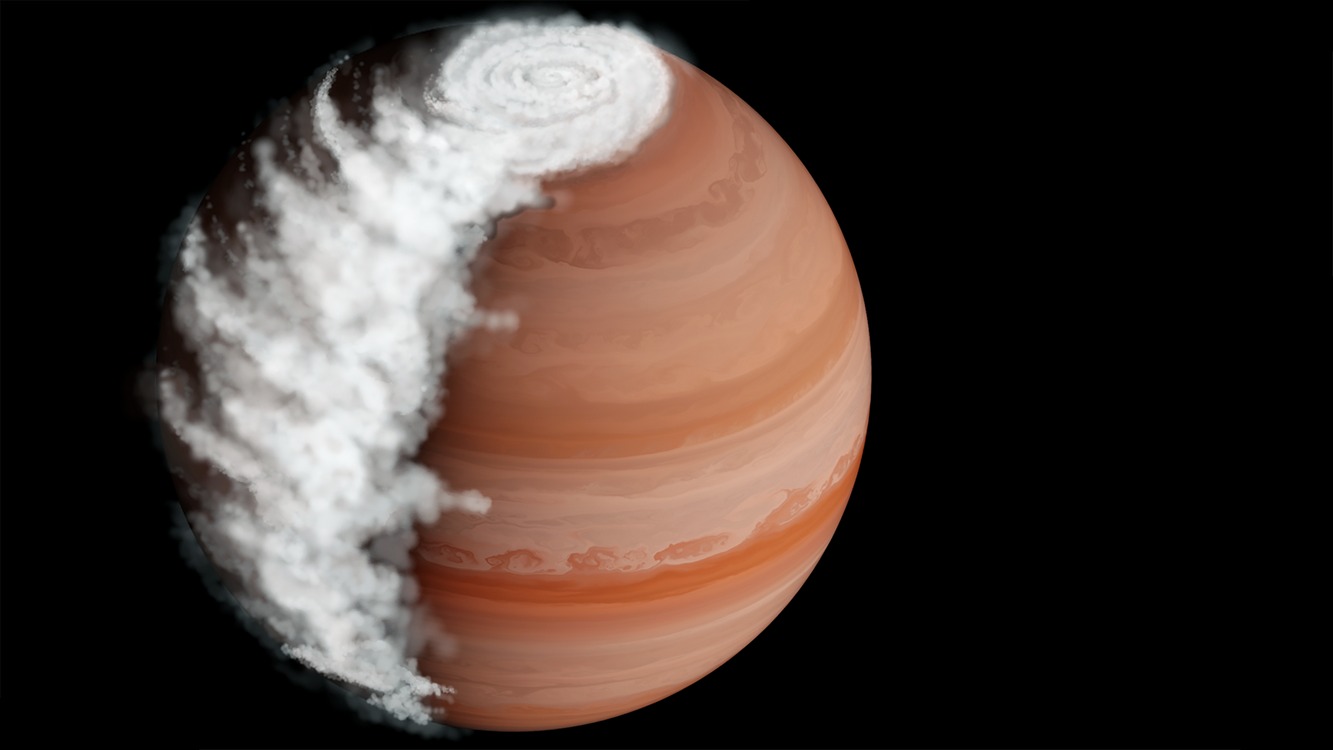
On the distant gas giant WASP-94A b, 700 light-years from Earth, the mornings bring clouds made of stone that vanish into the scorching heat by afternoon—a phenomenon that Johns Hopkins University researchers have just mapped with unprecedented clarity using the James Webb Space Telescope.
The discovery matters because for two decades, astronomers studying exoplanet atmospheres have been stymied by clouds. David Sing, a distinguished professor of earth and planetary sciences at Johns Hopkins, spent years peering through what he calls a "foggy window" at distant worlds, unable to determine what planets are actually made of. Now, by isolating the clouds themselves, his team has cracked a problem that has haunted the field since the first exoplanet was detected in 1991.
WASP-94A b orbits its star much closer than Mercury orbits the Sun, creating extreme and asymmetrical conditions. The research team used the James Webb Space Telescope to observe the planet's transits—its passages in front of its host star—measuring the atmosphere at two critical moments: the leading edge, where the planet's morning side faces the star, and the trailing edge at evening. The findings revealed a split-screen world. Mornings are dense with clouds made of magnesium silicate, the same mineral found in rocks on Earth. Evenings are crystalline and clear.
The mechanism is both familiar and alien. As clouds drift from the cool nightside of the planet into temperatures exceeding 1,000 degrees on the day side, they simply boil away—a process resembling morning fog burning off on Earth, but on a cosmic scale. Alternatively, powerful winds might lift clouds high into cooler altitudes, only to plunge them deep into the planet's superheated interior, vaporizing them entirely.
By studying the clear evening skies, first-author Sagnick Mukherjee and the team could finally see what the planet's actual composition resembled—something the Hubble Space Telescope could never achieve through the morning cloud cover. The result upended expectations. Earlier observations, which averaged in the clouds, suggested WASP-94A b contained hundreds of times more oxygen and carbon than Jupiter—a finding that contradicted planetary formation theory. When the clouds were separated out, the picture shifted dramatically: the planet carried only a modest surplus of these elements compared to Jupiter, bringing it into line with what scientists expect from formation models.
The insight proved portable. When Sing's team examined eight other hot gas giants, they found the same distinctive cloud cycle on two additional worlds: WASP-39 b and WASP-17 b. This suggests that both Jupiter-like compositions and the dramatic day-night atmospheric cycling are not rare oddities in the galaxy, but rather common features of hot gas giants across the cosmos.
The implications are expansive. Sing plans next to compare hot gas giants orbiting close to their stars with gas giants dwelling in the habitable zones of their host systems—the regions where liquid water might exist on planets. Each comparison deepens the map of how planets form and evolve, bringing humanity closer to understanding our own place in a universe now known to host countless worlds.