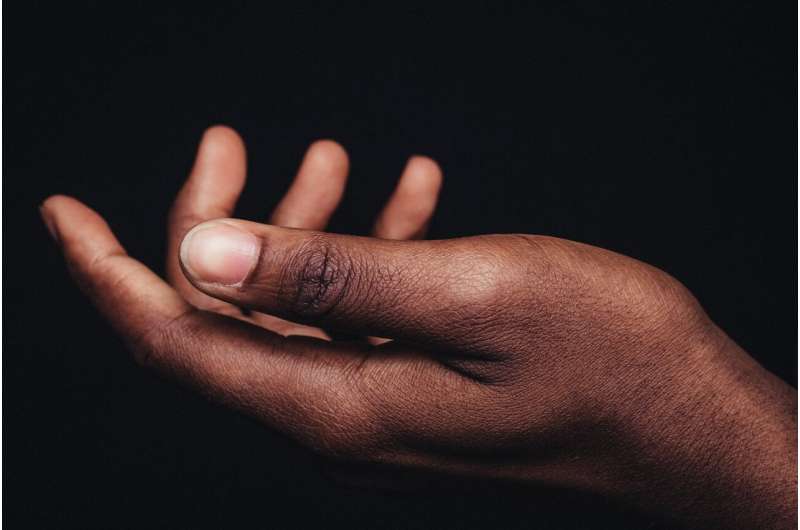
When a paintbrush stroked a rubber hand in sync with her own hidden hand, Margaret felt the phantom limb become part of her body—a sensation psychologists have studied for decades. But what McGill researchers discovered goes deeper than the illusion itself: people with a weaker sense of self are significantly more vulnerable to this trick of the mind, revealing something profound about how our identity and bodily awareness are woven together.
The rubber hand illusion is a classic tool in psychological research, and it works through a simple but powerful mechanism. A participant's real hand is hidden behind a screen while a rubber hand sits in plain view. Researchers then stroke both hands simultaneously with a paintbrush—the real one and the fake one. For most people, this synchronized touch creates a convincing sense that the rubber hand belongs to them. But some people experience the illusion even when the strokes are deliberately out of sync, and those people tend to share something in common: they have a weaker, less stable sense of self.
McGill researchers led by Willis Klein, a Ph.D. candidate in psychology, tested 77 participants between ages 18 and 40 from the university community. To ensure fair testing, both hands—real and rubber—wore gloves to hide any differences in skin tone. After the illusion experiment, participants completed a questionnaire measuring the clarity, coherence, and stability of their sense of self. The results confirmed what an earlier 2019 study had suggested: those who scored lower on self-concept clarity were more likely to fall for the illusion even when the sensory signals were mismatched.
"This really suggests that they maybe have a more malleable kind of bodily self, where they're more vulnerable to incorporating other things in the environment into their sense of self, even when most people wouldn't be vulnerable to that," said Jennifer Bartz, senior author and Professor in McGill's Department of Psychology. The findings appear in the Canadian Journal of Experimental Psychology, published in 2026.
The implications reach far beyond laboratory curiosity. This work supports embodied cognition—the idea that our minds and bodies are fundamentally inseparable, that how we think is shaped by how we physically experience the world. Evolutionary biologists have long assumed this must be true, but empirical evidence has been sparse. Willis Klein reflected on the significance: the study provides hard data backing an intuitive but previously untested theory about consciousness itself.
For clinicians, these findings open doors to new questions. How might embodied cognition affect empathy? How can therapists better support people living with borderline personality disorder or other conditions involving a fragmented sense of self? These are questions the McGill team plans to pursue, recognizing that understanding the mind-body connection could unlock better treatments for psychiatric conditions rooted in identity disturbance.
The research suggests something both unsettling and hopeful: our sense of self is not as fixed as we might assume. For some, that malleability makes them vulnerable to illusions. But it also means that therapeutic interventions targeting bodily awareness and self-concept stability might help people whose grip on their own identity feels unstable. In the space between a real hand and a rubber one, McGill researchers have found evidence that the mind and body speak a language we are only beginning to understand.