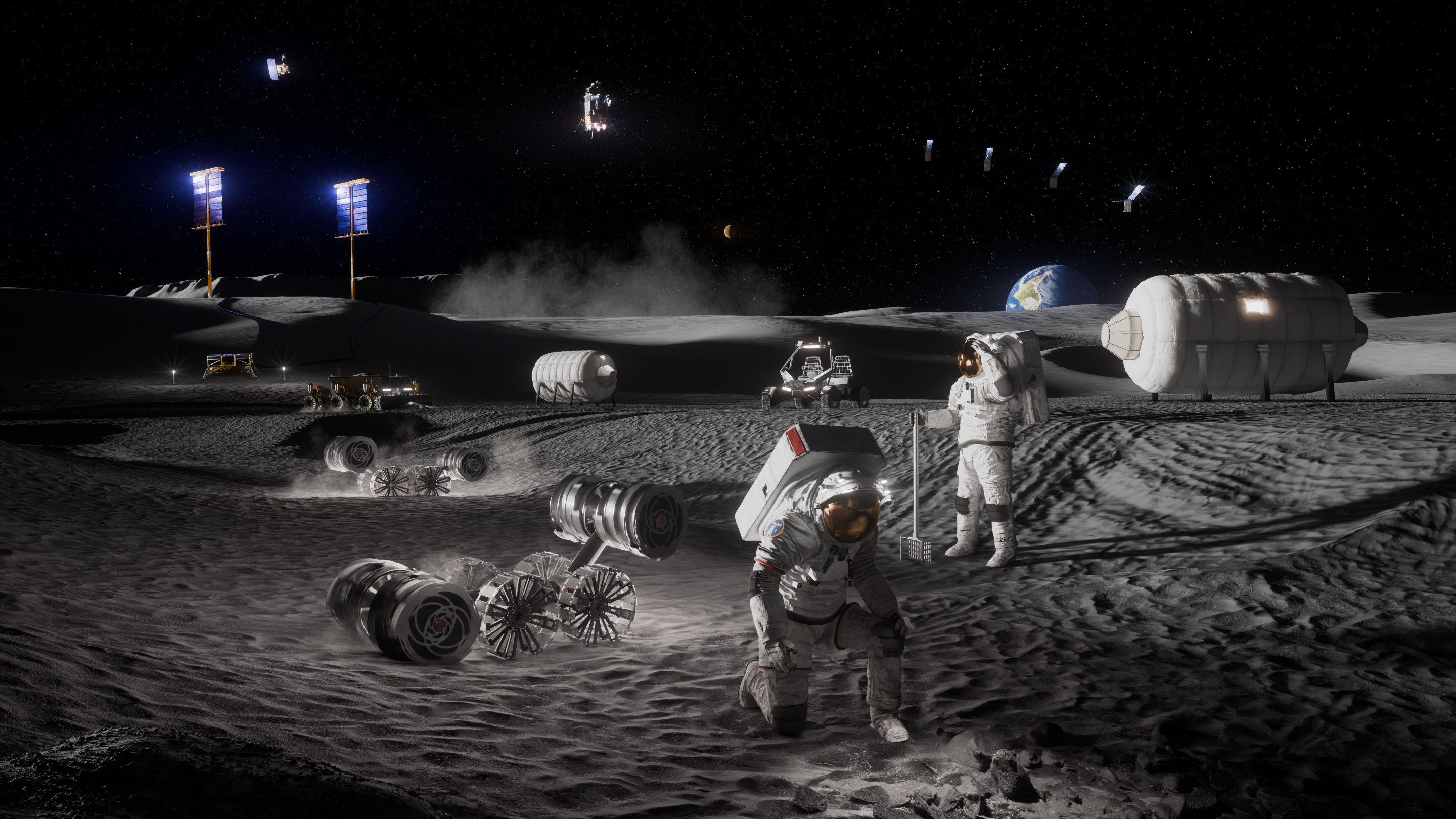
In the Moon’s South Pole region, sunlight can linger on some ridges while never reaching the floors of nearby craters. NASA hopes to use that stark contrast as it builds the Moon Base, a place where astronauts could live, work and explore for longer visits than before.
The South Pole was chosen for both practical and scientific reasons. Areas with longer stretches of sunlight could help power equipment and make travel easier. Deep, permanently shadowed craters are among the coldest places on the Moon, and scientists hope they hold frozen water. Finding water could help researchers understand the Moon and identify useful resources for future missions.
The outpost will take shape in three phases, with each stage building on what earlier missions learn. Phase One is underway. Over the next few years, NASA and its partners plan to send robotic missions to explore the region, test technology and practice landing. Landers and lunar terrain vehicles will run science experiments and help identify possible sites for the base.
Phase Two is planned for 2029 to 2032. NASA will begin placing long-term systems across several locations, including power supplies, cargo transport and communications equipment. Spreading these systems out could leave room for the base to grow. In Phase Three, NASA plans to bring the pieces together into a permanent outpost, with habitats and the power, communications and transportation systems astronauts need to stay for extended periods.
Several vehicles are intended to help make that plan possible. NASA’s VIPER rover is fully built and being tested at Johnson Space Center in Houston. It is scheduled to launch from Kennedy Space Center in Florida in 2027. VIPER is designed to explore permanently shadowed craters for water and other resources. It is expected to travel more than 15 miles, collecting data and examining lunar soil.
Another planned rover, PROMISE, will use nuclear power. It is being built from existing hardware developed for NASA’s Mars rover missions and will search for resources on and below the Moon’s surface. Its launch is targeted for late 2028. Crewed lunar terrain vehicles are also planned to reach the South Pole by 2028. Astronauts could drive them to explore farther and gather rock samples; when crews are away, the vehicles could be operated remotely from Earth to map the ground and collect information about local conditions.
NASA’s MoonFall mission is planned to send independently landing drones near the South Pole by 2028. During a single lunar day, about 14 Earth days, their high-definition cameras would map hard-to-reach areas and help NASA choose possible Artemis landing sites.
The region will be difficult to explore. The Moon has no noticeable atmosphere, and temperatures can exceed 130 degrees Fahrenheit (54 degrees Celsius) in sunlight or fall to minus 334 degrees Fahrenheit (minus 203 degrees Celsius) in permanently shadowed craters. Steep slopes, ridges, rocks and deep craters add hazards for both people and machines. Robotic scouts and remotely operated vehicles can help NASA learn the terrain before astronauts arrive. Each mission is a step toward a base built not in spite of the South Pole’s extremes, but with a better understanding of them.