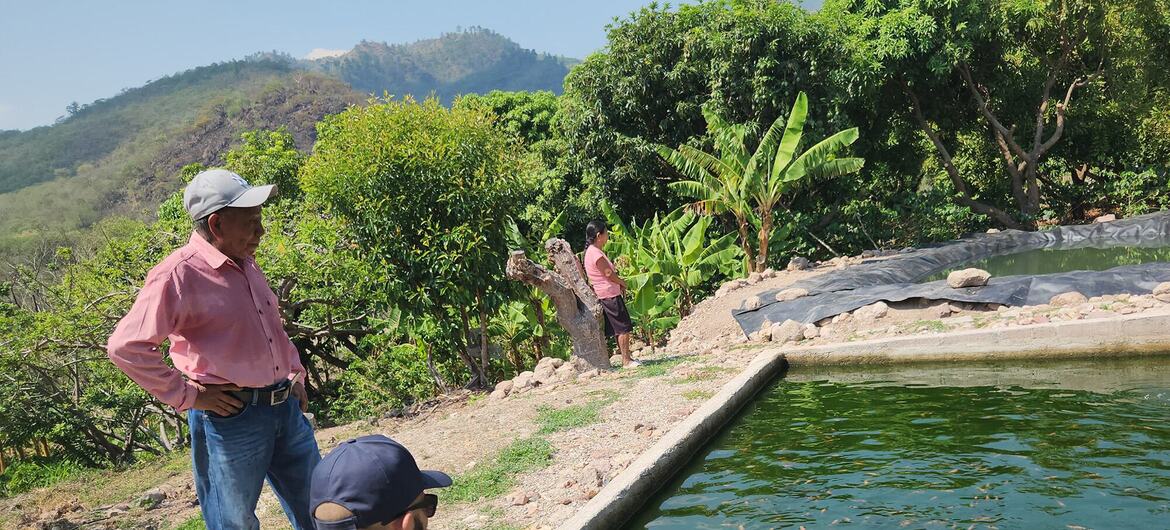
In Palagua, Honduras, Anastacio Martínez put five manzanas of his own land—about 3.5 hectares—toward a reservoir that could help his neighbors make it through the dry months. “When there’s no water, that’s where you run out of ideas,” he says. For a farmer who once depended on maize and beans, the shared water supply opened up new choices.
Palagua lies in Central America’s Dry Corridor, a drought-prone belt crossing parts of Guatemala, Honduras, El Salvador and Nicaragua. More than seven million people in the region lack guaranteed access to food. When rains stop before crops mature, families can lose both their harvest and their income, leaving them to face hunger or look for work elsewhere. The current El Niño climate pattern is raising the risk of below-average rain and drought in Central America. The World Meteorological Organization has said the event could be unprecedented in strength.
For years, Martínez planted two crops of maize and beans each year. A failed rainy season could wipe out both. The reservoir project, supported by the World Food Programme (WFP), changed how farmers could manage water. Reservoir storage and irrigation systems let them save water and use it during dry periods. Training helped farmers grow more kinds of food and make better use of limited water. The Food and Agriculture Organization of the United Nations supplied agricultural tools.
Martínez and other farmers spent three weeks learning at Zamorano, the Pan-American Agricultural School in Honduras. Among other skills, they learned to raise tilapia and grow plantains. Martínez, who once described himself as self-taught, now grows plantains, cassava, sweet potatoes and malanga. His farm also has about 80 mango trees and three fish ponds. He can harvest in both rainy and dry seasons, and neighbors buy produce directly from him. At 73, he is still farming. “I sleep peacefully. I have nothing to fear here,” he says.
In Camotán, in Guatemala’s Chiquimula Department, community organizer Marta Ávalos is helping neighbors prepare for another danger: having too little food when crops fail and household incomes vanish. Ávalos grew up in the town and worked picking coffee in some years so she could pay for school supplies and continue her education. She became a teacher, earned a degree in education and now works for the municipality, organizing community projects.
When WFP began helping local families cope with drought and the risk of child malnutrition, Ávalos helped organize the community response. Neighbors now store grain locally through preparedness measures supported by the Central Emergency Response Fund, a United Nations fund for urgent aid. The work is part of anticipatory action: taking steps before an expected crisis, rather than waiting until families are already in trouble. Ávalos says families are making more of what they receive than they did before.
The two communities show how preparation can address more than a dry field. Stored water, varied crops and locally held grain can give families more ways to get through a bad season without leaving home. Drought remains a serious threat across the Dry Corridor, but these projects are building practical resources—and skills—that communities can carry into the next one.