Peter Zoller compares the race to build the world's first industrial-scale quantum computer to the fervor of Mount Everest climbers in the 20th century—a breathless competition where participants ask "who is number one?" long before anyone considers why they're climbing at all. The pioneering theoretical physicist should know: it was Zoller and Ignacio Cirac, then a postdoctoral researcher in his group at the University of Colorado Boulder, who in 1995 proposed the first realistic blueprints for a quantum computer, imagining trapped ions as "qubits"—quantum bits that could exist in superposition, simultaneously representing 0, 1, and everything in between.
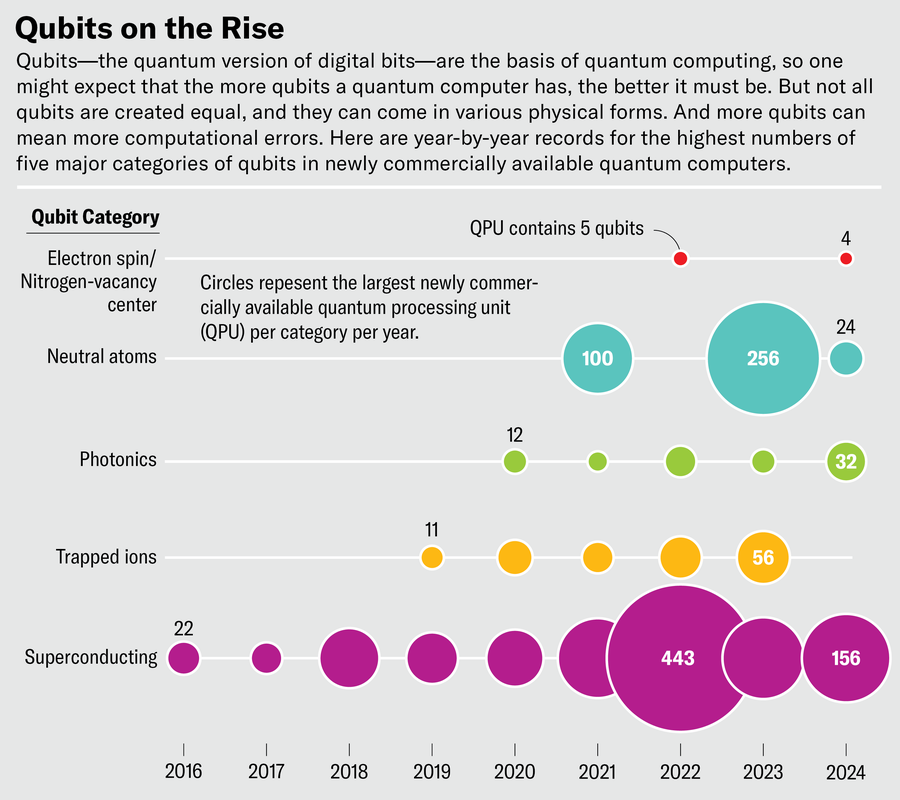
Three decades later, that vision is transforming into hardware. Teams around the world are now building quantum processors with hundreds, thousands, and even tens of thousands of qubits. IBM and Atom Computing, based in Berkeley, California, currently lead with systems hosting more than 1,000 qubits each. Last year, a research group at the California Institute of Technology built a record-breaking array exceeding 6,000 qubits—a milestone that would have seemed impossible a decade ago.
The excitement is palpable. In 2019, Google researchers led by Nobel Prize-winning quantum physicist John Martinis reported that their 53-qubit processor, Sycamore, had achieved "quantum advantage," performing a calculation in 200 seconds that would theoretically take classical supercomputers around 10,000 years. (IBM later disputed that figure, arguing their classical computer could do it in two and a half days, but the principle stood.) Yet even this historic breakthrough solved only an academic problem of little practical use—a proof of concept rather than a practical solution.
The real work lies ahead. In March, IBM's superconducting Heron processors accurately predicted neutron-scattering experiment results using 50 qubits or fewer, measuring the structure of an antiferromagnetic crystal at unprecedented scale. The catch: classical computers could perform the same task faster and more accurately. This gap reveals the hard truth experts now openly acknowledge: we remain years away from quantum computers able to tackle problems that even the best classical supercomputers cannot.
Those problems loom large. Quantum computers could one day break RSA encryption, the protocol securing bank transfers, cryptocurrencies, and digital communication worldwide. They could simulate quantum processes for fundamental physics, design better drugs and materials, and engineer artificial photosynthesis. But reaching that potential requires quantum physicists to solve three formidable challenges: scaling up to potentially a million qubits or more, engineering robust qubits that maintain their quantum properties longer, and correcting errors that emerge during calculations.
The timeline for cracking encryption has shifted dramatically. It was long believed that breaking RSA would require at least a million qubits. But in February, a team from Iceberg Quantum in Sydney, Australia, calculated that with careful optimization and error correction, hackers might need fewer than 100,000 qubits—a reduction so significant that Google announced in March a commitment to migrating its systems by 2029 to protect them. As quantum physicist Kihwan Kim of the Institute for Basic Science in South Korea notes, Google's 2019 demonstration was an important milestone, but "many people would say that it did not yet constitute a breakthrough on a problem of broad practical significance."
John Martinis, an expert on scaling quantum hardware, offers a sober assessment: there are no guarantees that million-qubit computers will ever be created. "The proof," he says, "will be building them and seeing that they work." For now, the quantum Everest expedition continues—but the climbers are finally asking whether the summit will deliver what the world actually needs.