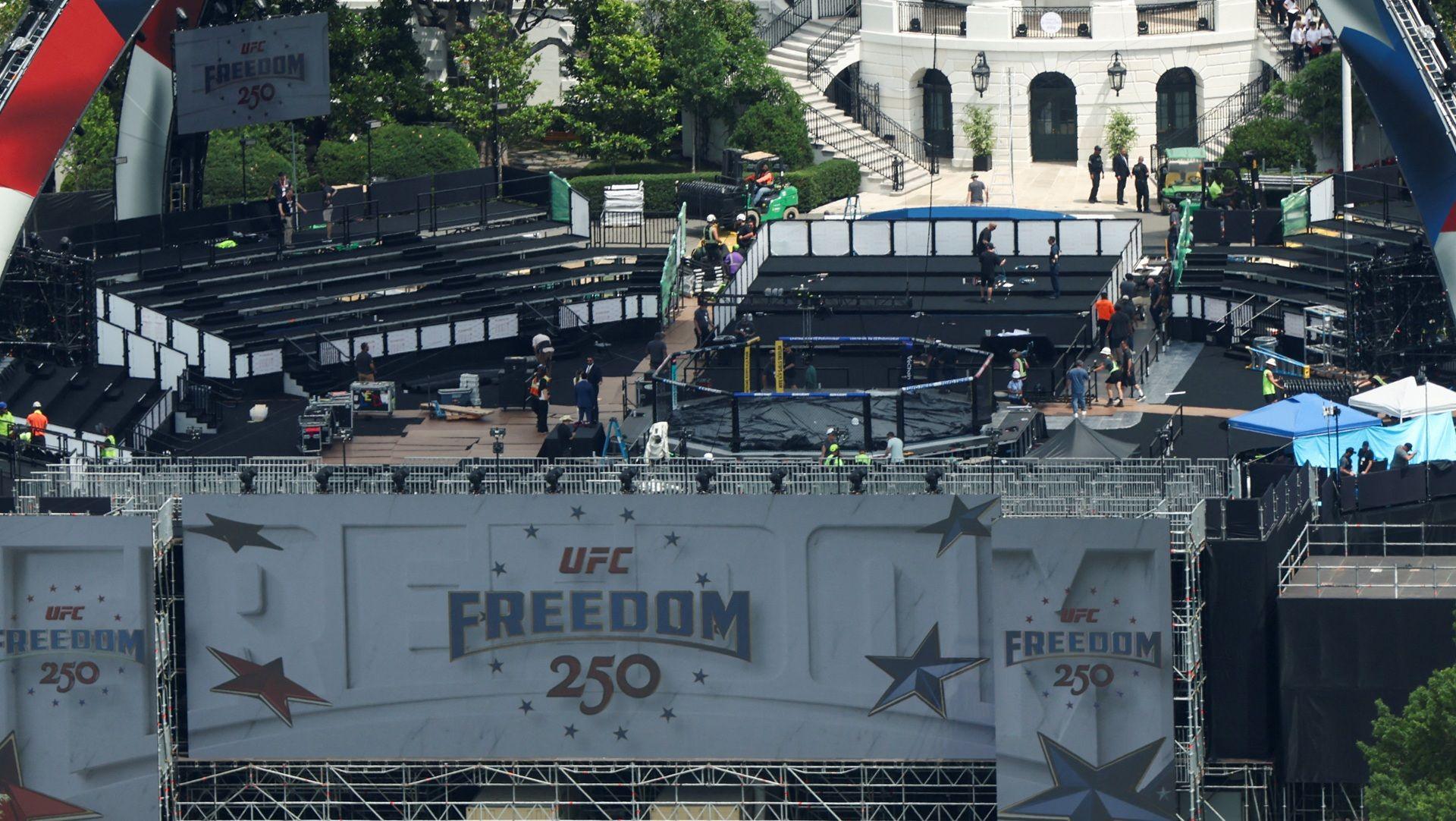
On the South Lawn of the White House, construction crews have been assembling something the historic compound has never seen before: a sprawling octagon arena, nicknamed "the claw," where lightweight champion Illia Topuria will defend his UFC title against Justin Gaethje this Sunday evening in Washington DC. The moment carries the weight of multiple historic convergences—the event marks 250 years of American Independence while also landing on President Donald Trump's 80th birthday, collapsing symbol-laden dates into a single, unprecedented evening on the most recognizable grounds in America.
The transformation has been striking. Over recent weeks, the White House landscape has shifted dramatically as construction workers have been assembling the infrastructure for UFC Freedom 250. The structure itself, which began taking shape in May, features domed arches spanning the staging area where the octagon will sit. For visitors arriving at 1600 Pennsylvania Avenue, the scene has been almost surreal—the careful geometry of power interrupted by the industrial apparatus of a professional fighting event, cables and steel rising against the backdrop of neoclassical architecture.
What makes UFC Freedom 250 noteworthy extends beyond the novelty. Topuria comes to the match as the reigning lightweight champion, defending his title against Gaethje, a fighter with significant credentials of his own. The choice to host mixed martial arts at the White House—an institution typically associated with state dinners, formal ceremonies, and diplomatic protocol—represents a striking shift in how American public spaces engage with popular culture. It signals, intentionally or otherwise, a recalibration of what the presidency chooses to celebrate and amplify.
The logistics alone have been staggering. Construction began months earlier to ensure the South Lawn could accommodate not just the octagon itself, but the thousands of spectators, production equipment, and security infrastructure required for an event of this scale. The domed arches of "the claw" aren't merely functional—they've become a visual signature of the preparations, the kind of architectural detail that immediately registers in photographs and memory alike.
For the fighters themselves, this represents rare territory. Topuria will be defending his lightweight crown in one of the most unconventional venues imaginable, every move broadcast from the very center of American political power. The symbolism is difficult to avoid—a cage match, an arena of controlled combat, set on the lawn where presidents have hosted state events and held press conferences.
The convergence of dates—250 years of independence, an 80th birthday, a title defense—makes Sunday evening something that won't be easily replicated. The White House has hosted countless significant moments in American history, but UFC Freedom 250 will occupy a particularly strange and particular corner of that narrative, a moment when the oldest institutions and newest forms of mass entertainment intersect in plain view. The eye-catching construction, the historic setting, and the title bout itself all point to an evening that will be watched and discussed far beyond the South Lawn itself.