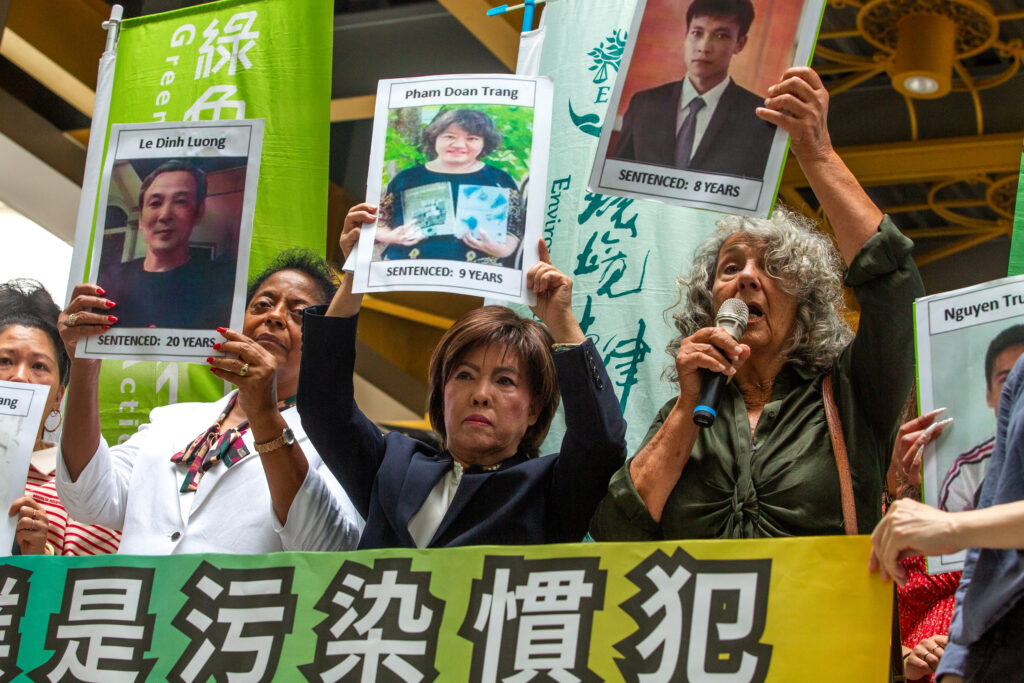
At nearly 80 years old, retired shrimper Diane Wilson traveled 8,000 miles from her tiny Texas Gulf Coast town to Taiwan, not to rest, but to confront one of Asia's largest petrochemical companies at its own shareholder meeting. Wilson, who spent all of March on a hunger strike outside a chemical plant near her home, had crossed 13 time zones with two fierce allies: Sharon Lavigne, a 76-year-old retired special education teacher from Louisiana, and Nancy Bui, 72, a former Vietnamese refugee whose organization is suing Formosa Plastics in Taiwanese court over a 2016 disaster in Vietnam.
Their journey to Taiwan wasn't driven by hope for quick victories. Wilson knew the company's board and chairman were unlikely to budge. Instead, she came to show Formosa—and the world—that decades of fighting corporate pollution haven't worn her down. The three women, brought by the Environmental Rights Foundation, a Taiwanese organization, came to pressure authorities, speak to shareholders, and inspire local activists battling the same multi-billion-dollar company on its home soil.
On a dock in Yunlin County during one of Taiwan's hottest weeks on record, Wilson met Lin Chun Lan, a gray-haired oysterman who has fought Formosa Plastics for 30 years. Their connection was instant and profound. Both were fisherfolk whose families had sustained themselves from the ocean for generations. Both had spent decades resisting the same corporation. Both had been shunned by local power structures for their refusal to compromise. As Lin's translator relayed his defiance—"He said, 'If you want to shoot me, just shoot'"—Wilson recognized her own stubborn resolve mirrored in a stranger across the world.
Wilson's activism has cost her dearly at home. For nearly 40 years, her radical environmental work branded her an extremist in a political system devoted to economic growth. But her persistence earned her the Goldman Environmental Prize in 2023, following a landmark lawsuit and a $50 million settlement agreement with Formosa Plastics on the Gulf Coast of Texas. Lavigne received the same prize for her fight against the company's plans to build in Louisiana's St. James Parish.
Both Wilson and Lin watched their fishing villages hollowed out by industrial development. Wilson remembers her Texas village's timeless way of life fading as marine life disappeared and petrochemical industries moved in with jobs that came at the cost of tradition and clean water. Lin recounted how Formosa once planned to fill his oyster farming waters with earth to build a steel mill. Though that particular project never materialized, later construction of industrial shipping infrastructure altered water currents so drastically that mud began filling the once-clear lagoon where his family had farmed for generations. Today, most fishermen along that coastline are gone.
This was Wilson's fourth trip to Taiwan since 1992, when local environmental groups first invited her to share what she'd learned from her battles in Texas. Over three decades, the relationship between activist and nation deepened into something more meaningful than strategy—it became a bond between people fighting the same enemy across oceans and languages.
Wilson didn't travel 8,000 miles expecting to win concessions on this trip. She came because staying in Formosa's face, decade after decade, matters. At 78, surrounded by allies just as weathered and determined as herself, she proved that some fights are worth crossing the world for.