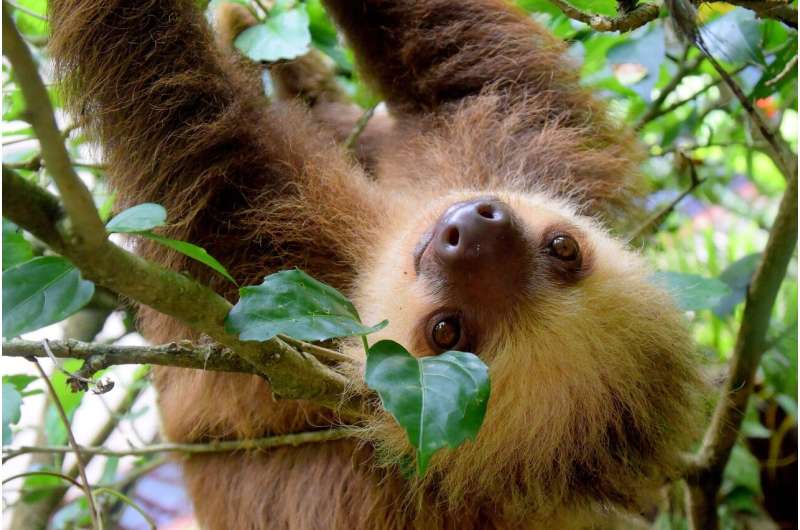
Deep in the rainforests of South America, the two-toed sloth hangs motionless in the canopy, its metabolism ticking along at less than half the speed scientists would expect for its body size. For decades, this enigma has intrigued biologists, but the dense jungle made it nearly impossible to unlock the genetic secrets behind the world's slowest mammal. Now, researchers at the Wellcome Sanger Institute and the Leibniz Institute for Zoo and Wildlife Research in Berlin have sequenced the two-toed sloth genome for the first time, revealing an extraordinary answer written in its DNA: sloth-specific "jumping genes" that have remained unchanged for millions of years and hold the key to understanding their famously sluggish metabolism.
The discovery matters because metabolism—how organisms convert food into energy—underpins health and aging in all mammals, including humans. If sloths have cracked the code for an exceptionally efficient, slow-burning system, that knowledge could reshape how scientists approach metabolism-linked diseases and aging. The team, which also included collaborators from Hospital Sírio Libanês in São Paulo, Brazil, published their findings in BMC Biology after extracting DNA samples from a captive sloth and sequencing them at the Max Planck Institute for Molecular Cell Biology and Genetics in Germany.
What they found was unexpected. Sloths carry multiple active copies of transposable elements—DNA sequences that can copy and paste themselves throughout the genome, sometimes called "jumping genes." These are remnants found in many mammals, but in humans they are typically inactive, old, and fragmented. In sloths, however, they remain active and have been conserved for approximately 30 million years, ever since they arose in the last common ancestor of all modern sloth species. When researchers compared the sloth genome with those of related mammals like anteaters and armadillos using a technique called comparative genomics, this pattern became clear.
Even more striking: many of these sloth-specific jumping genes are directly connected to mitochondria—the cellular powerhouses that generate energy—and to metabolic pathways. Dr. Marcela Uliano-Silva, senior bioinformatician and co-lead author at the Wellcome Sanger Institute, puts it plainly: "Evolution has already run billions of experiments. By studying unusual animals like sloths, we sometimes uncover biological solutions that humans never evolved." The team suspects these conserved genes are intimately tied to the sloth's extreme adaptation: the ability to regulate body temperature independently or allow it to fluctuate with the environment, sometimes dropping around 5°C (41°F), and the capacity to move through life burning energy at an extraordinarily low rate.
The research opens a promising new frontier. Scientists plan to study these genes in more detail using cell lines, lab experiments, and single-cell sequencing to validate exactly how they function. The long-term vision is ambitious: sloth cell lines could become a model system for understanding metabolism-related conditions and age-related health problems in other mammals, including humans. For the sloth itself, this genetic portrait confirms what anyone who has watched one feed on leaves from a single branch for hours already suspected—the slowness isn't laziness. It's written into every cell.