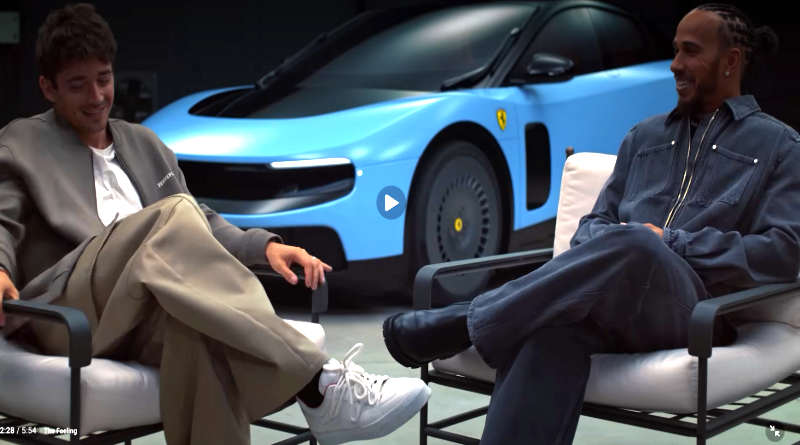
When Lewis Hamilton eased the Ferrari Luce around Maranello's Pista di Fiorano test track, something unexpected happened: the seven-time Formula One World Champion discovered the future might sound better than anyone expected. The newly unveiled Luce, Ferrari's first fully electric supercar, cost $640,000 and can hit close to 200 miles per hour despite its heavy battery cells—a feat that had Hamilton marveling at its engineering even as the car's radical departure from tradition left many Ferrari devotees, the tifosi, conflicted.
The disconnect tells a story about how innovation can divide even the most devoted fans. The Luce represents Ferrari's broadest pivot in decades, moving away from the roaring engines and rear-wheel-drive purity that defined the Maranello legend for eighty years. This five-seater, designed by Apple's former design guru Jony Ive and industrial stylist Marc Newson, carries 530 kilometers of range per charge and comes equipped with four-wheel-drive, four doors, and a spacious interior—features that feel more family car than track machine to traditionalists.
Yet when F1 teammate Charles LeClerc and Hamilton took turns testing the car, something remarkable emerged. Hamilton discovered twelve separate motors controlling everything from torque to suspension to steering—three per wheel, each with a specific job. "One controlling the torque. One controlling the suspension. And the other one," Hamilton paused during his explanation to LeClerc, "the steering, which is pretty incredible." LeClerc, still shaken from his passenger ride with Hamilton at the wheel, eventually found enthusiasm for what Ferrari had accomplished. "It's very Ferrari-like to look towards the future and to innovate," he said, praising the car's return to physical buttons that let drivers keep their eyes on the road.
The criticism from Ferrari's old guard was swift and stinging. Luca Cordero di Montezemolo, the former Ferrari chairman, seemed almost heartbroken. "It risks destroying a legend, and I'm deeply sorry," he said. "I hope they at least remove the prancing horse from that car." Others questioned whether the $640,000 price justified only 329 miles of range, whether eliminating the signature Ferrari engine growl was sacrilege, and whether a vehicle designed for family vacations could truly honor the brand's racing DNA.
Yet Hamilton's verdict suggested the engineers at Maranello had solved problems most observers didn't realize were solvable. "In terms of the attention to detail, you can tell that it's very Ferrari," he noted. "The power delivery is amazing. You just feel centered the whole time, even when you're going through corners." For LeClerc, the Luce represented something bolder: evidence that Ferrari could evolve without losing its soul. "The design is very-very different to what we've seen from Ferrari in the past," he said. "But I think it's very futuristic."
The question now is whether the tifosi can make the same leap. Ferrari's test track at Maranello, the Pista di Fiorano, with its 1.86-mile circuit designed to test every aspect of performance, had delivered its verdict through two of the world's most demanding drivers. Whether the passionate Ferrari fan base will embrace an electric future remains the real test—one that happens not on the track, but in the hearts of those who have loved the prancing horse for generations.