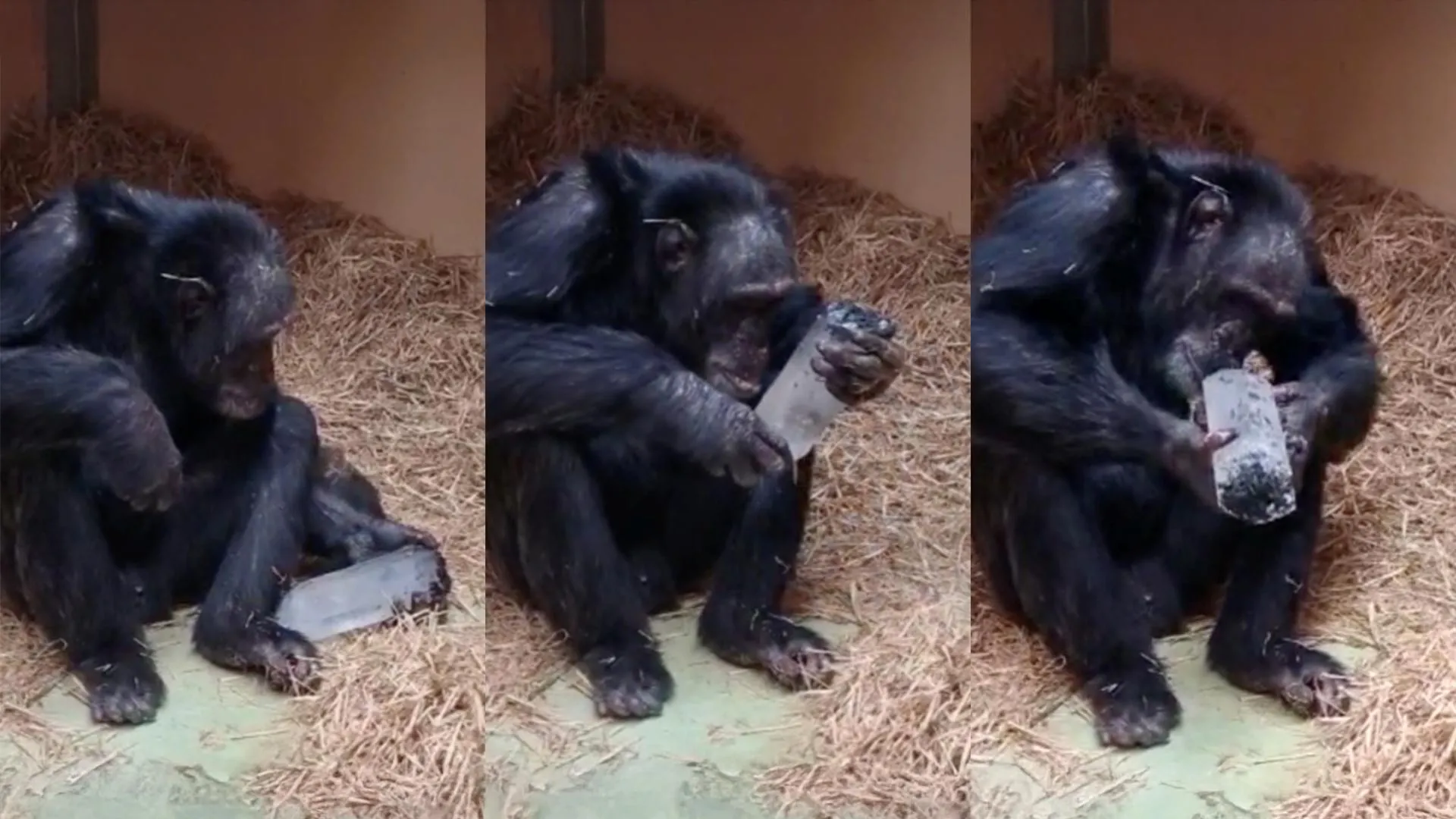
When a chimpanzee named Sandy picked up a handful of pebbles and crystals, she did something unexpected — she sorted them into separate piles, grouping the three different crystal types by their transparency and shine. It was a small moment, but scientists say it may help explain a behavior that has fascinated humans for hundreds of thousands of years.
Researchers at the Donostia International Physics Center in San Sebastián, Spain, have discovered that chimpanzees find crystals just as captivating as early human relatives did 780,000 years ago. Their study, published in the journal Frontiers in Psychology, suggests this attraction runs deeper than culture or learning — it may be written into our shared evolutionary history.
Humans and chimpanzees split from a common ancestor between six and seven million years ago, and the two species still share many traits. To test whether an attraction to crystals might be one of them, researchers gave two groups of chimpanzees at the Rainfer Foundation access to crystals alongside ordinary rocks. The first group included Manuela, Guillermo, Yvan, Yaki, and Toti. The second group included Gombe, Lulú, Pascual, and Sandy.
In the first experiment, researchers placed a large crystal beside a regular rock of similar size. Both objects initially caught the chimpanzees' attention, but the crystal quickly became the clear favorite while the ordinary rock was largely ignored. One chimpanzee, Yvan, eventually picked up the crystal and deliberately carried it back to the dormitories. The animals' curiosity was strongest right away and slowly faded over time — a pattern similar to how novelty wears off in humans. Caretakers had to trade bananas and yogurt to get the crystal back.
A second experiment tested whether chimpanzees could recognize smaller quartz crystals similar to those collected by ancient hominins. Mixed into a pile of 20 rounded pebbles, the crystals were selected within seconds — even after researchers added pyrite and calcite crystals with different shapes. Sandy, the chimpanzee who sorted objects by type, separated all the crystals, which differed in transparency, symmetry, and luster, from the ordinary pebbles.
"The chimpanzees began to study the crystals' transparency with extreme curiosity, holding them up to eye level and looking through them," said lead author Prof Juan Manuel García-Ruiz. "This ability to recognize crystals despite their differences amazed us."
Unlike trees, mountains, rivers, clouds, and animals, which are dominated by curved and branching forms, crystals stand out because of their flat surfaces and straight edges. They are the only naturally occurring polyhedral solids — geometric shapes with flat sides and sharp corners found nowhere else in nature. Those same qualities that caught chimpanzees' attention may also explain why early humans chose to collect them.
The researchers say similar experiments should eventually be carried out with wild apes, since the chimpanzees in this study live around humans. But the findings suggest something hopeful: our fascination with beautiful, unusual objects may be one of the oldest traits we share with our closest living relatives.