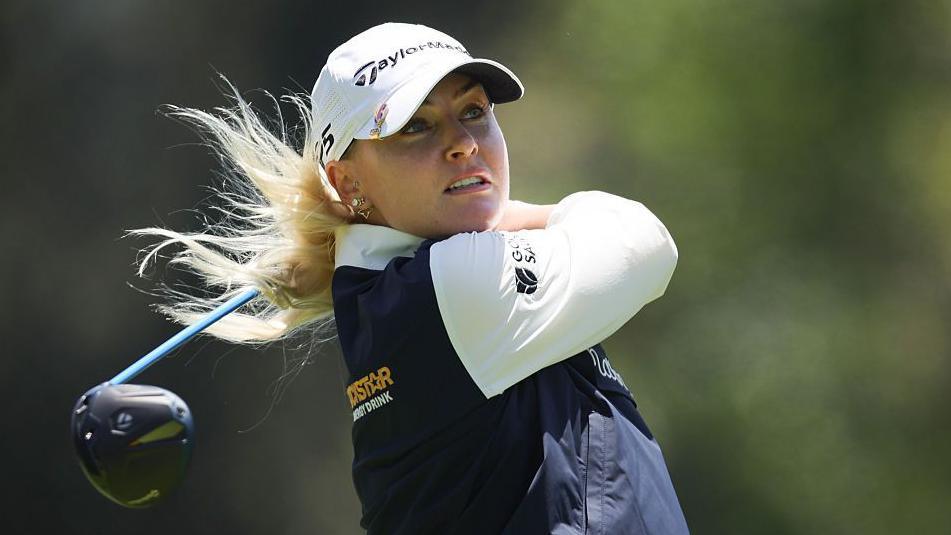
Charley Hull's closing putt at Riviera Country Club could have been for the championship—ten feet to the cup, the kind of moment where majors are won or lost. She calmly sank it anyway, posting a 67 in the final round that left her just one shot behind winner Nelly Korda at the US Women's Open in Pacific Palisades, California. For a 30-year-old from Kettering who has chased major glory for years, it was both achingly close and a sign that her breakthrough is near.
Hull's weekend assault on Riviera matched a championship record, combining a third-round 65—the lowest score of the week—with her clutch-filled closing 67. Her 132-shot total over the final two rounds equalled Meg Mallon's record from 2004 and reflected a dramatic shift in her approach. Rather than the cautious grinding of the opening days, Hull embraced what she calls "go for it" golf, starting her final round with an eagle and birdie in the first three holes. "I feel like sometimes, the first two days, I'm in a keep my head in the game," she reflected afterward. "But now I have nothing to lose. I can just go at everything and play free golf like I do at home and it's more fun."
The turning point was on the greens. Hull had required 63 putts over the first two rounds—a struggle that haunted her early week. But she picked up ten strokes on the greens in the final thirty-six holes, recovering from early mistakes to leave herself in contention when Korda, the world number one, reached the 18th. Korda's closing par secured her second major title of 2026, capping a season of extraordinary dominance that already includes the Chevron Championship. Her approach was methodical where Hull's was inspired: Korda spoke of grinding it out with caddie Jason McDede, talking through each shot without looking at leaderboards, staying patient through self-doubt before unleashing aggression when windows opened.
What makes this near-miss feel different for Hull is how close she has crept to breaking through. This is her fifth runner-up finish in major championships, but two of those have come in the past three majors. She has posted eight top-20 finishes in her last eleven major appearances—a pattern of excellence that suggests not if but when. At Pebble Beach three years ago, she was joint runner-up to Allisen Corpuz. The question is no longer whether Hull belongs among the game's elite, but when her combination of aggression and newfound composure will finally deliver that breakthrough win.
What made Riviera especially punishing—and especially suited to Hull's determined style—was how it tested every facet of golf. The approaches were sticky, making it hard to run balls onto greens. The putting surfaces were too firm to hold, demanding precision and nerve. Hull's 13 fairways hit on Friday and her improved accuracy down the stretch showed she had the technical game to handle it. She simply needed everything to align on the final nine, which nearly happened.
For Hull, watching Korda's ice-cream swirl putt disappear at the 18th must have stung. But as she walked off Riviera, she could look at her own record and her own play and see something undeniable: the major duck is not a curse anymore. It is a countdown. "I just love playing in the majors," she said. "If it's a normal week I struggle sometimes getting the motivation. But when it comes to major week, I just love it." That hunger, sharpened by six tournaments where she has come close enough to taste victory, suggests that patience for Hull's breakthrough is running short.