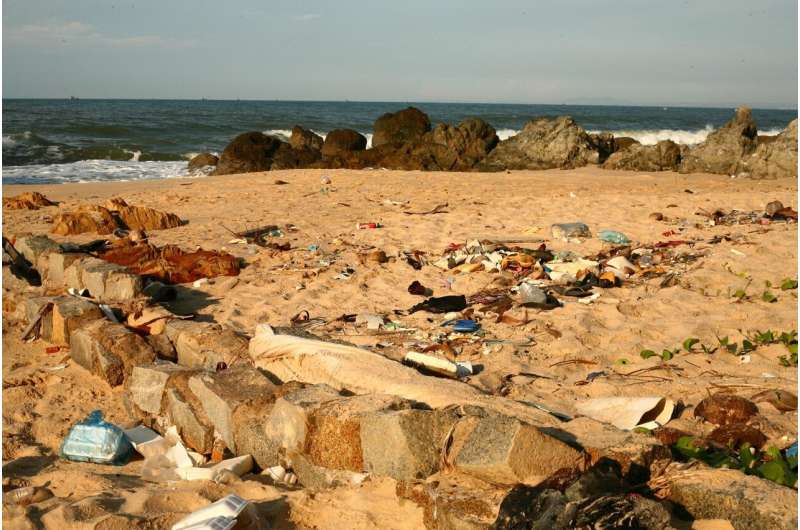
Northwestern University engineers have solved a puzzle that has long vexed environmentalists and marine scientists: why plastic products persist in sunlit rivers, lakes, and oceans for decades and centuries, seemingly immune to nature's cleanup efforts. The answer, Ludmilla Aristilde and her team discovered, is that water itself—not the absence of sunlight—is the culprit slowing plastic's demise.
The finding matters because it reframes how we think about plastic pollution. For years, scientists have known that ultraviolet light breaks down plastic through a process called photodegradation. Yet plastic debris in natural waters degrades far more slowly than laboratory studies suggested. Aristilde and her team suspected that earlier research was missing a critical detail: most lab experiments used pure water and artificial light, not the chemically complex reality of oceans, lakes, and rivers. They set out to fill that gap.
In a three-month study published in npj Materials Degradation, the researchers created realistic water conditions in the laboratory. They prepared ocean-like solutions with salt and dissolved ions like chloride, bromide, bicarbonate, and sulfate. They mixed freshwater scenarios with lower salinity and different ion compositions found in natural lakes and rivers. To some experiments, they added organic matter—decaying plants and microbial material—mimicking real environmental conditions. As a baseline, they also tested polystyrene plastic strips in purified water. All samples were exposed to simulated full-spectrum sunlight.
What they found was striking. Sunlight did trigger degradation across all conditions—plastic surfaces became rougher, cracked, and chemically altered. But the damage varied dramatically depending on the water's chemistry. Plastic degraded most in purified water, less in freshwater, and least in seawater. Under a microscope, samples in pure water showed obvious "mountains and valleys" on their surfaces after sunlight exposure. When researchers added natural organic matter, degradation slowed even further in both freshwater and seawater solutions. The more realistic the water became, the less the plastic broke down.
The reason is elegant in its simplicity: competition. Aristilde explained that in pure water, sunlight travels directly to the plastic and initiates chemical reactions. But in natural water teeming with dissolved ions and organic matter, those components intercept the sunlight first, competing for the same light-driven reactions that would otherwise hit the plastic. Meanwhile, salts dampen the plastic's chemical reactivity, and the combined effect of salts and organic matter can neutralize reactive molecules before they attack the polymer.
The implications ripple outward. This work was led by postdoctoral researcher Nasrin Naderi Beni and doctoral student Cara Flynn, members of Aristilde's research group at Northwestern's McCormick School of Engineering. Their findings suggest that solving plastic pollution requires designing materials that degrade even in salty, complex environments—or that don't rely on sunlight as the engine of their breakdown. It's a reminder that chemistry and environmental context matter as much as the plastic itself. As plastic accumulation continues in waterways worldwide, understanding why degradation stalls in real-world conditions is the first step toward engineering solutions that actually work where plastics end up: not in sterile laboratories, but in the messy, living waters of our planet.