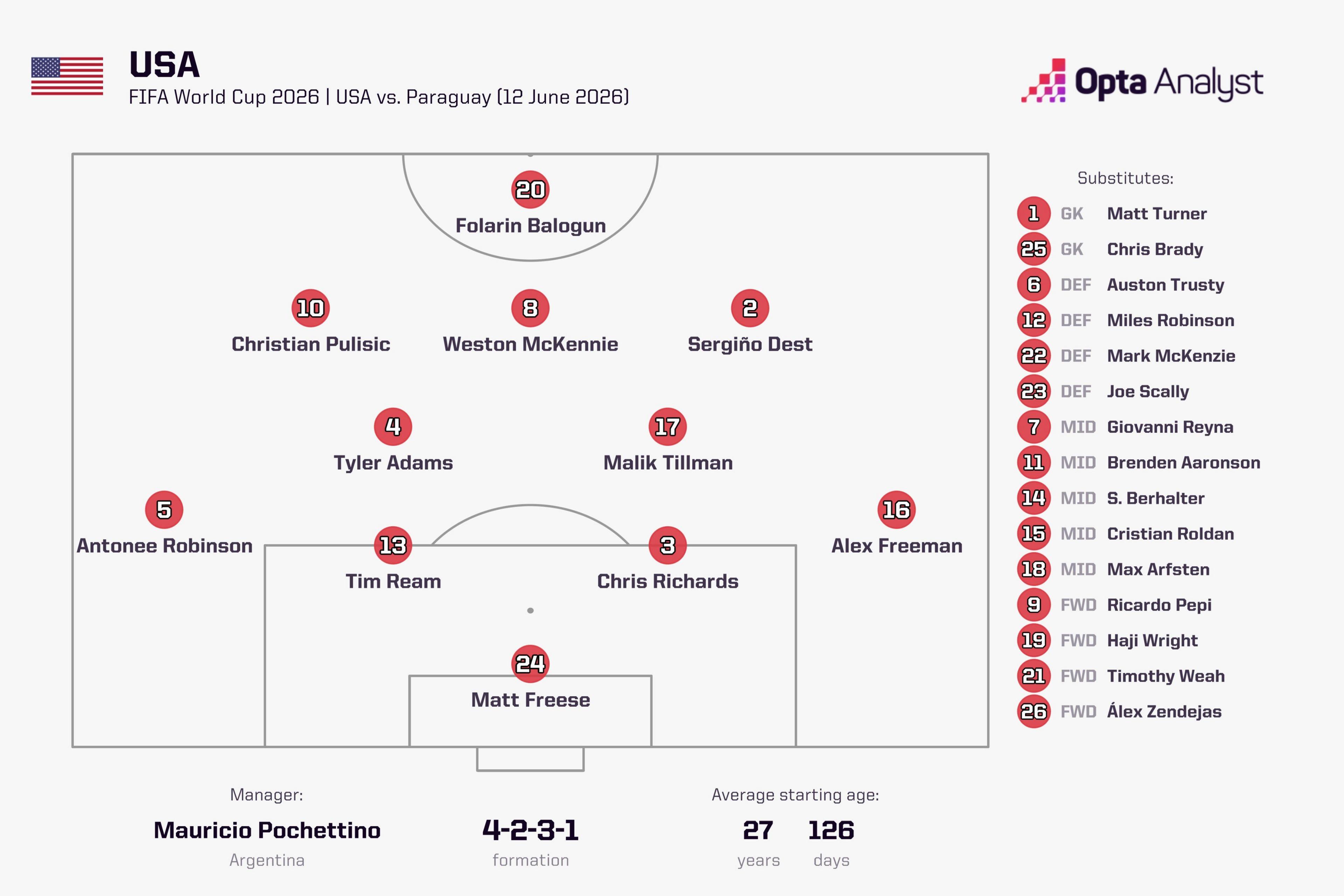
When Folarin Balogun received the ball between Paraguay's defensive lines and slotted home his second goal of the evening, he was doing exactly what Mauricio Pochettino had designed his squad to do — and the numbers behind that strike told a remarkable story. The United States had managed four goals from just six shots on target, an expected goals tally of 1.34 suggesting their attacking efficiency was nearly three times what the statistics would have predicted. It was the kind of ruthless, fluid performance that left even seasoned tactical analysts struggling to pin down exactly what formation they were watching.
For the past several seasons, the footballing world has grown accustomed to a rigid 3-2-2-3 shape in possession — Manchester City, Chelsea, and Arsenal have all employed a full-back pushing into midfield to create that familiar box. But Pochettino, the Argentine coach now steering the U.S. men's national team, has taken inspiration from that structure and then deliberately broken its rules. Against Paraguay in their World Cup opener, his side played a shape that defied easy categorization: the back line read as a four, the midfield dissolved into a roaming quartet, and traditional positional discipline was swapped for something far more elastic.
The fixed points in Pochettino's system were deliberate and few. Right-back Alex Freeman dropped alongside centre-backs Chris Richards and Tim Ream to form a three, with left-back Antonee Robinson pushing high on the opposite flank. Folarin Balogun stayed forward as the reference point up top. That was it. Everything else was designed to move.
The four players in the midfield — Tyler Adams, Malik Tillman, Weston McKennie, and Christian Pulisic — were tasked not with holding their positions but with finding each other. They clustered together in the middle of the pitch, swapped sides freely, and exploited the spaces between Paraguay's defensive zones. At one moment, McKennie drifted toward the left to join his three fellow midfielders, leaving the right half-space conspicuously open. That numerical advantage in a narrow band allowed for quick combinations that drew Paraguay's defenders out of shape, creating exactly the kind of hesitation that Balogun needed to race into behind.
The Pulisic-Robinson dynamic added another layer. The two swapped roles throughout the match — sometimes Robinson inverted into the midfield four while Pulisic stretched the pitch on the touchline, where his one-against-one dribbling caused constant problems. Other times, Pulisic drifted inside while Robinson hugged the line. The unpredictability made marking almost impossible against a team defending zonally, as Paraguay's players found themselves responsible for areas rather than individuals.
Pochettino called it something beyond tactics — a philosophy of freedom within structure. The results spoke for themselves: four goals, six shots on target, and a signal to the rest of Group D that this American side has figured out something genuinely new. When they face Australia on Friday, they'll look to prove it wasn't a one-night surprise but the beginning of something built to last.