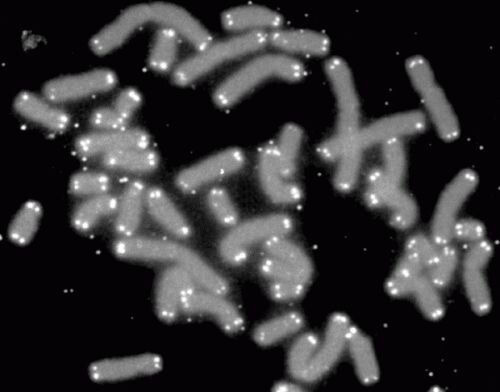
When Mary Armanios first began studying families with puzzling cancer patterns—multiple generations affected by lymphoma, leukemia, and melanoma—she noticed something unusual in their blood cells. Their telomeres, the protective caps on chromosomes that typically shrink with age, weren't shortening the way they should. Instead, these immune cells were staying biologically young far longer than normal, and that prolonged youthfulness was creating trouble.
Armanios, a professor of oncology and genetic medicine who directs the Telomere Center at Johns Hopkins, has spent years tracing this paradox. Now, research published in Blood reveals how inherited mutations in the POT1 gene disrupt normal cellular aging, allowing lymphocytes to survive far beyond their typical lifespan—and, in doing so, creating conditions where cancer-causing mutations can accumulate unchecked.
"In this setting, lymphocytes retain a kind of youthfulness that allows cancer-associated mutations to persist and expand over time," Armanios explains.
The findings emerged from examining 51 individuals across 24 families who carried POT1 variants. Normally, POT1 acts as a brake on telomere length, keeping these protective caps from growing excessively. When one copy of the gene is inactivated, that brake fails. About 60 percent of mutation carriers developed ultra-long telomeres—placing them in the top one percent of the human population for telomere length.
That cellular longevity comes with a cost. Data from the UK Biobank, which tracked 210 adults with POT1 variants alongside nearly 500,000 others, revealed an eightfold higher risk of lymphoma. By age 80, roughly 45 percent of carriers had developed a lymphoid cancer. Three-quarters of these blood cancers arose from lymphocytes—exactly the cells whose lifespan had been extended.
But the study also surfaced a more hopeful pattern. "The good news is the cancers tended to be slow-growing and usually curable," Armanios notes. Family members developed everything from childhood leukemia to adult-onset chronic lymphocytic leukemia—cancers often considered biologically separate—yet across generations, these malignancies shared a common thread: their indolent nature.
Perhaps most significantly, researchers discovered that even before lymphoma diagnosis, carriers showed early signs of trouble. After age 60, nearly all POT1 mutation carriers displayed expanded lymphocyte clones, carrying mutations commonly associated with lymphoma. This discovery opens a window for monitoring. If doctors can track the emergence of these clones, they might catch cancers earlier—or potentially intervene before malignancy develops.
The research points toward a fundamentally new mechanism of cancer susceptibility, one rooted not in a tumor's aggression but in the very persistence of the immune cells meant to protect us. Understanding that persistence may be the key to watching for it.