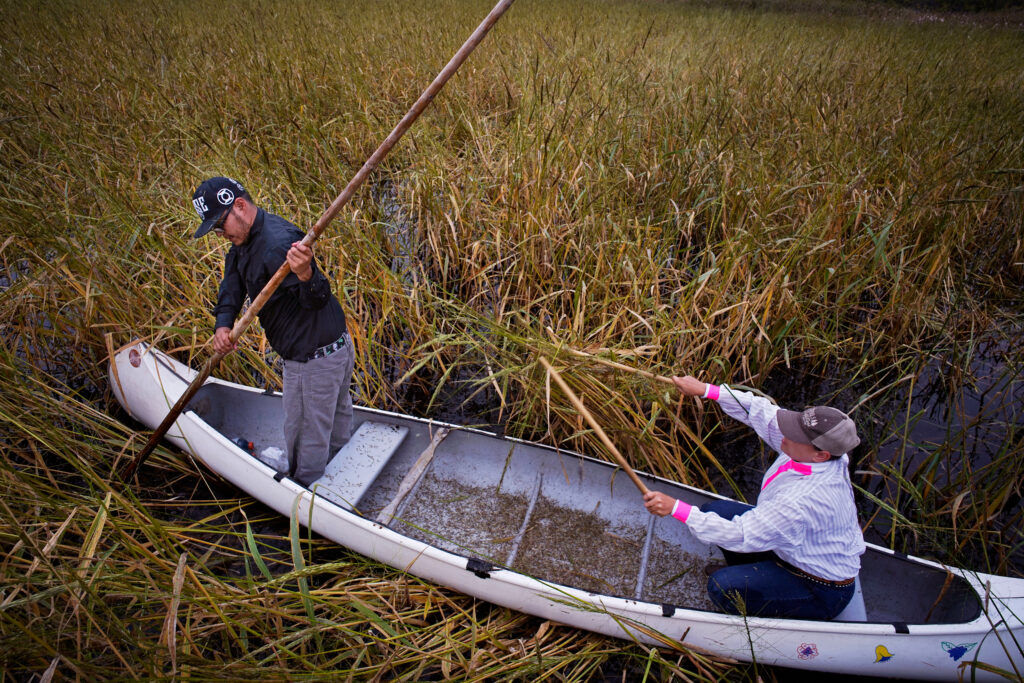
Bazile Minogiizhigaabo Panek was seven years old when his mother poled their canoe through the shallow waters of northern Wisconsin, and he and his sister began tapping wild rice plants with sticks, watching the seeds rain down into the boat. That memory—part of a practice Indigenous peoples have carried out for millennia—carries profound weight. For the Ojibwe, Dakota, Menominee, and other tribes of the Upper Midwest, manoomin, as wild rice is known in their languages, is far more than a food source. It is a relative, a teacher, and the living embodiment of cultural identity.
Yet the manoomin that once abounded throughout the region has been declining sharply. Federal and local agencies dammed rivers for hydroelectric power and logging; pollution from mining and farming degraded waterways; motorboat wakes ripped plants from lake bottoms during vulnerable growth stages. Finding where manoomin still grows, protecting those habitats, and restoring them has proven slow and costly—work complicated further when the Trump administration cut funding for some restoration projects. For a people whose connection to this plant stretches back thousands of years, the erosion of manoomin represents an erosion of identity itself.
But the plant and its protectors have shown remarkable resilience. Recent breakthroughs offer real hope. Researchers have discovered that drone technology can detect wild rice growth patterns with precision, potentially transforming restoration efforts from guesswork into strategy. Separate research co-authored by Panek, published last year, demonstrated that cutting back competing vegetation and strategically lowering water levels during certain growing periods can slow the plant's decline. These are not exotic interventions—they are practices rooted in traditional ecological knowledge, refined by science.
Beyond the laboratory, tribes, universities, and nonprofits are partnering on the ground. At the University of Wisconsin-Madison, Jessie Conaway, an Indigenous arts and sciences research coordinator, is leading wild rice restoration efforts around Wisconsin's Lake Winnebago. Her vision is direct: locate habitats that historically sustained rice, then equip community members with the skills and equipment to harvest and process it themselves. "This leads to food sovereignty, cultural revitalization, nutrition, the building blocks of communities," Conaway says.
This collaborative approach stands in contrast to earlier scientific efforts. For more than a century, researchers at the University of Minnesota have pursued genetic modification to create "shatter-resistant" or "shatter-proof" varieties—manoomin engineered to withstand industrial harvesting. Taylor Fairbanks, a member of the White Earth Nation who recently completed her senior thesis on manoomin's history, pushes back on this path. Genetic modification, she argues, severs the relationship between people and plant. "When we create manoomin to become shatter-proof, then it's not actually manoomin," she said. "Manoomin has been able to steward itself, and we have been able to do that in return."
This tension reflects a deeper question about who gets to define restoration. In 2018, the White Earth Band of Ojibwe enacted a groundbreaking ordinance recognizing manoomin's inherent rights to exist, flourish, regenerate, and evolve—a striking assertion that the plant itself holds legal standing. The work now underway honors that principle: restoring manoomin not by remaking it, but by protecting its ability to be what it has always been.