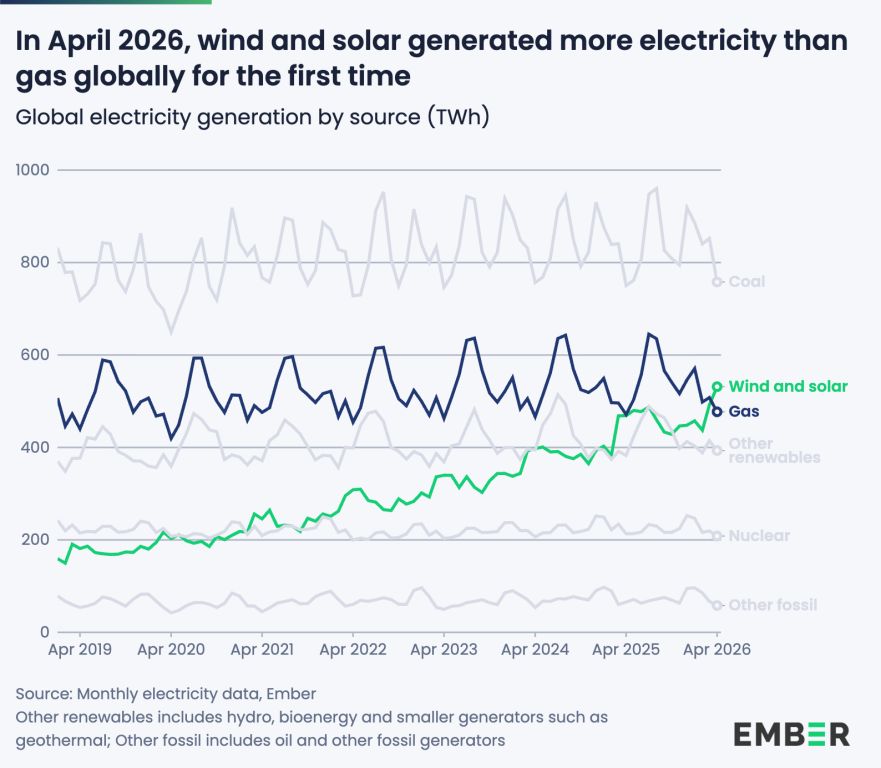
In April 2026, wind and solar power generation crossed a threshold that would have seemed impossible just years before: for the first time in history, renewables generated more electricity than natural gas on a global scale. The milestone arrived not in a laboratory or policy briefing, but in the actual power grids supplying the world—wind and solar reached 531 terawatt-hours while gas contributed 477 TWh, a 54 TWh advantage that represents far more than a statistical curiosity.
This shift matters because energy systems shape everything from geopolitical stability to climate futures. For decades, gas has been treated as the bridge fuel of the energy transition, the "lesser evil" that would carry us from coal toward renewables. But April 2026 suggests that bridge is being bypassed entirely. The growth is not a blip driven by temporary factors. Ember's analysis shows that five years earlier, in April 2021, global gas generation stood at nearly identical levels—476 TWh—while wind and solar generated just 245 TWh. In five years, renewables nearly doubled while gas barely budged, revealing the true speed of transformation underway.
The momentum accelerated across major economies. China reported 14 percent year-on-year growth in wind and solar generation, the European Union achieved 13 percent growth, and the United States saw 8 percent increases. But the standout figures came from smaller players reshaping their grids: the United Kingdom posted a striking 35 percent increase, Australia 17 percent, and Chile 24 percent. Globally, wind and solar output rose 13 percent year-on-year during the month. These gains came while the world faced a new energy crisis triggered by Middle East conflict—precisely the kind of moment when countries might reach for familiar fossil fuels.
Instead, countries accelerated renewable deployment. Indonesia unveiled plans for 100 gigawatts of solar-plus-storage capacity. South Korea committed to tripling its renewable energy capacity to 100 GW by 2030. The Philippines, Thailand, and the United Kingdom all accelerated project approvals. Kostantsa Rangelova, speaking from Ember, captured the economic logic driving this shift: renewables are "cheap, homegrown and secure sources of electricity." For countries dependent on imported liquefied natural gas, LNG-powered electricity is increasingly unable to compete with wind and solar—a fundamental reversal that changes which energy sources make financial sense to build.
It's worth noting that April's seasonal conditions—strong spring winds in the northern hemisphere combined with rising solar output and lower electricity demand between heating and cooling seasons—created ideal circumstances for renewables to surpass gas. The achievement doesn't yet reflect annual global figures, where wind and solar have not yet exceeded gas generation over a full year. But Ember found no evidence of large-scale switching from gas to coal globally, suggesting the displacement is occurring in only one direction.
What April 2026 reveals is not a temporary reaction to crisis but a structural reshaping of global electricity markets. Wind and solar met all of global electricity demand growth in 2025, according to Ember's previous research. The real story is not one month's milestone, but the convergence of economics, geopolitics, and climate urgency all pointing in the same direction. For the first time, the fastest-growing electricity sources are not just renewable—they are becoming irreplaceable.