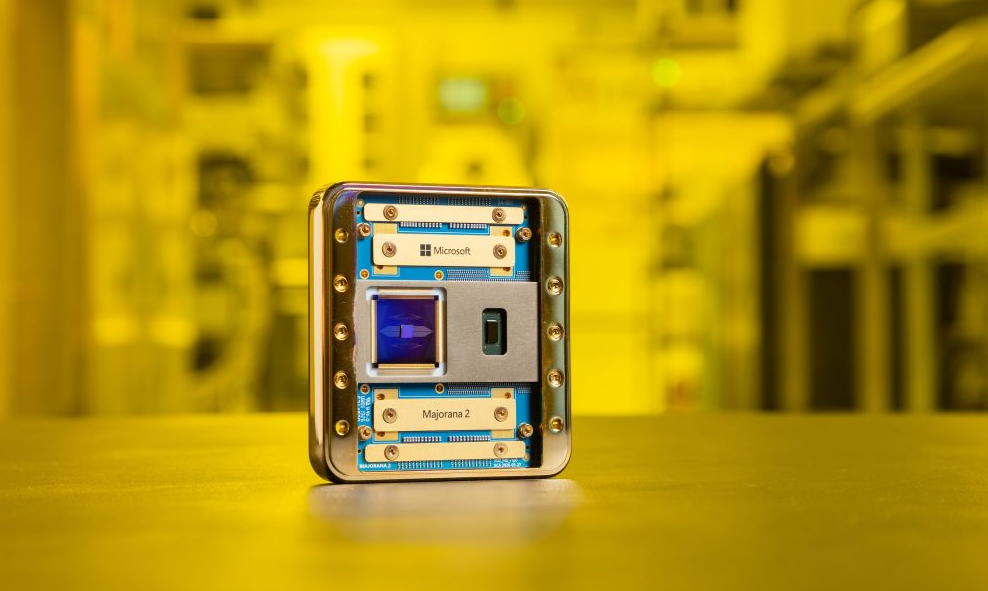
Microsoft's new Majorana 2 quantum chip can hold a qubit stable for a full minute—a breakthrough that cuts the company's timeline for building a commercially viable quantum computer roughly in half.
The achievement matters because quantum computing has long been plagued by a fundamental problem: qubits are fragile. They lose their quantum properties when exposed to even tiny environmental disturbances, making it nearly impossible to perform meaningful calculations before the system collapses. Microsoft has been pursuing a distinctive solution called topological quantum computing, an approach that stores information across multiple Majorana particles rather than in a single particle. Because the data is distributed this way, it gains inherent protection against localized noise—like having information written in two places at once instead of one.
Last year, Microsoft introduced Majorana 1, which achieved qubit lifetimes of five to 10 seconds. The new Majorana 2 has shattered that record. Some qubits now remain stable for as long as a minute, while the chip consistently achieves at least 20 seconds of stability per qubit. According to Microsoft Technical Fellow Chetan Nayak, this represents a 1,000-fold improvement in stability compared to its predecessor. The key difference is material: Majorana 2 swapped out aluminum superconductors for lead ones, which provide superior shielding against the external disturbances that cause errors.
This incremental but decisive materials change, combined with operation speeds reduced to microseconds and extremely small qubit dimensions, has given Microsoft enough confidence to announce it could build a scalable quantum computer by 2029—half the timeline the company previously stated. "We need to make improvements each year that will get us closer to delivering a computer that we believe will have massive commercial and societal value," Nayak said. "We're 1,000 times better" than a year ago.
Notably, Microsoft achieved this breakthrough with help from its own agentic artificial intelligence research platform, Microsoft Discovery. Rather than relying solely on human researchers to run experiments and analyze data, autonomous AI agents handled many of the complex measurements required during chip design, optimized the fabrication process, and sifted through decades of research data to surface patterns and problems that human teams might have missed. Because these agents work faster than people and can process information across multiple scientific disciplines simultaneously, they generated new hypotheses and identified previously unnoticed performance issues.
Holger Mueller, an analyst at Constellation Research, called the achievement a massive step forward. "It had seemed like the industry had already settled on the materials science behind quantum circuitry, but then here comes Microsoft with a new chip that uses a special indium arsenide compound to make it 1,000-times more potent with 20 seconds of qubit parity lifetime," Mueller said. "That's basically unheard of." The fact that Microsoft unveiled this work during its Build keynote, he noted, signals the company's serious commitment to solving the quantum computing puzzle.
The work sits at the intersection of two profound technological challenges: building hardware stable enough for quantum computation, and deploying AI tools that can accelerate scientific discovery itself. If Microsoft's roadmap holds, the next few years could finally deliver on the long-promised potential of quantum computers to solve problems that today's classical machines cannot touch.