On May 23, scientists and conservationists around the world pause to celebrate World Turtle Day—and this year, they have real reasons to hope. While more than half of the world's 359 turtle and tortoise species now face extinction, a remarkable year of conservation breakthroughs shows that with sustained effort and ingenuity, humans can pull these ancient creatures back from the brink.
Turtles, tortoises, and terrapins have survived for millions of years, outlasting dinosaurs and enduring multiple ice ages. Yet they cannot evolve quickly enough to adapt to the pressures of the modern world: climate change, habitat destruction, trafficking, and fishing nets have pushed the order Testudines to a crisis point. The International Union for Conservation of Nature has identified 68 species as critically endangered, including the Burmese roofed turtle, of which only about 10 mature individuals remain in the wild.
But 2025 brought genuine victories. In February, Floreana giant tortoises returned to Ecuador's Galápagos Islands after nearly 180 years of absence, presumed extinct. A decades-long breeding program had carefully preserved DNA from Floreana populations living on neighboring islands, allowing scientists to rebuild the species on its native home. It is a painstaking restoration that required patience, scientific precision, and institutional commitment—a model for what species recovery can look like.
Globally, green turtles achieved a milestone last year: their population increased by approximately 28 percent since the 1970s, earning them reclassification from endangered to least concern. This turnaround reflects the impact of international protections, habitat restoration, and careful coastal management across the species' global range.
Mexico demonstrated how enforcement and innovation can work together. In November 2025, police operations targeting turtle trafficking recovered more than 2,300 live, wild-caught freshwater turtles and released them back into suitable habitat. The operation was triggered by the theft of 55 critically endangered Vallarta mud turtles—the world's smallest turtles—from a university laboratory. That same month, researchers in Mexico tested fishing nets equipped with solar-powered green lights, finding they reduced turtle bycatch by nearly two-thirds. The theory is elegant: the flashing lights help green turtles and loggerhead turtles see the nets in dark water and avoid becoming tangled in them. If deployed widely, this low-cost innovation could spare thousands of lives each year.
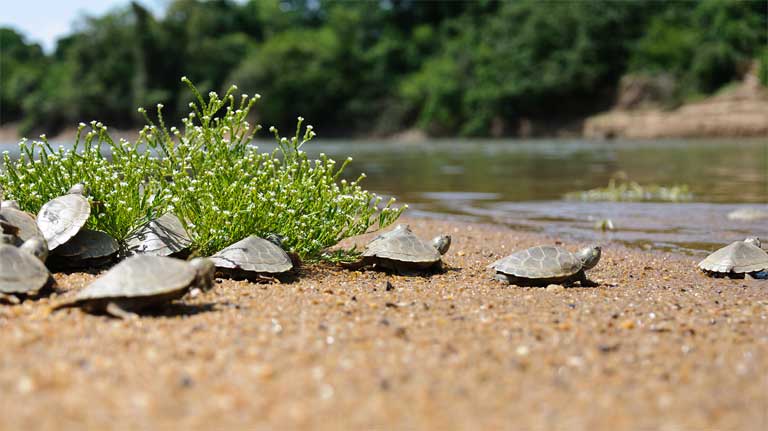
Yet conservation threats persist. In the Brazilian Amazon, researchers have raised alarms about a proposed shipping waterway on the Tapajós River. The Amazon river turtle, South America's largest freshwater species, relies on underwater vocalizations to coordinate nesting, hatching, and migration across vast distances. Dredging equipment and barge traffic would introduce noise that could disrupt these critical signals in one of the species' most vital breeding areas. Brazil classifies the species as near threatened and approaching vulnerable status, meaning that even incremental habitat disruption could tip it further toward decline.
These stories—extinction and rescue, loss and recovery—reveal a deeper truth about turtle conservation. These species have evolved over millions of years to thrive in specific environments. Their survival depends on humans recognizing that their recovery is not merely a matter of good intentions, but of sustained action: breeding programs, trafficking enforcement, fishing innovation, and protection of their acoustic and physical habitats. World Turtle Day reminds us that we have both the responsibility and the capacity to ensure that turtles, which have outlasted so much, do not outlast us.