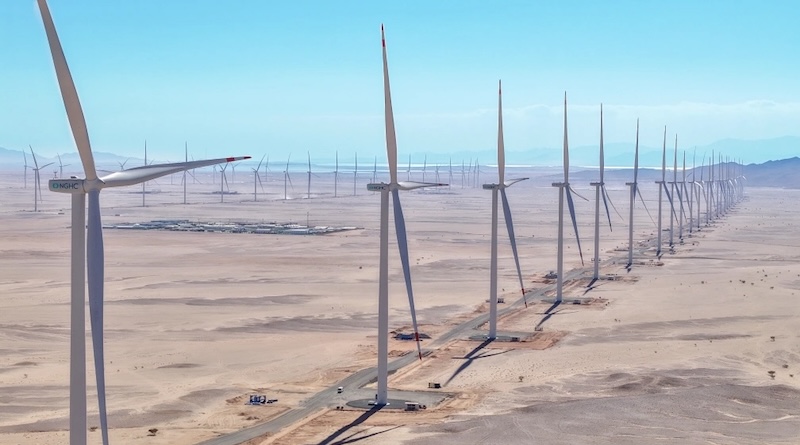
Deep in the Saudi Arabian desert, where the Red Sea meets the sky, the world's largest green hydrogen plant is rising from the sand. It is already 80 percent complete, and its builders say it will begin churning out clean energy this summer — right on schedule, despite political winds blowing in the opposite direction thousands of miles away.
The plant sits in Oxagon, a futuristic industrial city being carved out of the northwestern Saudi Arabian coast inside the ambitious NEOM project. When finished, it will be a beast: 257 wind turbines spinning alongside a solar farm so vast it covers an area roughly the size of Manhattan, the dense island at the heart of New York City. Together, those turbines and panels will generate 4 gigawatts of renewable electricity — enough to power millions of homes — all fed into machines called electrolysers that split water into hydrogen and oxygen using clean energy instead of fossil fuels.
The hydrogen produced here will not travel far by ship in its original form. Instead, it will be mixed with nitrogen to create green ammonia, a substance easier and cheaper to ship across oceans than hydrogen gas. The plant is designed to produce 600 tonnes of green ammonia every single day. That ammonia can become fertilizer for farms, fuel for ships, or be "cracked" back into hydrogen wherever it is needed — in Europe, Asia, or beyond.
Three partners are building this massive undertaking. The project is owned by the NEOM Green Hydrogen Company, a joint venture between NEOM itself, Saudi Arabia's ACWA Power, and a surprising American company: Air Products. Headquartered in Pennsylvania, Air Products has been a leader in industrial gases for decades. The company announced earlier this year that it is finalizing a deal with Yara, a Norway-based global firm, to market and distribute the ammonia this plant will produce.
The timing is striking. While the United States has seen roughly $121 billion in renewable energy investments cancelled or put at risk amid shifting federal policies, according to energy research firm Wood Mackenzie, the rest of the world is not waiting. Investors and governments in the Middle East, Europe, and beyond are pressing ahead with clean energy projects that critics say the United States is now passing by.
Green hydrogen is still a young technology, and experts are watching closely to see whether large-scale projects like NEOM can deliver on their promises. But for now, the desert construction site at Oxagon is a visible sign that the global push toward clean energy is bigger than any single country's politics. The turbines are spinning, the panels are gleaming, and the first hydrogen could flow before the year is out.