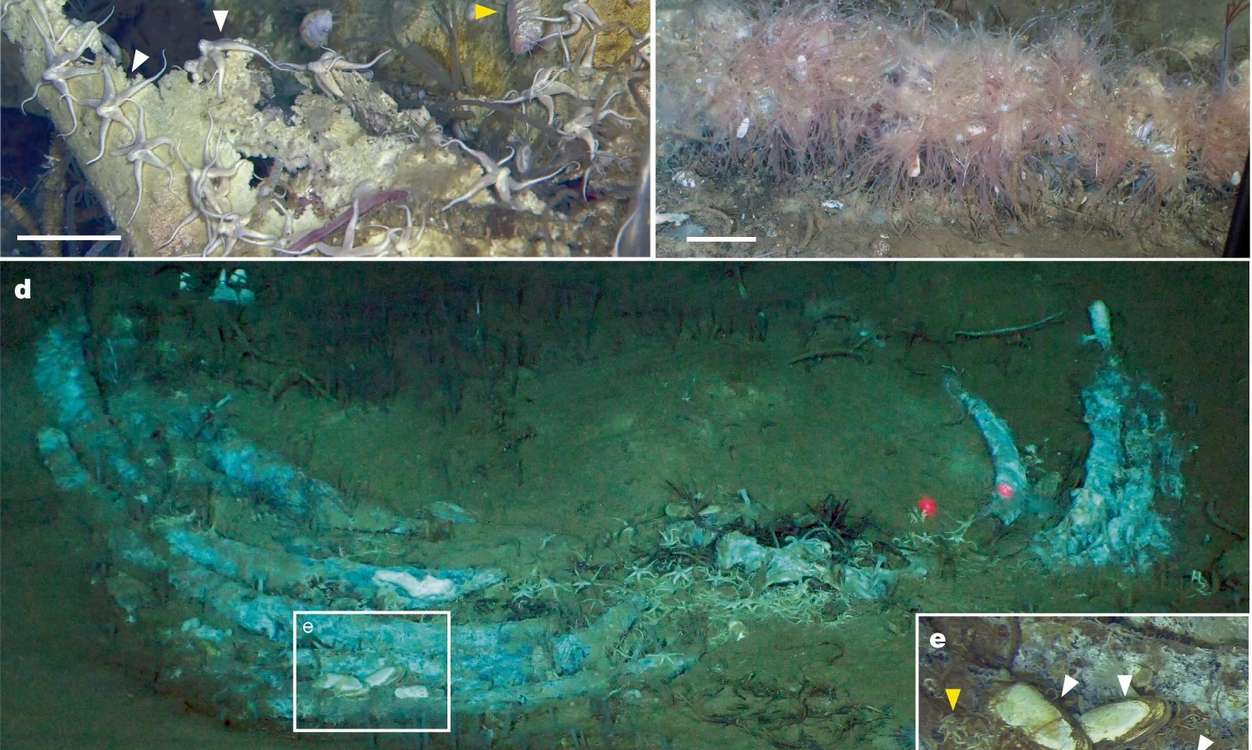
Peng Zhou reached for the robotic arm of the submersible, his screen glowing with the ghostly outline of a whale skull half-buried in the abyssal mud—5.3 million years old, yet still drawing life from the darkness. At 20,000 feet below the Indian Ocean, in the remote Diamantina Fracture Zone, Zhou and co-lead scientist Xiaotong Peng had stumbled upon the largest whale graveyard ever discovered, a sprawling necropolis where death fuels an extraordinary web of deep-sea survival. What they found wasn’t just bones—it was a thriving, otherworldly community, pulsing with bivalves, brittle stars, jellyfish, and worms, many of which may be entirely new to science.
Whale falls—carcasses that sink to the ocean floor—have long been recognized as oases in the deep, supporting species that rely on sulfide-rich environments much like those around hydrothermal vents. But the scale of this discovery is unprecedented. The team documented nearly 500 whale skeletons across a 660-mile stretch of seafloor, collecting 485 bones during their dives. Their estimates suggest up to 10 million dead whales may lie within this zone, most belonging to beaked whales, including modern species like Andrews’ beaked whale and the strap-toothed whale. Fossilized remains of an Antarctic minke whale and a living sei whale were also found, alongside the skulls of two extinct species—Pterocetus and Izikoziphius—offering a rare window into marine evolution over millions of years.
Even more astonishing was the life clinging to these ancient remains. Thousands of deep-sea organisms, some typically found only near hydrothermal vents, were flourishing on the bones, feeding off the lipids and sulfides released as the skeletons slowly decompose. The researchers now believe these whale falls act as evolutionary hotspots and biogeographic stepping stones, allowing sulfide-dependent fauna to disperse across vast, otherwise inhospitable stretches of ocean floor. As Zhou put it, “The vibrant ecosystems we saw offered a completely different perspective on this otherwise dark and cold ocean floor.”
This discovery isn’t just a marvel of natural history—it reshapes how we understand connectivity in the deep sea. In an environment where light never reaches and food is scarce, whale falls may have served as critical waystations for life, enabling species to migrate, adapt, and survive over geological time. With so many unidentified bones and potential new species still being analyzed, the Diamantina Fracture Zone may yet reveal more secrets. As scientists continue to explore Earth’s least-known realms, this graveyard of giants reminds us that even in death, life finds a way to endure—and evolve.