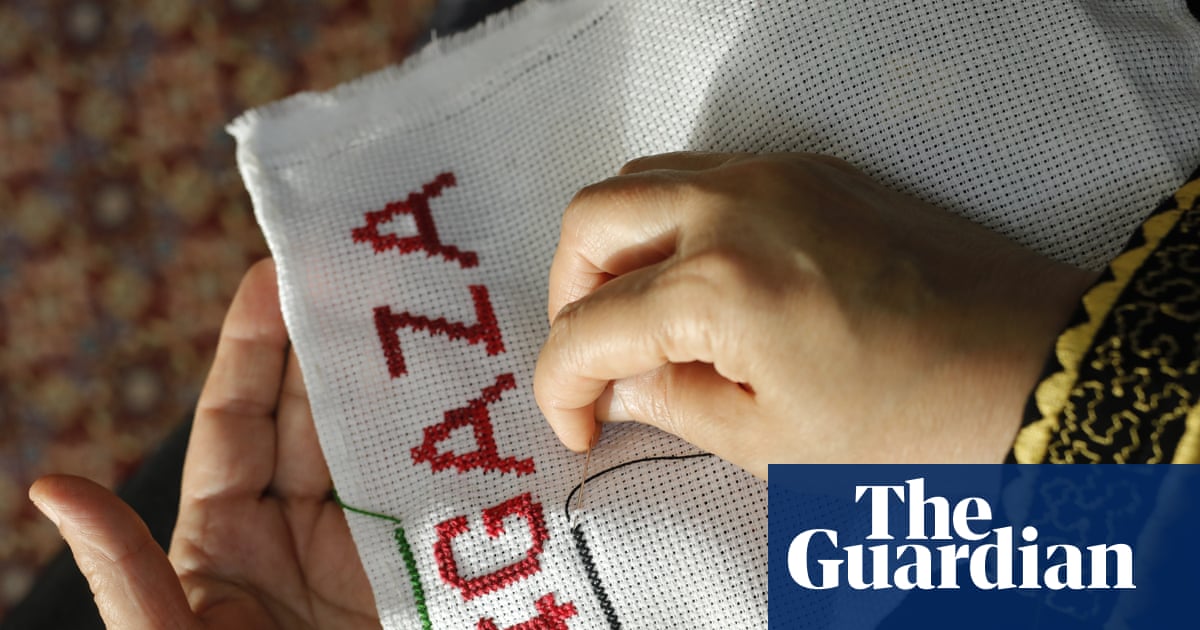
Under collapsing ceilings and typed on phones with failing batteries, Palestinian students at the Islamic University of Gaza are publishing poetry that carries their stories to the world. With 95 percent of their university's buildings destroyed or damaged by Israeli bombing, they gather online in fragmented moments—whenever there is enough solar power to hold a brief video meeting—to read verses written in rubble and memorized because paper may not survive.
"Poetry keeps hope alive. Even in the darkest moments, Palestinian poetry continues to imagine a future," says Nazmi al-Masri, professor of languages at the Islamic University of Gaza. Since the war began, 72 members of the university faculty and 543 students have been killed. Yet 2,860 students have graduated in that same period, many of them turning to poetry as a way to witness what cameras cannot reach and numbers cannot explain.
Their new collection, "Let's Throw Away War," was born from a simple phrase spoken at the end of a poetry reading celebrating the work of Alison Phipps, a professor of languages and intercultural studies at Glasgow University who has collaborated with the Islamic University of Gaza for 17 years. Phipps and her colleague Tawona Sitholé, a Zimbabwean poet, helped bring the students' work to publication through Wild Goose Publications, an imprint of an ecumenical Christian community on the Scottish island of Iona.
The collection honors Refaat Alareer, a beloved Gazan poet and teacher killed in an Israeli airstrike on December 6, 2023, along with his brother, nephew, sister, and three of her children. Some students dedicated their poems to his memory, answering the call of one of Alareer's most famous works: "If I die / you must live / to tell my story." That poem travelled across the world because, as al-Masri explains, "it expresses something very simple but very powerful: the fear of disappearing without being remembered."
Palestinian poetry has a centuries-old tradition centered on themes of homeland, exile, memory, resistance, love, and survival—forms that blend lyrical beauty with political testimony. In cultures where certain representative arts are restricted by religious tradition, poetry becomes especially vital. As Phipps notes, young people in Gaza wanted to write in the manner of great Palestinian poets like Mahmoud Darwish and Fadwa Tuqan, and they seized the opportunity to be published.
What strikes readers most is the near-total absence of bitterness in poems written amid such devastation. These are young people who have chosen not to reflect or become the violence they abhor. "For my students from Gaza, being alive is resistance," Phipps says. One student writes: "Holding on to life / As resistance, / To carry the stories / Of those who left us, / Whose spirits remain carved / Into the silence of this place." Another echoes the words of Palestinian poet Mosab Abu Toha: "We carry our houses in our hearts after the walls are gone."
In the words of Phipps and al-Masri's introduction to the collection: "These are not poems written in quiet rooms." They are written in defiance of silence, typed on devices running low on power, spoken aloud in moments when connection is possible. They are proof that even when physical spaces are erased, the human need to witness, to remember, and to hope persists.