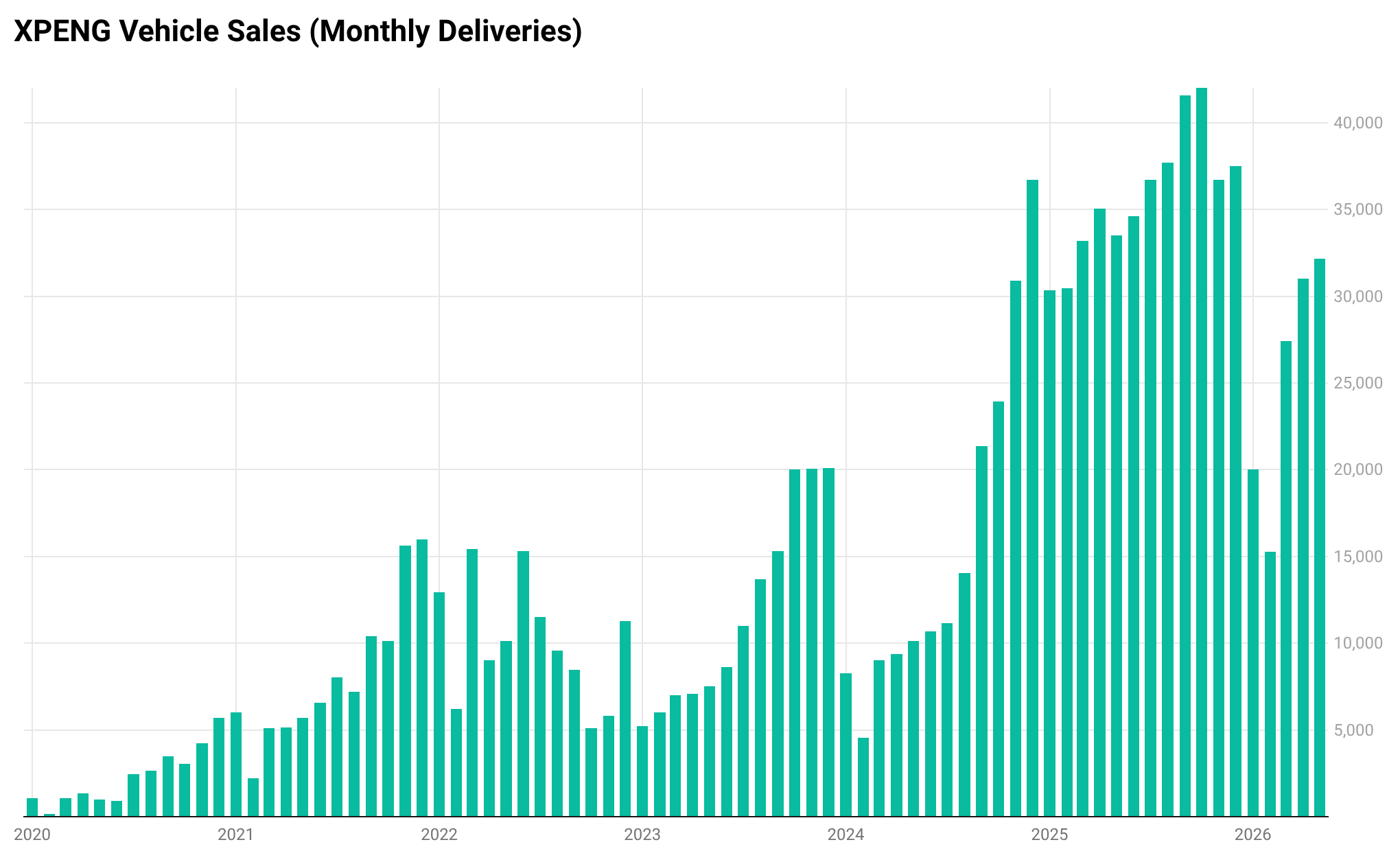
In May 2026, XPENG delivered 32,158 electric vehicles from its headquarters in Guangzhou — a modest 4% uptick from April, though still 4% below where the company stood a year prior. The numbers, taken at face value, tell a story of a company treading water rather than riding a wave. But step back, and the real headline emerges not from the sales floor but from the atmosphere above it.
From January through May, XPENG's cumulative deliveries hit 125,851 units, down 22.6% compared to the same stretch in 2025. By traditional metrics, that's a stumble. Yet the company quietly highlighted something more striking in its monthly delivery report: those vehicles are expected to slash life-cycle greenhouse gas emissions by more than 2 million metric tons compared to internal combustion engines — equivalent to the carbon absorption of 33.16 million young trees over a decade.
That's not a rounding error. That's a forest's worth of impact, baked into every vehicle XPENG sent onto roads this year.
The sales picture may be muted, but the pipeline tells a different story. Last month, XPENG launched production of robotaxis — an ambitious bet on autonomous mobility — and the newly released XPENG GX racked up tens of thousands of orders almost immediately. These aren't incremental steps; they're bet-the-company moves into markets that could reignite growth.
"We're in a holding pattern on deliveries, but the trajectory of the company is anything but static," one industry observer noted, pointing to the dual pushes into robotaxis and the GX as signals of a company rebuilding momentum from a stronger foundation.
For now, XPENG remains in a period of consolidation — stabilizing sales, investing in next-generation technology, and quietly displacing more emissions than most people realize. The surge in delivery numbers may be around the corner, driven by thatGX order backlog and whatever robotaxi markets open up. The company that struggled to find another big growth spurt may have actually found the path to one.