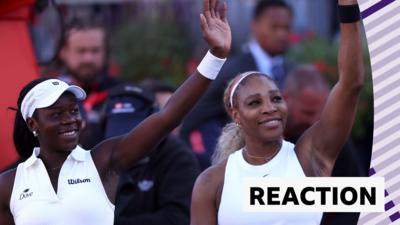
At 44, Serena Williams walked onto the Andy Murray Arena at London's Queen's Club and reminded the world that comeback stories don't have an expiration date. Alongside Canadian partner Victoria Mboko, the American tennis icon claimed a first-round doubles victory that transcended sport—a statement moment that underscored a simple, radical truth she would later voice to the crowd: "You can do anything at any age."
For fans who have watched Williams reshape the landscape of professional tennis across three decades, this return carried particular resonance. The Queen's Club, one of tennis's most storied grass-court venues, became the stage for a woman who has won 23 Grand Slam singles titles and redefined what it means to compete at the highest level. Her reappearance wasn't tentative or apologetic. It was assured, commanding, and utterly in character.
The timing of her return speaks volumes about cultural momentum. Increasingly, athletes and public figures are challenging the unspoken age limits society imposes. Williams's decision to step back from competitive tennis in 2022 was widely respected; her choice to return in 2024 feels equally deliberate—a signal that competitive fire doesn't necessarily diminish with time, only the pressure to maintain it constantly. At Queen's Club, she answered her own question with her racket.
Playing doubles rather than singles carries its own meaning. It's a format that allows for partnership, shared responsibility, and a gentler re-entry into the professional circuit. Yet there was nothing gentle about how Williams and Mboko executed their win. The pair moved with precision, communicated with the ease of seasoned professionals, and most importantly, succeeded. For Williams, it wasn't merely about playing again. It was about winning again.
The Andy Murray Arena itself holds symbolic weight. Murray, another tennis legend who battled injuries and age-related doubts, has become something of a barometer for how long elite tennis careers can meaningfully continue. That Williams chose to make her return on a court named for another aging champion feels almost purposeful—a passing of the torch between generations of fighters who refused to quietly retire.
What makes this moment particularly resonant for audiences beyond tennis is the accessibility of its message. Williams spoke directly to the crowd afterward, and the words she chose—"you can do anything at any age"—aren't abstract inspiration. They're lived evidence. She's not selling a wellness trend or a motivational brand. She's demonstrating, in real time, what persistence and self-belief look like when you've already achieved more than most could dream of.
The Queen's Club doubles victory is unlikely to be the final chapter of her story. Whether it becomes a springboard to larger tournaments or remains a singular moment of return, its significance is already written. Williams proved that taking time away doesn't mean stepping away forever. She showed that age is genuinely just a number when ambition, skill, and the will to compete remain intact. And she gave a packed crowd in London a glimpse of something increasingly rare in professional sports: an athlete playing purely because she wanted to, on her own terms, at her own pace.
That's the real triumph at the heart of this comeback.