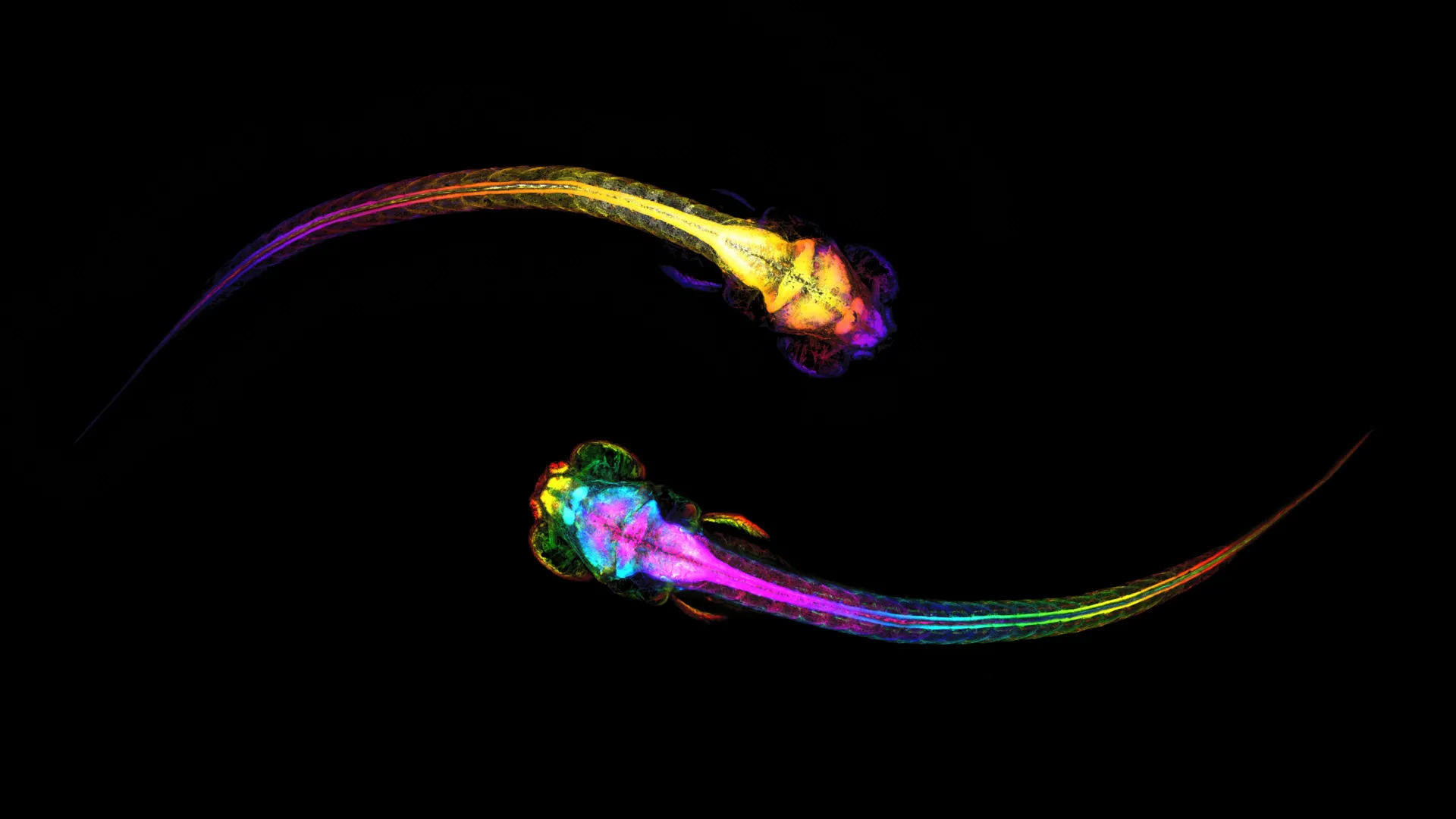
Several seconds before a zebrafish darts toward another fish in the tank, its brain has already committed to the act. Researchers at the Hebrew University of Jerusalem have discovered that the social decisions unfolding in fish brains mirror a universal principle: the brain begins orchestrating our social moves long before we consciously move.
Why this matters becomes clearer when you consider how much of human life revolves around the decision to approach. Every handshake, conversation, or collaborative moment begins as a neural spark — a shift in electrical and chemical signals cascading across distinct regions of the brain, working in concert even as we believe we are simply making a choice. Understanding this process could illuminate why some people are naturally more social than others, and might eventually explain disruptions in social behavior that characterize certain neurological and psychiatric conditions.
Dr. Lilah Avitan and her team at the Edmond and Lily Safra Center for Brain Sciences used zebrafish to map this neural choreography in real time. The choice of zebrafish was strategic: their transparent brains allow scientists to monitor activity at the level of individual cells, something impossible in mammals. The researchers created a setup where one fish watched and responded to another swimming nearby, while they recorded from across the entire observer fish's brain. This wasn't a snapshot — they tracked the neural cascade moment by moment as social decisions unfolded.
What they found was elegant and surprising. When a fish was about to swim toward another fish, brain-wide changes emerged several seconds before any movement occurred. Rather than activation in a single social decision center, the process involved coordinated shifts across multiple brain regions. Activity increased in the pallium, a higher brain region associated with complex behaviors, while simultaneously decreasing in other areas. Together, these shifts formed what researchers describe as a neural "pre-decision state" — a distinctive pattern that predicted the social action before it happened.
The strength of this neural signature varied from fish to fish. Those with stronger brain-wide patterns tended to be more social overall, suggesting that the neural signal isn't just a sign of impending action but a reflection of an individual's underlying social drive. The pallium emerged as central to generating the motivation to approach others. In other words, the brain regions that prepare us to be social are the same ones that determine, in part, how social we are likely to be.
The implications ripple outward. Because similar brain structures drive social behavior across many species, these findings offer clues about human social function and the neural basis of social disruption. The research suggests that when social behavior goes awry — whether in autism, social anxiety, or other conditions — the problem may involve how the brain's pre-decision machinery is calibrated or connected.
What makes this work particularly striking is its humility about complexity. Rather than finding a simple "social button" in the brain, Avitan's team revealed an orchestra: multiple regions working in synchrony to create the motivation and readiness for connection. The brain, it seems, doesn't make a social decision in an instant. It prepares, signals across its whole landscape, and only then does the body respond to what the mind already knew.