Ken Nedimyer had spent most of his life diving the reefs of the Florida Keys. He'd seen the underwater forests of staghorn and elkhorn coral — so thick, divers said, you could swim through them like a jungle canopy. Then the disease came. Then the bleaching. Then the storms. In some places, those coral populations dropped by nearly 90%.
But in the year 2000, his daughter needed a project for 4-H. Nedimyer, a tropical fish collector and aquaculture operator, decided to help her grow broken pieces of staghorn coral instead of letting them die on the seafloor opinions. He hung the rescued fragments from underwater "coral trees" — and something remarkable happened. The fragments grew. Quickly.
Years later, those modest trees have helped plant more than 200,000 corals across damaged reefschers, kickstarting a global revolution in reef recovery. What began as one father helping his daughter became a model ocean restoration groups now copy worldwide.
A revolution that hangs from a line
The idea sounds almost too simple: take a broken coral fragment, suspend it in the water column on a tree-like frame where it can't be smothered by sediment, and let it grow. Nedimyer's early experiment worked so well that he donated his propagated staghorn to the Florida Keys National Marine Sanctuary.
The approach struck a nerve because it solved the bottleneck that had stymied restoration for years — how to grow large numbers of corals efficiently. Today, "coral tree" nurseries are standard practice in marine restoration, and the momentum keeps building.
In French Polynesia, CNN reports that the Coral Gardeners, part of the Rolex Perpetual Planet Initiative, are "super-boosting" coral reefs as a potentially historic El Niño looms. On the island of Mo'orea, divers are racing to outplant heat-tolerant corals before warming waters arrive.
Meanwhile, Scuba Schools International is partnering with The Coral Planters and Blue Oceans in 2026 to fund the outplanting and monitoring of 800 corals. Since 2017, that organization has planted 40,315 coral fragments, restored 43,400 square feet of degraded reef, and established seven active restoration sites. Hundreds of students are reached annually through its Edu'Coral education program.
The same lesson, on land
It turns out coral restoration isn't the only place where careful, community-centered care beats simple planting. In 2014, Mexico launched a massive restoration drive targeting 1 million hectares of degraded land — part of a wider commitment of almost 7.5 million hectares under the Bonn Challenge and Initiative 20x20.
The program didn't just put trees in the ground. It combined forest restoration with watershed recovery, agricultural improvements, financial incentives, and technical assistance for local communities. The result? By 2018, plant survival had jumped from just 33% to 64%.
The lesson, according to the program's architects, was that restoring a damaged landscape depends as much on long-term care as on the initial planting. That could be the motto for the entire restoration movement — in the water and on land.
The clean-energy wave, where you'd least expect it
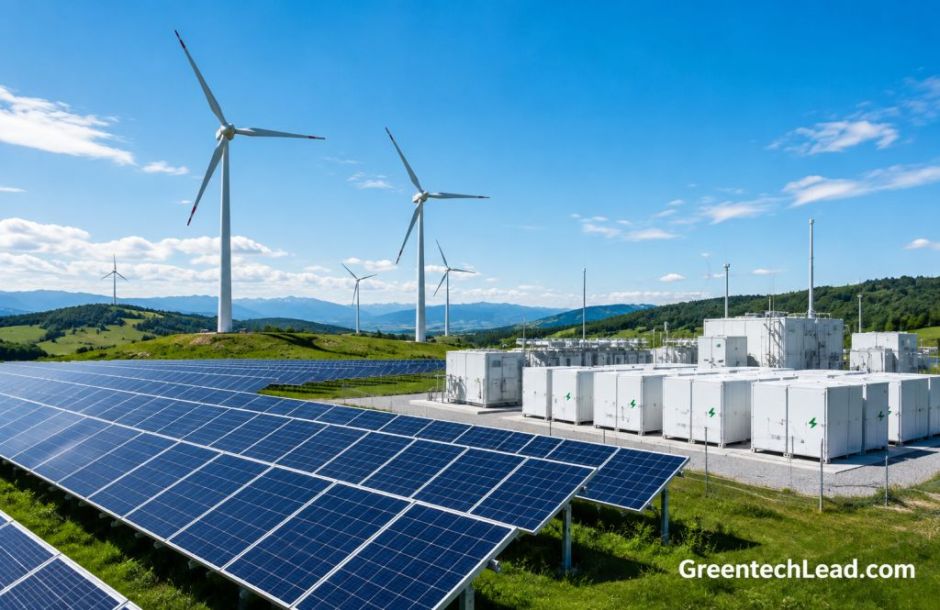
There's a similar quiet revolution happening in energy. As GreentechLead reports, committed global clean-hydrogen investment has surpassed $130 billion across more than 570 projects — with 90% already under construction or operating. In Romania, Econergy has just brought a 70 MW / 141 MWh battery storage system in Brașov into commercial operation, paired with its Parau 1 solar project to shift renewable electricity between times of day.
And here's the surprise: according to the Solar Energy Industries Association, states that voted for Donald Trump in the last presidential election accounted for eight of the top ten solar-building states in the country. Texas and Florida ranked first and third. The U.S. added more than 11 gigawatts of solar in the second quarter of 2026 — up 45% from the same period a year earlier — with Trump-supporting states making up nearly three-quarters of that growth.
"At least at the macro level, Republican-led and governed states are not only open to but embracing solar energy as a technology," said Tim Pawlenty, the SEIA's CEO and a former Republican governor of Minnesota.
Restoration is a practice, not a single act
There's a thread running through all of these stories. Whether it's a Florida fish collector hanging coral from tree frames, a Mexican program teaching farmers to nurture seedlings for years, or Texas ranchers filling their land with solar panels, the pattern is the same: restoration isn't a moment. It's a practice, sustained over years, powered by ordinary people who decided to care for something beyond themselves.
Nedimyer's daughter probably just wanted a project that would earn her a 4-H badge. Instead, she helped save a reef. The next time you plant something — a tree, a garden, even a coral — remember that the planting is only the beginning. The care is what changes the world.
Sign in to join the conversation.
Comments (0)
No comments yet. Be the first to share your thoughts.