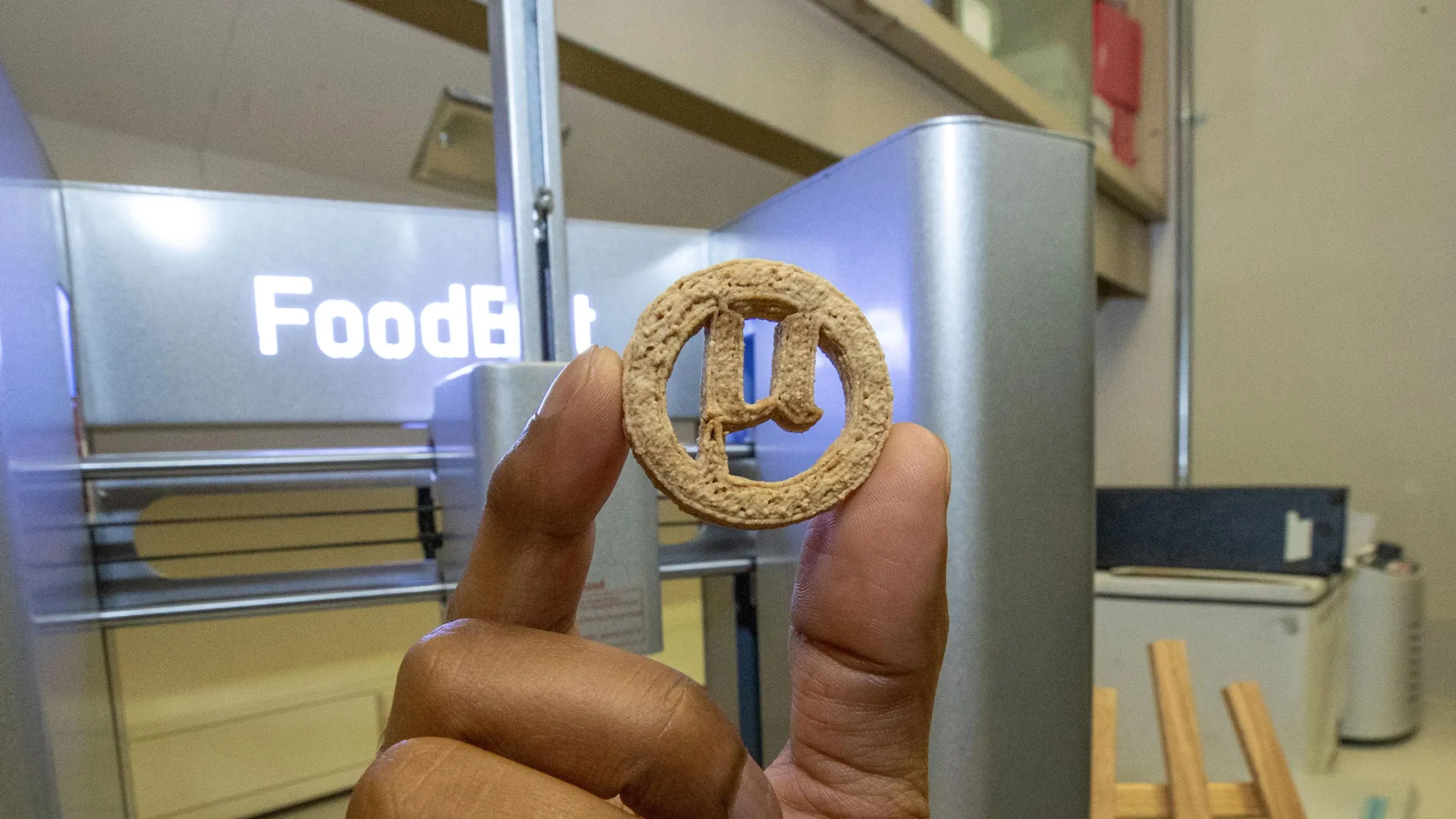
Imagine this: the human body holding 214 million protein shapes we've barely begun to understand, and a single moon mapping its own ice fields. Now add a cookie — an actual, edible, 3D-printed cookie — born from a plastic bottle.
This is the strange, wonderful frontier where artificial intelligence and human curiosity are colliding.
Searching by shape, not sequence
For decades, scientists decoded biology by reading genetic sequences like sentences in a book. But at the University of Miami's Sylvester Comprehensive Cancer Center, a team led by Daniel G. Isom, Ph.D., decided to try a different page. Instead of sequencing, they asked AI to compare the three-dimensional shapes of more than 214 million predicted proteins.
What emerged were hidden members of the GPCR family — proteins that help cells sense and respond to signals around them. "For decades, we have largely explored protein biology using sequence as our guide," Isom said. "We wanted to know what biology we might be missing if we searched by three-dimensional structure instead." The discovery points to a whole new layer governing how cells communicate, survive stress, and possibly trigger disease.
That same shape-shifting logic is transforming how we understand things far beyond the human body. At the Eastern Institute of Technology in Ningbo, postdoctoral researcher Hao Xu built a graph-based framework that plucks precise, physically interpretable equations straight out of solid-material data — no preset formula required. It beats mainstream models in accuracy while staying human-readable athletes, engineers, and manufacturers could actually use.
Teaching microbes new tricks
But AI isn't the only clever mind at work. Nature has a few billion years of experience.
At Aarhus University, Rosie Graham studied the bacteria and microorganisms already chewing through garbage worldwide holistically. She found one enzyme, derived from a compost microbe, that can degrade the polyurethane in shoe foams, mattresses, and kitchen sponges. Roughly 22 million tons of polyurethane hit the market every year — more than 5% of all plastics. Now, a genetically tweaked compost microbe may someday help recycle it.
At Southern Illinois University Carbondale, researcher Lahiru Jayakody took the same philosophy into the kitchen. "Microbes are very clever. So, we are using their traits to solve the problems we created." His team engineered yeast to convert PET plastic and agricultural waste into protein-rich, 3D-printed treats called µBites — developed partly for NASA's Deep Space Food Challenge)Skip the plastic-cookie shock for a moment: the system can produce proteins, fats, vitamins, and even vanilla flavoring from waste. Disaster zones on Earth, and astronauts deep in space, may one day eat fine.
Even the moon, and the sea, join in
NASA, collaborating with IBM Research, has launched the NASA-IBM Lunar Foundation Model tiny but mighty — one of the first open-source AI models built for lunar science, hosted on Hugging Face for anyone to use. Trained on 17 years of Lunar Reconnaissance Orbiter data, it maps ice, craters, and volcanoes, turning the moon into a textbook any researcher can crack open)Skip
Closer to shore, however, a trio of studies at the ocean's edge reminds us that "small" matters enormously. At King Abdullah University of Science and Technology (KAUST), researchers revealed that current global production of oysters, mussels, and crabs already contains enough vitamin B12 and selenium to meet the annual nutritional needs of more than 5 billion people — nutrients we've been quietly overlooking.Skip Meanwhile, an international team including CIIMAR built a genomic tool that reads thousands of tiny variations in clam DNA, letting farmers breed shellfish more resistant to disease and climate change. And at USC, researchers found that older adults who stayed physically active were less likely to lose their hearing as they aged.
All of these discoveries share one trait: they found value hiding in plain sight.
A pattern worth noticing
Notice what ties them together: every team looked where others weren't looking. At shapes instead of sequences. At compost instead of factories. At mental health benefits hiding in everyday activity. At the nutritional wealth of a humble clam.
The lesson? The world is brimming with overlooked treasure — if we're willing to search by shape, not just by habit. The next solution to our biggest problems might already be living in a pile of compost, glowing on a lunar map, or hiding among 214 million protein folds within our own bodies.
We just need the right lens, and a little curiosity, to find it.
Sign in to join the conversation.
Comments (0)
No comments yet. Be the first to share your thoughts.