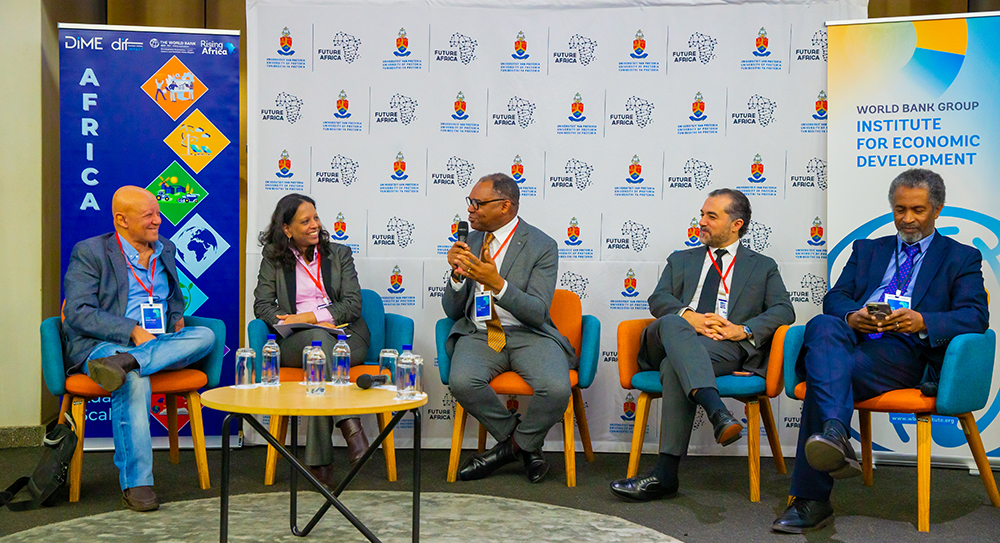
At the Growth Academy Africa conference in South Africa, Indermit Gill, Chief Economist of the World Bank Group and Senior Vice President for Development Economics, posed a deceptively simple question: Why do some countries achieve sustained growth and job creation while others stall? The answer, he argued, reveals an opportunity hidden within Africa's own backyard.
The challenge across the continent is not a shortage of capital or talent. Many African economies already possess strong entrepreneurial energy and scientific capabilities. What they lack is the ability to scale innovation beyond a small cluster of frontier firms—to turn ideas into widespread productivity and jobs. This insight reframed the entire conversation at the conference, which was co-organized by the World Bank Group Institute for Economic Development, the Growth Academy, the African Union Development Agency (AUDA-NEPAD), and supported by Japan's Ministry of Finance through the Knowledge for Change Program.
Ufuk Akcigit, Arnold C. Harberger Professor of Economics and Co-Director of the Growth Academy at the University of Chicago, reinforced this diagnosis by identifying the central bottleneck: not innovation itself, but the widespread adoption of existing technologies. The policy shift that follows is profound. Rather than narrowing focus to attracting investment, policymakers must create conditions that allow productive firms to grow, compete, and hire workers. This means strengthening firm capabilities, encouraging competition, and enabling private sector-led expansion.
The discussion moved beyond abstract economics into concrete infrastructure and systems. Jakkie Cilliers, Chairman of the Institute for Security Studies Board of Trustees and Head of the African Futures and Innovation Program, emphasized that this ecosystem requires improvements in education, governance, energy, and digital infrastructure. Tetsushi Sonobe, President of the Japanese Association for Development Economics, added a spatial dimension: better transport systems, energy networks, digital connectivity, and urban planning can help address the inequalities that leave workers and entrepreneurs stranded away from markets and opportunity.
Rather than viewing AI and digital transformation as threats, participants saw them as accelerators. Dr. Monica Musenero Masanza, Uganda's Minister for Science, Technology and Innovation, shared how her country is working to link research, technology, and industrialization to create value-added industries and quality jobs. The vision is not import substitution but using emerging tools to leapfrog bottlenecks in agriculture, logistics, manufacturing, and public administration.
Lessons from Morocco, Ghana, and Ethiopia showed what industrial policies backed by foreign investment can achieve—but only when they strengthen local supply chains, address informality, and ensure that external capital generates real spillovers into the wider economy. These were not prescriptions from the Global North handed down to grateful recipients; they were diagnoses and strategies emerging from African economists and policymakers themselves.
The stakes are clear. Africa's growth story remains unwritten, but its completion depends on translating diagnosis into reform. It requires competitive and dynamic firms, ecosystems that diffuse innovation at scale, and the political will to implement changes that make economies more dynamic, competitive, and inclusive. The ingredients exist. The question now is execution.