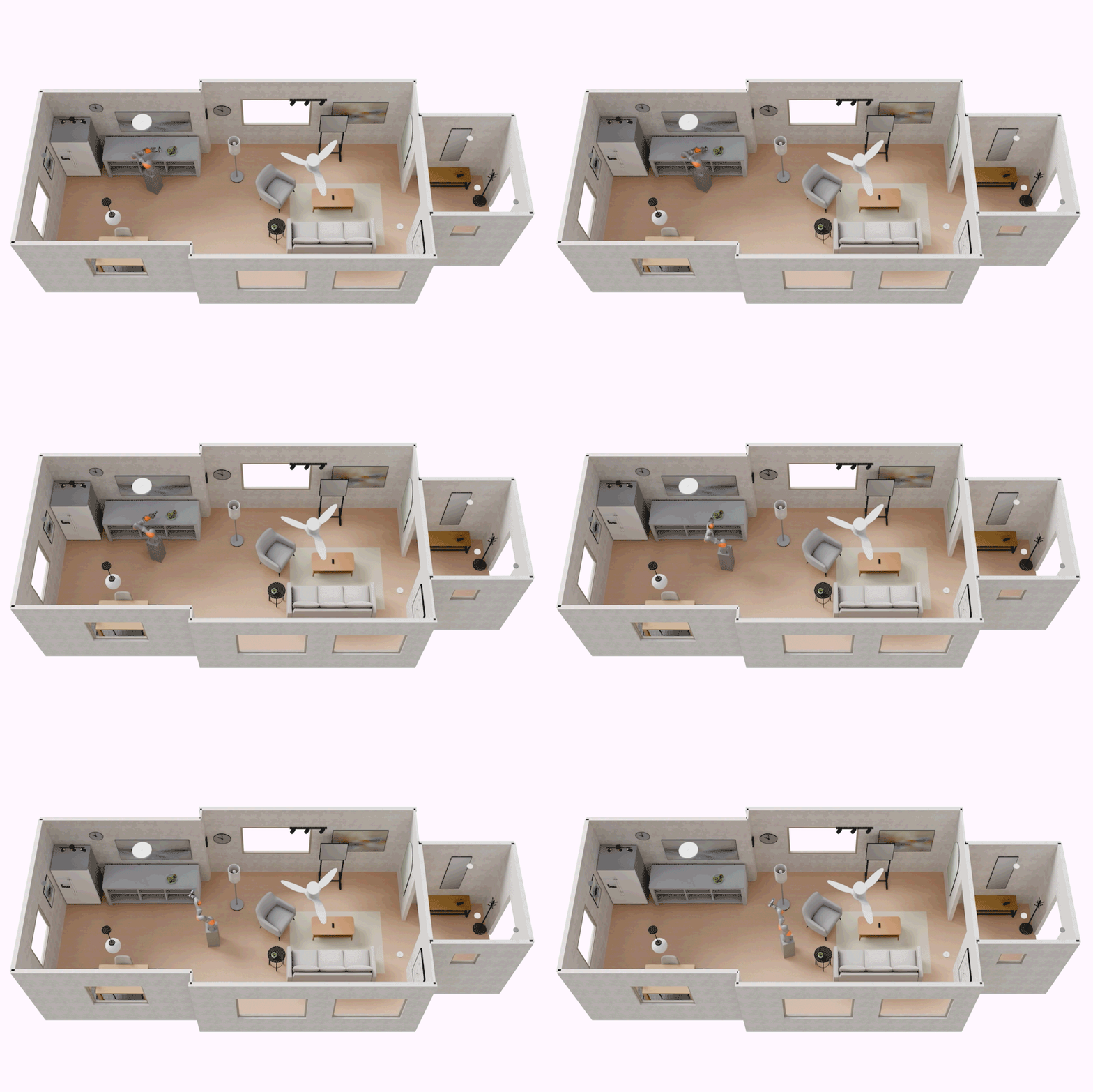
When a robot was asked to pick up an apple from a bowl and place it on a cutting board, it didn't hesitate. The machine completed the task smoothly, moving through a virtual kitchen that had never existed until an AI dreamed it up moments before. This wasn't a stunt — it was a glimpse at how robots might learn new skills without any human physical hand-holding, thanks to a new system called SceneSmith built by researchers at MIT.
Teaching robots to help out in kitchens, factories, or hotels is harder than it sounds. These machines learn best by doing things over and over, but setting up those practice sessions in the real world takes enormous time and effort. Researchers have turned to computer simulations — virtual worlds where robots can practice safely without breaking anything. The problem? Building those virtual worlds has been slow and limited.
SceneSmith changes that. Developed by scientists at MIT's Computer Science and Artificial Intelligence Laboratory (CSAIL) alongside Toyota Research Institute, the system uses three AI agents — think of them as a team of digital interior designers — to create realistic 3D indoor rooms in minutes. One agent designs the scene, another critiques whether it looks believable, and a third manages the whole process until the result feels right.
The agents aren't starting from scratch. Each one taps into a powerful vision-language model (a type of AI trained on massive amounts of text and images from the internet) that understands how real rooms are supposed to look. Ask SceneSmith for "a garage with a car, workbench, stacked tires, and a ladder," and it will build exactly that — complete with details a robot can interact with.
The results are striking. SceneSmith creates rooms decorated with up to six times more objects than older methods, giving robots richer environments to explore and practice in. In tests, the system generated over 1,300 different scenes, from bedrooms to restaurants. Researchers even had humans judge whether the AI's assessments of robot performance were accurate — the humans agreed with the AI more than 99 percent of the time.
"We made over 1,300 scenes using a leading VLM that has internet-scale priors, and it made insanely creative and diverse arrangements," says Nicholas Pfaff, an MIT electrical engineering PhD student and CSAIL researcher who co-authored the work. "I hadn't taught the system to do that in the prompts; it just improvised."
The implications stretch beyond convenience. With so many virtual environments ready on demand, engineers can test whether a robot is truly ready for the real world before ever powering it on — catching mistakes in simulation instead of in someone's actual kitchen. Researchers even teleoperated real robots through SceneSmith's virtual spaces, opening cabinets and navigating between rooms to confirm the environments held up under sustained physical interaction.
It's a quiet shift with big potential: someday, your household robot might owe its skills not just to human engineers, but to a team of AI agents that built the training ground where it learned to help.