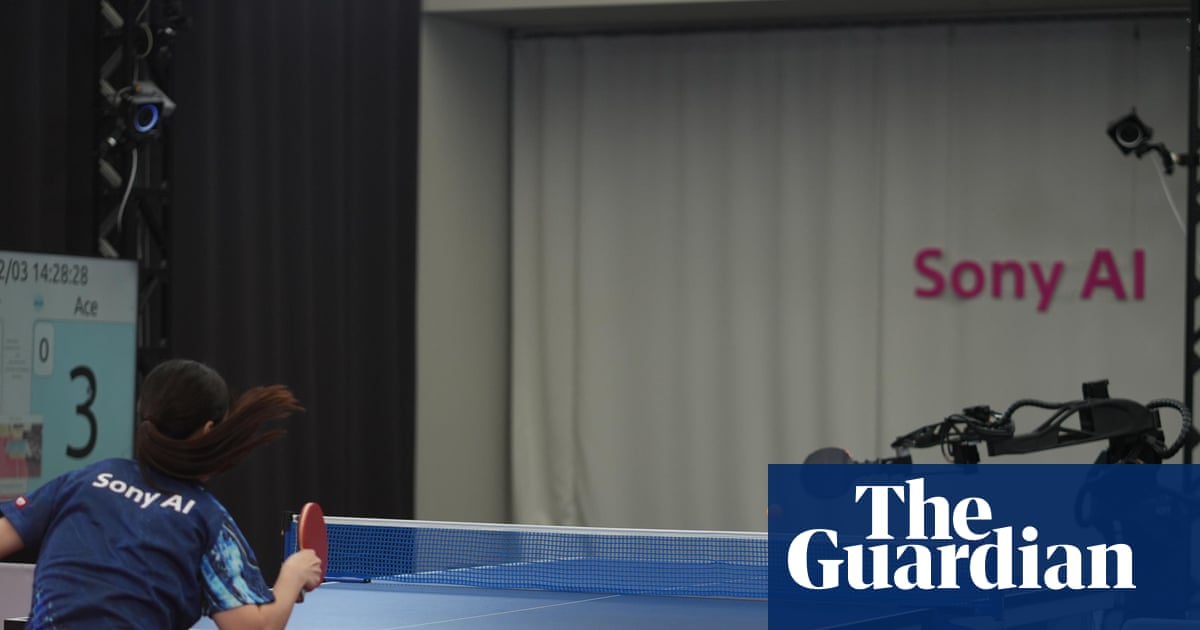
In Zurich, Sony AI's robotic table tennis player, named Ace, did something that roboticists have chased for decades: it stepped onto a competition court and won matches against elite human athletes. Not just exhibition matches or casual games, but official competition under real sport rules—and it won three out of five matches against elite players, though it lost both games it played against professionals. The achievement, published in Nature this week, marks a watershed moment for robotics, because table tennis has long been the sport that separates the possible from the truly difficult. The lightning-fast reactions it demands, the need to read and replicate spin, the split-second decisions—these have made it the proving ground for whether machines can compete in the real, unpredictable world.
What makes Ace's victory more than a parlor trick is how it had to solve problems that matter far beyond the sport. The robot didn't rely on simple reflexes or brute computing power. Instead, it drew on 3,000 hours of simulated games to learn strategy and decision-making. Its eight-jointed arm sits on a movable base—no two-legged stumbling—while multiple cameras positioned around the entire court track the ball from every angle. By zooming in on the ball's logo, Ace's camera system can estimate spin and axis of rotation in the milliseconds before the ball reaches it. This combination of perception, calculation, and physical execution represents the frontier of what machines can do in unpredictable environments.
Peter Dürr, director of Sony AI in Zurich and project lead for Ace, noted that the robot has only improved since the Nature paper was submitted. "We played stronger and stronger players and we beat stronger and stronger players," he said. The matches revealed Ace's quirks and capabilities in equal measure. It proved exceptionally skilled at tricky shots—when a ball catches the net and takes an altered trajectory, Ace responded with uncanny speed. Rui Takenaka, an elite player, found that when he served with complex spin, Ace returned it with equally complex spin, making the rallies genuinely difficult. But when he served a simple knuckle serve, Ace returned something simpler, giving him an opening. One moment stood out to Kinjiro Nakamura, a former Olympic table tennis player: Ace executed an early interception with backspin that Nakamura had considered impossible. Watching the machine pull it off shifted his thinking—perhaps humans could learn and execute that shot too.
There is something unsettling about playing an opponent with no eyes to read, no body language, no sign of pressure even when a game hangs at 10-10. Dürr observed that players want to see their opponent's eyes, to sense intention and feeling. Ace's "eyes" are scattered around the court, hidden from view. That absence of human cues may, paradoxically, have made it a tougher competitor.
Jan Peters, a professor at the Technical University of Darmstadt who works on table tennis robots, called the project "truly impressive," but cautioned that excellence in table tennis doesn't automatically solve broader robotics challenges like manipulating objects in real-world settings. Yet the progress hints at something larger. Peters noted that a transformative moment in AI may be coming within the next decade—something as significant as ChatGPT was in 2022. Ace's quiet victory on a Zurich table tennis court may be a glimpse of that threshold.